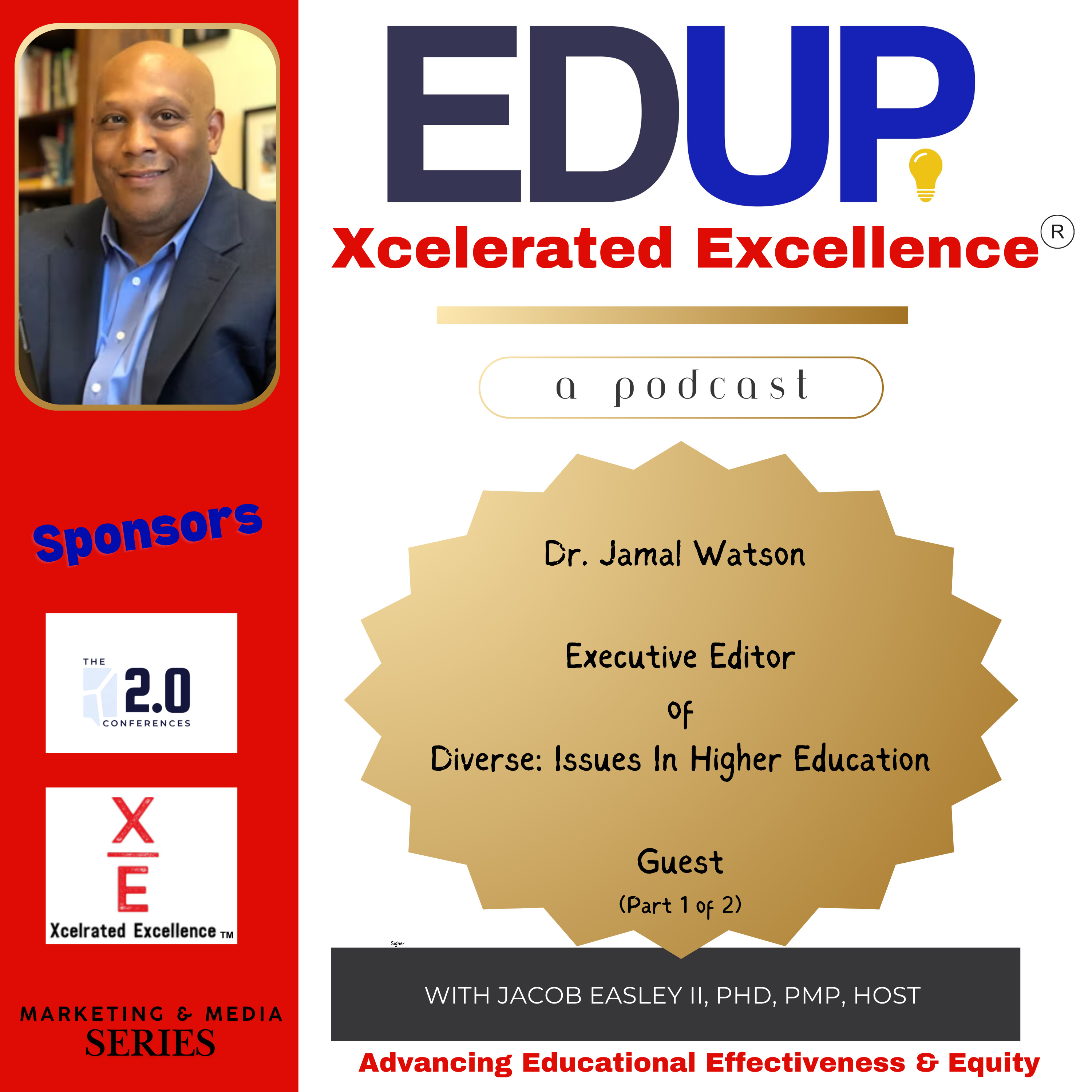
Exploring the Role of Journalism in Education and Reporting on the Student Debt Crisis
We revisit a highly listened to episode of EDUP Xcelerated Excellence, featuring award-winning journalist and educator Dr. Jamal Watson. Dr. Watson is a longtime senior leader at Diverse: Issues In Higher Education, now The EDU Ledger, where he has served as senior staff writer, managing editor, executive editor, and editor-at-large since joining the publication in 2005. He is also associate dean of the School of Professional and Graduate Studies, director of Strategic Communication and Public Relations and Journalism and Media Studies, as well as professor of Strategic Communication and Public Relations at Trinity Washington University.
In their conversation, host Dr. Jacob Easley II invites Dr. Watson to explore the importance of journalism and framing the student debt crisis as a civil rights issue. Drawing on decades of reporting and his forthcoming work on the student debt crisis, Dr. Watson situates journalism as a catalyst for systemic change.
Through their exchange, listeners will understand:
👉 How The EDU Ledger has evolved over four decades
👉 Why storytelling and journalism matter for equity and recruitment
👉 Why student loan debt must be understood as a civil rights issue
The Value Proposition of Diverse: Issues In Higher Education
Dr. Easley: “You’ve held several roles at Diverse: Issues In Higher Education—as a writer, managing editor, executive editor, and editor-at-large. From your perspective as an editor and longtime steward of the publication, what is the value proposition of Diverse? What unique lane are you occupying in the higher education media landscape, and what impact are you striving to have?”
Dr. Watson: “We started off in 1984 as Black Issues In Higher Education. We wanted to put a public spotlight on the conditions of Black students, Black faculty, Black staff—not just at predominantly White institutions, but also at historically Black colleges and universities, and higher education in general.
Over time, there were challenges to using terms like ‘Black.’ Affirmative action cases came down, and quite frankly, it hurt our advertising business model. So we had to rethink how we cover Black people while also taking a Kimberlé Crenshaw approach of intersectionality and asking, how do we cover other groups as well? Because some of these issues are not just germane to Black people.
We began to say, let’s also put a spotlight on the Latinx community, the Asian community, move beyond race to talk about disabilities, the LGBTQ community, and other issues that were really roaring in the 1990s and early 2000s. That’s when we changed our name from Black Issues to Diverse Issues In Higher Education.
What’s interesting is that we’re now at another moment in history where even the term ‘diverse’ has become controversial. DEI has come under attack, and that has presented challenges with institutions that love and support our work but may not be able to advertise with us.
Still, one of the principles we’ve stood on is that our job is not just to be reactionary to what’s coming out of Washington, D.C., but to provide a forum for best practices—to show how some colleges and universities are actually getting things right. Institutions often get beaten up when they do things wrong, but there are plenty of examples of campuses bringing students together, addressing class, gender, and race—even if they’re not calling it DEI.
A university president once told me, ‘We read your publication to find out what our peer institutions are doing.’ That affirmation—that institutions are using our work to learn from and even steal best practices—really underscored why this work matters.”
Dr. Jamal Wastson
Why Journalism Matters for Equity, Recruitment, and Representation
Dr. Easley: “When you think about the work of Diverse, how might journalism and media more broadly help address persistent gaps in parity—particularly for marginalized communities entering education, whether in P–12 or higher education?”
Dr. Watson: “Oftentimes institutions are trying to do a good job in recruitment, but one of the pieces that’s missing is their inability to tell their story well. That’s where journalists can help put a spotlight on what’s happening.
There’s so much negative discourse around teaching—pay, working conditions, burnout—but there is also a great deal of joy in this work. When I talk to young people, even middle school students, and they ask me what I do, they’re fascinated when I tell them that every day looks different. I teach a class, I go home, I might come back later, I teach online, I travel, and I write stories in between.
That disrupts the traditional notion of work—the nine-to-five idea our grandparents lived by. When they hear that you can write a book, co-author with a student, teach, travel, and engage intellectually, it opens their imagination. They start thinking, ‘This might be a job for me.’
I knew I wanted to be a journalist, but I didn’t know I could do journalism in higher education and do all these other things too. If we tell those stories better, we give young people possibilities they probably weren’t even thinking about.”
Student Debt as a Civil Rights Issue
Dr. Easley: “You’ve described student loan debt as a civil rights issue. Based on your interviews with students, administrators, and policymakers for The Debt Crisis, what stories or moments most shaped that framing for you?”
Dr. Watson: “I tried to capture why so many young people felt trapped by mounting debt—even though they did everything right. They were told, go to college, get a good degree, and that degree will lead to a good job and the American dream.
What I found was that many students enjoyed their college experience but couldn’t fully immerse themselves in it. My experience was very different. When my parents dropped me off at Georgetown, my dad said, ‘You only have three things to do—eat, sleep, and read.’ I didn’t have to worry about working because I had financial support, including from my church, which literally collected an offering for me before I went to college.
Many of the students I interviewed couldn’t just focus on being students. They were working because they were worried they wouldn’t be able to stay in school. These were traditional-age students—20, 21 years old. And we know students often drop out not because of academics, but because of finances. Recruitment is only one piece; retention is the other.
That’s why I argue student debt should be treated as a civil rights issue. It has crippled about 45 million Americans of all races who are unable to realize their full dreams because they owe so much. Dr. King understood economic justice—he was killed while supporting sanitation workers. If we’re serious about equity and access, we have to confront student debt as part of that legacy. There are other models around the world that show we can do this better. College is still important, but the cost has become unsustainable.”
Listen to the full episode:
“Dr. Jamal Watson—Exploring the Role of Journalism in Education and Reporting on the Student Debt Crisis (Part 1 of 2)” on EDUP Xcelerated Excellence, hosted by Dr. Jacob Easley II, PMP.

Transforming Communities through the Black InGenius Initiative (BiGI), University of San Diego