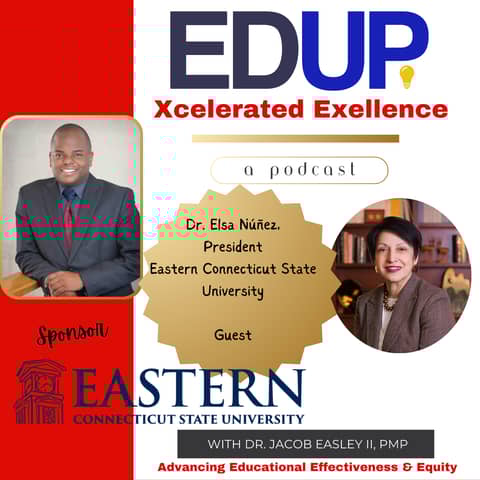
Leading an Elite Liberal Arts College in the Absence of Elitism with Dr. Dr. Elsa Núñez

We revisited one of the most listened to and first recorded (full-length) episode of the EDUP Xcelerated Excellence—a powerful conversation with Dr. Elsa Núñez, then-President of Eastern Connecticut State University. Eastern the state’s only public liberal arts institution of higher education. Under Dr. Núñez’ leadership, Eastern became a national model for academic rigor, inclusive excellence, and access to opportunity—proving that “elite” education need not be elitist.
In the featured episode, “Leading an Elite Liberal Arts College in the Absence of Elitism,” host Dr. Jacob Easley engages Dr. Núñez in an inspiring dialogue about higher education’s purpose, the meaning of equity, and how institutional culture can evolve to truly serve all students.
Below are three standout moments from their exchange.
The Purpose of a College Degree
Dr. Easley: “There are camps out there that profess the decline of higher education or the importance of higher education. You don’t need a degree—just go right into the workforce. But what would you say to someone who's considering a college degree in the current climate?”
Dr. Núñez: “The college degree is not just to make money or to get a job. It’s for your own self-worth. Why shouldn’t you be a college graduate? Why shouldn’t you educate yourself to the fullest and develop your potential while you’re young—or even if you come back later in life?
It’s an investment in yourself. The degree is for you—to read, to think, to be exposed to different ideas and people, and to enhance your intellectual development. Of course, you can have a fine life as a carpenter, or an artist, or in any field without college. But why not expand your mind and your world?
You don’t want to be 60 or 70 and say, ‘I wish I had gotten a college degree.’ To me, a liberal arts education is not elitist—it’s about becoming a better citizen, a more thoughtful person, and understanding your role in a complex society. It’s about learning how to think critically, communicate clearly, and see the world through multiple perspectives.”
What Does Equity Look Like?
Dr. Easley: “What would you say that equity looks like at Eastern?”
Dr. Núñez: “When I started our special programs, I said to high school counselors: Yale wants all the A’s, UConn wants all the B pluses and A’s—but who wants the C-minus student?
To me, equity means providing opportunity for people who otherwise might not have it. Getting Black and Brown students who already have straight A’s is easy. But what about the student whose life circumstances have made that impossible?
If you’re an immigrant living with twelve people in an apartment, if your mother is incarcerated, if you’ve grown up where gun violence is a daily reality—how could you get straight A’s? Yet if you’re still showing up, still pushing forward, still earning those C’s, that's an achievement.
At Eastern, equity means finding those students with potential and grit, welcoming them into a rigorous public institution, and saying: You belong here. We provide a safe environment—our dorms, our classrooms—where they can hear, often for the first time, that they are intelligent, creative, and full of promise.
That’s what true equity is—not selecting only those whose lives have been free from struggle, but creating conditions where perseverance is recognized as excellence.”
Building Cultures of Equity and Inclusion
Dr. Easley: “If you had to share key advice for other leaders seeking equity and effectiveness amid continual change, what would you say?”
Dr. Núñez: “You must begin with conversations—deep, honest, and often uncomfortable conversations within your institution’s cultural context. Every campus is different. You can’t simply adopt national goals without asking: What does equity mean here? What does social justice look like for our students and our community?
If you move too quickly to solutions, people may not be ready. You have to bring faculty, staff, and students together to talk through these ideas—sometimes for years. It can feel slow, even tedious, but that’s how culture shifts.
Once everyone understands the institution’s values and goals, implementing equity-driven strategies becomes far less complicated. People buy in. They know why resources—both human and financial—are being directed in certain ways. Without that shared understanding, you create friction and resistance.
Equity and excellence require patience, clarity, and sustained dialogue. When you invest the time to build that foundation, real transformation becomes possible.”
Listen to the full episode:
“Dr. Elsa Núñez — Leading an Elite Liberal Arts College in the Absence of Elitism” on EDUP Xcelerated Excellence, hosted by Dr. Jacob Easley.
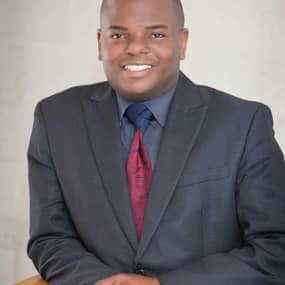
Host
Entrepreneur, higher education leader, podcaster, scholar, and change agent. President of Xcelerated Excellence Consulting LLC.
Dr. Jacob Easley II is an internationally accomplished and award-winning educational leader and entrepreneur. He is an expert in educational policy and politics, focusing on educational accountability, effectiveness, and improvement. He has served in various faculty and leadership positions across five different states and the District of Columbia. Dr. Easley is proud of his work as an advocate for equity and access and quality educational opportunities for all students. He has published numerous books, articles, and commentaries on educational accountability, change, equity, and educator preparation. He is the immediate past president of the New York Association of Colleges for Teacher Education (NYACTE). Dr. Easley is a National Association of Holmes Scholars Alumni (NAHSA) lifetime member and former president of the organization. He is also the founder of the International Congress of School Effectiveness and Improvement’s (ICSEI) Culture, Race, and Intersectionality Network.

Anti-oppressive Education and the Non-neutral Role of Schools in Social Equity