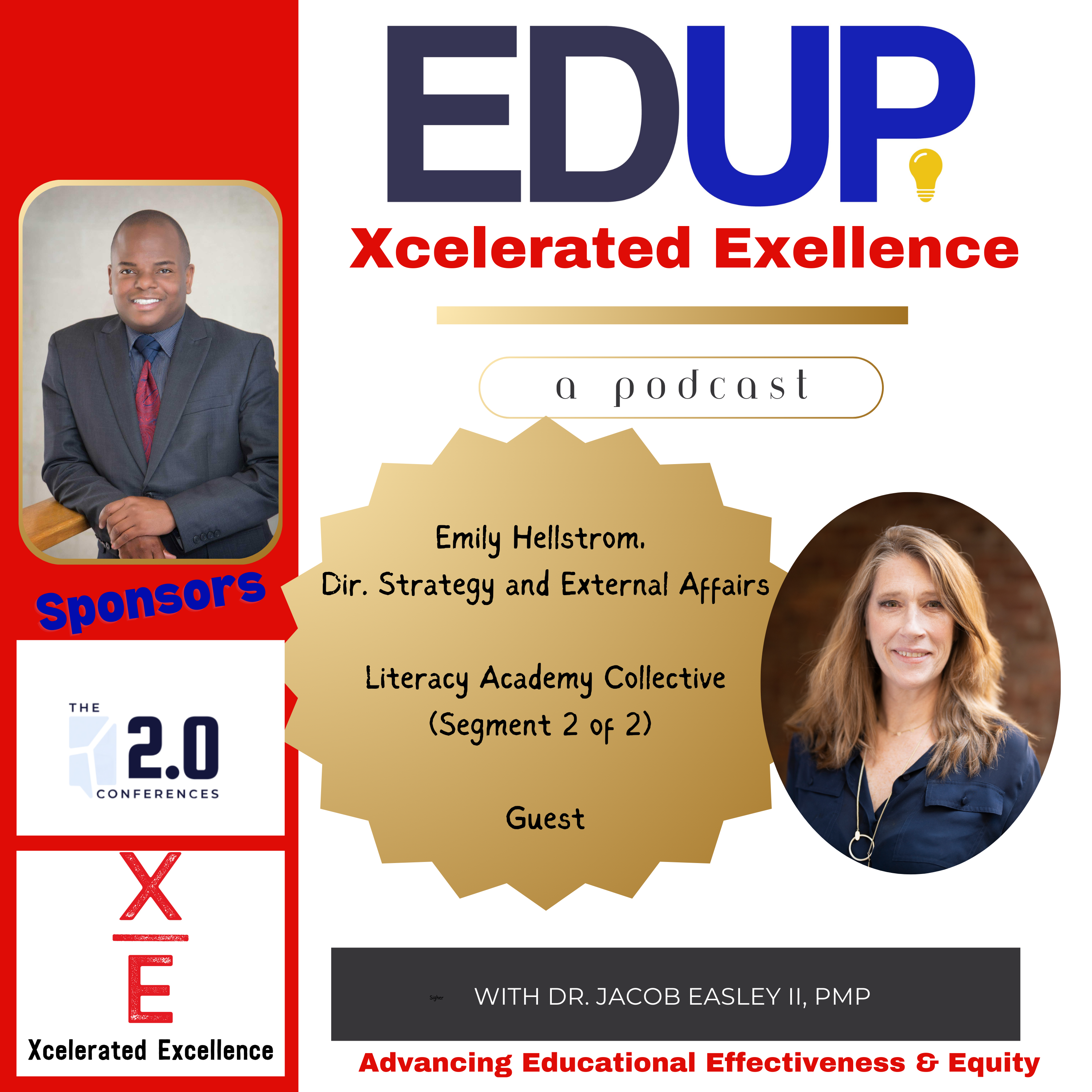
Literacy Instruction for Struggling Readers, Literacy Academy Collective—Emily Hellstrom

We return to a powerful and widely listened-to episode of EDUP Xcelerated Excellence, a conversation with Emily Hellstrom, Director of Strategy and External Affairs and co-founder of the Literacy Academy Collective (LAC)—an organization committed to transforming literacy outcomes for New York City’s most struggling readers.
In conversation with host Dr. Jacob Easley, Emily challenges the idea that structured literacy is a simple checklist or scripted program. Instead, she describes literacy instruction as an equity-driven ecosystem, one that depends on deep teacher knowledge, continuous professional learning, and an unwavering commitment to meeting students where they are. From daily diagnostic feedback to accelerated progress monitoring, Emily makes clear that effective literacy instruction is inseparable from justice.
Emily reminds listeners that reading is not something children simply “pick up.” It is taught and how it is taught determines who gets access to opportunity.
Below are three standout moments from their exchange.
How Context Shapes Structured Literacy at the Literacy Academy Collective
Dr. Jacob Easley: “We're on location in the New York City Public School with Emily Hellstrom, Director of Strategy and External Affairs for the Literacy Academy Collective. We ask her, how does context shape the implementation of structured literacy for struggling readers at the Literacy Academy Collective?”
Emily Hellstrom: “This is why we do this practicum. Teaching children to read does not come in a manual. This is about deep ongoing teacher knowledge and supporting educators in ongoing professional development. The body of science of reading is vast and growing. We’re learning new things.
We have a summer practicum in service of what’s going on during the year. We have a standalone school, South Bronx Literacy Academy, PS 642 in the South Bronx in District 7. There is ongoing work that is happening here. Our school is set up so that we have a foundational reading skills program every single morning for 90 minutes, Monday through Friday. But we don’t stop there.
Every class is a literacy class for us. We are constantly retooling, reworking, looking at how we are infusing literacy—both oral language and direct explicit instruction—throughout the day. We didn’t even talk about writing yet. Both encoding and written expression are so important because they reinforce reading. So we are looking at that across the day.
We have to look at this stuff with regards to math too. We look at foundational numeracy, language processing, and the demands of word problems because our students often struggle there too. So context means looking across the whole school day and understanding how all instructional moments affect reading progress.
Even with a strong program like Preventing Academic Failure (PAF), we ask how to deepen phonemic awareness, especially for English language learners who require more repetition. Summer becomes our time to pilot improvements. We focus on four areas: increasing teacher knowledge, trying new approaches, systematizing practices, and differentiating instruction. Not all students need the same dosage of skills, so we design structures that help us give each child exactly what they need.”
How Teachers Use Data to Implement Structured Literacy
Dr. Jacob Easley: “Evidence-based decision-making is considered to be a vital condition of educational effectiveness. Can you explain for us, how classroom teachers go about using data to implement structured literacy?”
Emily Hellstrom: “For struggling readers—including those with diagnosed or undiagnosed language-based learning disabilities—using data is essential. These students are literally reshaping the neural pathways in their brains as they learn to read. If they sit with errors too long, the wrong pathways form. So we rely on immediate, diagnostic feedback.
Teachers circulate throughout lessons, reinforcing what is correct and marking errors so they can be immediately addressed. We don’t plan weeks ahead—we plan daily based on what students actually demonstrated that day. What did they master? What needs review? What needs to be retaught from the beginning? Daily instruction grows directly out of what we see students doing in real time.
We also use weekly progress monitoring—Acadience—to make sure students are moving through skills. We group students by skill level rather than grade level, and those groups shift every four to six weeks based on data. Because our students are often two or three years behind, we aim for accelerated learning, not typical progress.
Our consistent routines make transitions easier when students move groups. They join a new teacher, but the structure stays the same, so they settle in quickly and continue receiving explicit feedback. In the big picture, we use diagnostic data daily, weekly, and through benchmarks across the year to understand progress at both the individual and schoolwide levels.”
How Teachers Are Supported in Evidence-Based Decision Making
Dr. Jacob Easley: “How are teachers supported in being able to use evidence? Here in the practicum, it seems rightfully so because this is only a six-week program, five of which are working directly with children. That’s a daily approach. And for the traditional academic, at least a weekly approach. So how are teachers supported in their use of evidence-based decision making?”
Emily Hellstrom: “One of our core mission pillars is supporting teachers. The structures of learning apply to students and adults alike. We cannot ask teachers to adopt new practices without giving them the time, training, and support they need. The summer practicum is key to that. Teachers come out of those six weeks confident in planning, delivering, and assessing a 90-minute structured literacy lesson. They’re not required to attend—they want to—because it gives them such a strong foundation.
Throughout the year, we fund extensive professional learning: LETRS, handwriting and OT-informed instruction, articulatory gestures, intentional read-aloud routines, and other targeted PDs. All instructional minutes matter, especially read-alouds, because they build the background knowledge our students need and are fully capable of absorbing.
Our team-based approach is also essential. Speech and language pathologists work alongside teachers, not in pull-out settings. Because all of our students are struggling readers, what is good for one is usually good for all. So our SLPs and OTs provide Tier 1 instruction that strengthens language and foundational skills for everyone.
We also recognize that teachers bring their own histories, beliefs, and even educational traumas. Change is hard, especially when it requires confronting long-held assumptions. When teachers struggle to get into a growth stance, that’s where we see difficulties. Our coaching—especially through Ilya, our instructor of education—helps teachers unpack those challenges so they can grow. We support adults with the same care and intentionality we give our students.”
Listen to the Full Episode
“Emily Hellstrom—Literacy Instruction for Struggling Readers, Literacy Academy Collective” on EDPU Xcelerated Excellence, hosted by Dr. Jacob Easley.

Host
Entrepreneur, higher education leader, podcaster, scholar, and change agent. President of Xcelerated Excellence Consulting LLC.
Dr. Jacob Easley II is an internationally accomplished and award-winning educational leader and entrepreneur. He is an expert in educational policy and politics, focusing on educational accountability, effectiveness, and improvement. He has served in various faculty and leadership positions across five different states and the District of Columbia. Dr. Easley is proud of his work as an advocate for equity and access and quality educational opportunities for all students. He has published numerous books, articles, and commentaries on educational accountability, change, equity, and educator preparation. He is the immediate past president of the New York Association of Colleges for Teacher Education (NYACTE). Dr. Easley is a National Association of Holmes Scholars Alumni (NAHSA) lifetime member and former president of the organization. He is also the founder of the International Congress of School Effectiveness and Improvement’s (ICSEI) Culture, Race, and Intersectionality Network.
Transforming Communities through the Black InGenius Initiative (BiGI), University of San Diego