


 Spotify

 iHeartRadio

 Apple Podcasts

 TuneIn

 Pandora

 Audible

 Amazon Music

 YouTube

 Castbox
Dr. André O. Hudson—Strengthening Access for Science Education with a focus on Happy Individuals at RIT
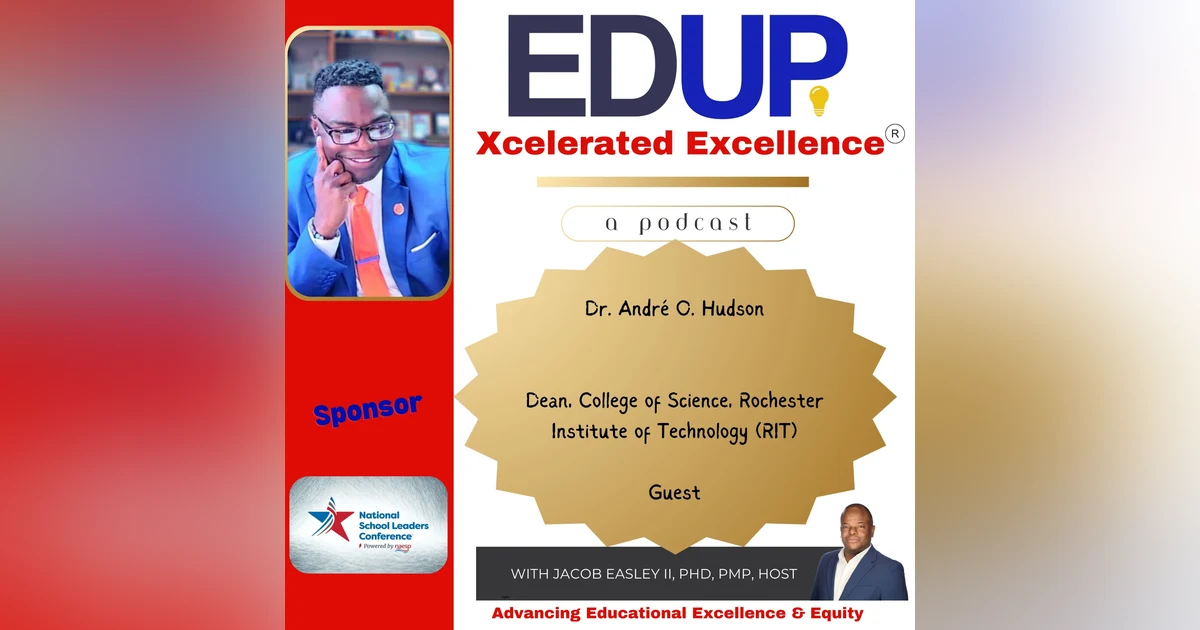

Our guest, Dr. André O. Hudson, is Dean of the College of Science at the Rochester Institute of Technology (RIT), a role he has held since 2023. He previously served as Head of the Thomas H. Gosnell School of Life Sciences from 2017 to 2022. Originally from Jamaica, he emigrated to the United States at age 14 and earned his B.S. in Biology from Virginia Union University in 2000. He received his Ph.D. in Plant Biology and Pathology from Rutgers University in 2006, where his research focused on amino acid metabolism and biochemistry. Followinga postdoctoral fellowship at Rutgers, he joined the RIT faculty in 2008.
Dr. Hudson’s research program lies at the intersection of biochemistry and microbiology, with a focus on amino acidmetabolism, enzyme structure and function, plant-associated bacteria, and antibiotic resistance. His work advances understanding microbial physiology and has important implications for public health.
Over the course of his career, Dr. Hudson has secured more than $6 million in external funding from federal agencies, industry, and foundations. He has authored over 100 peer-reviewed publications and six book chapters and has mentored more than 100 undergraduate and graduate students, in addition to 30 high school students. His contributions to science and mentorship have been widely recognized, including his election as a Fellow of the American Association for the Advancement of Science (AAAS) in 2023.
In addition to his academic and research leadership, Dr. Hudson is actively engaged in community and professional service. He currently serves on the Board of Trustees of the Rochester Museum & Science Center (RMSC) and participates in several other scientific, educational, and community-focused organizations.
Associations
Keisha Hudson; Dr. Anthony Madu; Alpha Phi Alpha
Your Host: Jacob Easley II, PhD, PMP
Sponsor NAESP. National School Leaders Conference–Powered by NAESP is designed for Pre-K–12 principals and assistant principals, featuring high-impact learning tracks, networking, and the newly added "Camp Lead-A-Lot" retreat. Held July 13-15, 2026, Orlando, FL, learn more and register at naespconferenence.org.
Resources:
DEIA and meritocracy: Partners in scientific process
Greeting: Michelle Maslowski
#EDUPXE #EDUCATIONALEXCELLENCE #EDUCATIONALEQUITY #STEM #XEListeningTour
0:02 Ensure that the ecosystem is is 1 where we we care about people, right to be not. And the care doesn't mean that you you don't have the whole people accountable, or you don't have rigor, or you don't have expectations or you don't have crucial or difficult conversations. In that sense, care just means that it's your everyone has a duty. Everyone has a responsibility, everyone has an own as an agency to do something that is called to make for their classroom, their departments, their office, their college, their institute, a better place. And what if and some of them in this kind of Micra, like for example, during finals week, we have some scholars and a club and they basically wrote post it notes all over the college.
0:52 They wrote post it notes all over the college. And this put post it notes everywhere you can. And it was like, you got this right, the confidence, so forth and so on that that to me is like that to me is care. Like when a student comes to me and says, you know, I was, I put something in the trash and I noticed that there was a lot of, you know, recycle. Hey, this is Michelle Mislowski, Managing Director at Carter, and you are listening to Edu Accelerated Excellence. Welcome to the Ed Up Accelerated Excellence podcast. And we would like to share an opportunity for educators to contribute to our XE listening tour this week. Take time to listen to a community member regarding their educational excellence and equity experience because we believe that by listening, we unlock the engine for powerful educational transformation.
1:57 Share your insights via voicemail at Ed Up xe.com, and your comments may be shared on air with the podcast. That's the XE Listening Tour at edupxe.com. Attention School Leaders Registration is now open for the National School Leaders Conference, powered by the National Association of Elementary School Principals, happening July 13th through 15th in Orlando, FL Join education leaders from across the country for engaging sessions, meaningful networking, and practical ideas you can bring back to your school immediately. Whether your focus is instructional leadership, school culture, Wellness, or student success, you'll leave energized and equipped for the year ahead.
2:44 Plus, enjoy the magic of Disney while investing in your growth as a leader. Learn more and register at naespconference.org. That's NAESP conference.org. Welcome, welcome. Welcome to Add up Accelerated Excellence, the podcast for the advancement of educational excellence and equity. And I'm your host, Jacob Easley, the second PHDPMP. And today's guest is really going to fill the well about the role of science, science education. And we have a renowned guest who is Dean for the College of Science at Rochester Institute of Technology, Doctor Andre Hudson.
3:38 Andre, will you? I'm going to be well, definitely welcome to the show, Andre. And will you introduce yourself for giving voice to your name as only you can. And what is top of mind right now for you in your sphere at RIT? Thinking about the importance of science education. Thanks Jacob. It's a pleasure to join your podcast and connecting with you. So thank you for the lovely introduction. My name is Audrey Hudson. I'm a scientist as you, as you mentioned, but some more importantly, I'm a father and a husband and I think community member so forth.
4:25 And one of the things that you mentioned in terms about science education. And I think for me, science education is holistic, it's diverse and it's necessary more this time more than ever. And here are the reasons why I think irrespective not to software RIT or just science as a vocation or profession, but I think we have a lot of currents will have a lot of emergence issues, some of which we don't even know what they are or what they will be. But part of our job as a scientist and academicians and educators, it's not so much to educate as it to inspire the next generation of talents in that sense.
5:16 And, and so I think the problems that we have now, whether it's climate change, plastic pollution, antibiotic resistance, you know, future pandemics, whatever they will be, right, outbreaks and endemics, etcetera, etcetera, what we do now is going to impact and affect how we respond later. And so I think science is it's like a chess game. You know, you kind of need to play the long game, right, to ensure that you have the talent pool in order to do that. And part of that talent pool in terms of it needs to be holistic in not only does the the skills that you need to do it, but you also have to be mindful of the diversity of talent that is there and not necessarily phenotypic diversity could be diversity of thoughts, right?
6:07 And for, for individuals to bring in their lived experiences and their backgrounds at their culture, at the heritage and who there is a person to ensure that those individuals have a seat at the table. Because you know, if you don't have diversity, they like to say, all we're doing is learning more and more, more and more about less and less. And, and so diversity of thoughts is just as important as phenotypic diversity are more important in in some sense. But I think the whole enterprise of science needs to be super intentional and strategic. And I think that's part of the education mission is not only to educate you about the pathways and the enzymes equations and you know that kind of the roads kind of learning, but how do how do you spark a young scholars mind too? So like, wow, I'm interested if that's how do you spark someone who's a scientist but is interested in outreach, is interested in politics, is instructed in ethics. All of the issues are all of the points that they're kind of radiate out that makes science work. Well, you know, as a, as a scientist myself, well, I love being at the bench.
7:09 I for science to work well, I don't think we need everyone at the bench, right? We need the ethicists and the policymakers and the, you know, the, the, the individuals who work on to fund and make decisions on how a science is going to go. And so I see science as super holistic, not just disciplinary, so to speak. Oh, so Andre, thank you for that. As you were talking, 3 words came to mind sort of framework is this holistic approach is looking at the, the biological, the social, because we know that social context, but also environmental, environmental. And I think those all dovetail.
7:51 And we know that we talk about diversity. Communities are diverse. So it's good to know if you talk about, let's say the pandemic may affect one community differently than another community, I think you're right. You definitely need to think of have a holistic approach and have multiple people at the, the table. Because I, I remember I was watching on Instagram just a couple of days ago during the outbreak of the AIDS epidemic, folks were saying we thought it was a white man's disease. And then it hit the black community and, and the speaker said we weren't ready. Yes. No. So a holistic approach, I think definitely is important. So let's let's talk about you for a bit and then we're going to jump right into the wonderful work that's happening at RIT, Rochester Institute of Technology. So you were born in Jamaica.
8:47 Yeah. And you came to the States or your family migrated to the States while you were a teenager, a young teenager. So what values and lessons growing up in Jamaica shaped who you are today as a scientist, an educator, a leader? And I'm going to add this a family man, because you led with family first. That's a fascinating question. I think for me, I think the culture in Jamaica, albeit, you know, very homogeneous in terms of the makeup of the people, so to speak. I think one of the things that I gather it was kind of diverse in terms of the, the support that we got and the, and, and one of the things early on that I got from my family, particularly my grandma is about this, this hard work is this kind of the concepts of hard work. And she used to have this wonderful saying that I actually share with my students all the time, which is, you know, she used to say, I had to when I grew up, I had to make milk out of coffee, which means that, you know, you're going to find a way out of no way.
9:49 You have to go going to be entrepreneurial. You're going to, you know, some people might say squeeze blood out of a rock or, or something like that. And I think that this kind of hard work and persistence certainly has guided the way I lead this guy to the way I approach science, this kind of the way I, I kind of my attitude, so to speak. And it's fascinating because I always share with my colleagues that's when I interview prospective candidates for, you know, bearing positions. One of the things I'm fighting is that so much how smart you are or how accomplished you are. I'm trying to gain some insights about your attitude because things are not going to be always perfect. You're not going to have everything that you need at the table.
10:33 But you know, are you the scientist that if you don't have equipment a right, you could cobble, you know, the equipment that you have access to, to gain, to garner the, to answer the question that you want to answer and still be productive, right? And are, are you able to basically pivots in kind of real time so forth? Like what is your attitude when when things are not at all? And I think that's, that's what I got from growing up in, in, in, in Jamaica is just more than anything else is the attitude of success, which I think when I migrated to the United States, right, that was a difference in terms of culture, certainly speaking different in terms of access, difference in terms of opportunities and so forth. This week, it's almost like I was primed and ready to go and I saw I, I think I have this kind of concept of just no excuses, right?
11:24 Things may not be optimal, things may not be preferred, but my mindset is that they're also not impossible, right? Or not impossible. And so how do I still keep that attitude in order to do what I want to do, what I need to do, what I wish to do and when? It kind of feel like a not optimal environment for the most part. And for different people, that means different things right there. So it's not kind of, you know, what is suboptimal to me might be optimal to someone else. What is optimal to me might be suboptimal to someone else. But at the end of the day, you look at how productive you are, how entrepreneur you are, what your wife said is in terms of what you need to get done. And I think that's growing up in Jamaica. That's what I got.
12:04 And I got that from my family. I got that from seeing my grandma raised 9 kids just on her own and how all nine of her children were well educated, very, very smart, very productive members of society. And how she did that was through hard work and persistence. And I think that's kind of like in my core I'm so to speak. Yeah. Thank you for that. Thank you for that. And I, I just want to wonder as someone who's who immigrated, how did your sense of identity or how was it shaped or shifted once you became a bit more integrated into the US fiber?
12:46 Sure. I think for me, I'm migrating here. As I said, I was kind of ignorant of just kind of like race and politics and kind of, you know, those kind of things that, you know, someone who was born and kind of raised in America missed for my wife, you know, who was born here and raised here right now. Her perspective is way different than mine, right? Because her mother and her family are were born here and experienced things. And it's almost like, you know, this epigenetic or kind of things that are transferred from generation to generation. I really didn't, I didn't really experience that, so to speak, but I, I, I think acclimating was certainly did take some time, right?
13:32 And so the person I am today was way different. So if you talk to people who know me when I write, I was very quiet, right? My accent was a little bit more pronounced. I didn't, I wasn't out there. I wouldn't have kind of thought, even though I had my thoughts and so forth and so on. I was more of kind of somewhat introverted, so to speak. And to be honest with you, I really really did not want to come to America. I mean, I really, really thought it. And initially when I came here, one of my plan is how to convince my parents to send me back home should I get in trouble. And she just sent me back home because initially, like, I didn't like it because I mean, Jamaica was like I ever say my formative years at my friend group. So played football, which in America people call soccer ice, ice, ice, this, this football to be cricket set to speed outside. And, you know, if I wanted to mango, I could just go climb the tree and get back.
14:28 Sometimes you, you, you're hungry and thirsty and you just go get a coconut. And you would just get kind of this kind of like a life that is not the kind of rat race, not the kind of hustle and bustle. It was kind of or chill and laid back and so forth. And so which is a cold different vibe than America, especially when we moved here, we moved to New York City. It's not like we moved to Iowa or, you know, Idaho or some other state that is kind of or chill, but moved to the city in the Bronx, which was like, well, but the good thing about it is that there were so much of a contingent of immigrants, so to speak, from different cultures and different islands and different places, right?
15:11 So it was kind of melted pot. So after you come here and get acclimated, it was like, wow, I could still go to the store and get all the Jamaican produce, the Jamaican things, and you could still cook your Jamaican meals at home. So it was kind of like that home away from home, so to speak. But there is nothing like the land of your purse, right? There's nothing like the air that you breathe at hearing the waves crash on the rocks and you know, the, the, the, the hearing, the, the persistent patois in, in, in your, in your brain and so on. So it's, it's funny because every time I meet and interact with this scholar from Jamaica, for example, we just immediately reconnect. And it's, we don't connect about the major or anything else.
15:53 It's about the culture and the music. And we just start talking in patois and everyone could understand this. And people look at those like, what language are you speaking? And it was just, it's just so fascinating, right? How, how, how much someone's culture impacts who they are in terms of their well-being. It's it's, it's something often not overlooked. It's something that is often overlooked, I should say. Well, you know, you talk about well-being and I have a a good friend of mine who's from Jamaica, still lives in Jamaica and he was visiting New York. This is New York City. So we're walking on the sidewalk and I says, Johan, you're going to have to keep up with me and move over. I said as he walk a little faster.
16:36 He says why I'm not in a hurry. Yeah. Yeah. And so, but what happened was I said, OK, the folks around you, in their minds, they're not in a hurry either. It's just that the rhythm and pace of walking is faster and a bit more congested. So what happens is because of the slow pace that you're walking, folks are getting irritated because I can hear them behind me walk up behind me and say so. But I think, but I think that's important because place and well-being matter. So the studies that have shown that recently arrived immigrants have lower rates of health disparities even though they're coming from low economic condition, but within one generation they sometimes have the exact same, they have parity of heart disease, high blood pressure as as the American population within one generation. Generation wow interesting wow, I never knew that. Thank you for educating me and and I should show that to Jacob that, you know part of me growing up in Jamaica in terms of shipping point.
17:53 I always say like an I'll cut from the cloth of nanny of the Maroons and the Bob Marley's and you know the Marcus Garvey that he did just something in my in in who I am as a person about standing up for for people and giving back in certain ways that you know are not beneficial. So it's not a kind of a self-imposed quid pro quo right. It's some something bigger than I am in and my sister, who is my sister Keisha Hudson, who is the chief public defender of the city of Philadelphia, is a great example of that. And she's my Shiro. And it's just fascinating how unlike we are.
18:33 We're different in terms of our styles and approaches. And I mean, she's a lawyer, a scientist and all of that. But when it comes down to fights, when it comes down to standing up for people and we like we, you know, you know, it's, it's the, it's the roots of Marcus Garvey at Bob Arland's culture, which is like, you know, you get up and stand up, right? You just don't sit by and idle and, and at Skylark, as we would say in Jamaica, right? You do something about it, right? And the repercussions may not be beneficial, but you know, those individuals pay the price for us to have the opportunity today. And so I think this kind of protest kind of being and who you are as a person, it's standing up for your core, as I might assured with you that there's some things I'm willing to rock on and there's some things that I'm not going to move on. And those things are very, very important. Yeah.
19:27 And I think really that it's not protest for the sake of protest, but what I'm, what I'm interpreting that is, is protest for what we may call communal well beings. Exactly. So it's altruistic, altruistic protesting, right. But you know, I'm not doing it just to protect me or protect my vocation or so forth. I'm thinking about playing of class in my head, right? I'm thinking about the scholars, you know, 20 years from now, the college 20 years from now, the you know what the vocation is 20 years from now. So there have to be some kind of a stewardship and, and, and to sometimes, you know, you have to take residents and sometimes it's you're, it's not comfortable and sometimes it's hard, right?
20:08 But you're thinking about the folks before me and before you, right, who kind of went through the trenches just for us to have the opportunity. And I think it's. I think it would be a disservice to them and disrespectful after time in a sense for us, it's just kind of like, OK, go ahead and whatever, let's move on, right? I I, I don't think I, you know, they your blood, sweat and tears should mean something. So Andre, you, you attended and graduated. We like to say graduated from because when we talk about HBCUS, yes folks will often you know, the joke is you attended, but did you graduate? Yes or yeah? Virginia, Virginia Union University, then that was your undergraduate experience, and there was something that happened with regard to your research there that changed everything for you.
21:02 So can you describe that experience in relation to nurturing your scientific proclivities? Sure. So while I'm the students at Virginia Union University, I had this wonderful mentor and I think this is where and I shared this story right after I tell this story, I tell another story that in terms of representation, I would think I didn't know it at the time, but when I went to Virginia University, it's one of the best decisions I ever made for two reasons. Number one, I thought I, I think the education and the experience was fantastic, but more importantly, I met my wife there, right. So which obviously wouldn't the probability of that happening outside of us being at the same institution at the same time is probably zero, so to speak. But I think what Virginia Union provided for me was this self of confidence in terms of like, you know, when you go through four years and you know, almost every single professor looked like you or were immigrants like you, they have this value of pure impact that comes with it.
22:05 And it's fascinating that I really didn't think about it. Or he wasn't in the parents to me in real time until I got older, so forth. And kind of like, wow, that was so inspiring to me. So while at the Virginia Union University, you know, my, my initial intention was to go get a biology degree, go on to medical school, you know, you know, kind of the traditional routes and so forth. And had this wonderful undergraduate mentor. His name is Doctor Anthony Madu. You know, he was came from Nigeria and went on and got a PhD and you know, was a microbiologist and did the fantastic work. But Doctor Madhu, one of his thing was also building the pipeline. And so he applied to the NIH along with colleagues to get a grant from the NIH called the Marc U star program. You know, ARC was minority access to research careers, undergraduate students training in academic research. So ARC U star rap program in the Marc program provided opportunities for them to recruit students who wanted a research career.
23:09 And so part of that experience was you're going to do undergrad, your research, you're going to do internship, you're going to take specialized classes to prep you for Graduate School and so forth and so on. So I got that was selected as an ARC scholar. And once selected as an ARC scholar, I was just fascinated with this whole thing of research, right? And I never even took the empath. I was even interested in medical school after I got hooked by the research bug, so to speak. But in Doctor Maddu's lab, I, I found myself in terms of confidence. I, I, I, I, I found a voice, so to speak. I found that science could be a great advocate not only for a career, but science could be a way for me to express myself just like an artist would it, it would be no difference than I, I looking back, it was no different than Nas growing up in Queens Bridge, right?
23:58 And someone said, Hey, Nas, here's the life in the studio. Go right for me, that lab experience was my microphone that like booths in order for me to express myself and also think while that union I I I pledged Alpha by Alpha fraternity incorporated down the chapter the greatest fraternity in the world. That might be the truth here. And I think that experience also guided in shaped who I am not only as a leader in the sense, but as a person in, in, in terms of doing things bigger than yourself, thinking about community, thinking about community service, thinking about the future, thinking about bigger things other than undone yourself, right. And so I think that HBCU education is not just an education, it's an experience.
24:48 And if you look at my trajectory routes after HBCU, going on to a large land grant institution and my current job and my current role at RIT, those are three different types of institutions, 3 different settings, three different models. And so it actually my HBCU experience actually helps me every single day as not only as a person, but as a leader. So when I see a students, a first generation students, I, I know what that means. When I see a student who having to work three jobs, just the way it ends meet, I know what that means. When I see a student who, you know, they don't have a cadre of support, they don't have their tribe, so to speak, I know what that feels like, right?
25:30 And so we could be certainly reactive in some sense, but it affords us and affords my thinking and my leadership start to be proactive in ensuring that we put in place mechanisms and structures and support for those scholars who need that type of support. It should be successful. So I thank every day, I thank God every day for my HBCU experience. It was, it was fantastic. Thank you. Before we transition into talking about RIT and your work there as a Black student entering the STEM spaces, how did that HBCU experience help you to deal with the idea of belonging?
26:13 Because you, you, you brought up a good point going to Virginia Union University, though it was a different environment for you coming from Jamaica and now here in New York and now you're going to Virginia. You mentioned that the professors looked like you. I. Mean I think that that's very, very important I think what that experience gave me was confidence. And so when I went on to, when I went out to Rutgers, right? And you know, in my cohorts, there was a lot of underrepresented students, so to speak, right? I found that I was primed and ready to go. And throughout my education, I, I, one of the things about, I think my style and the mentorship that I have mentors that I have is that we've always kept in touch, right?
26:56 And so I still talk to Doctor Madhu, I still talk to my PhD advisor. I still talk to the people who have kind of guided and helped me on the way. And there were times when, you know, you just like, I don't know what this is for me, right? And you will call those people. And their job was not to criticize or to judge you or to, you know, you know, to kind of chastise you. Their job was to be like, it's Andre. He's fine. He's academic, He'sing. He's just part of the process. You're fine. You got the skills, you got this. So the sense of confidence and support that is needed is super, super important. And Jacob, I'll tell you why that's important when we have first generation students, right? My son just finished his first year of college. If the model support my wife and I support provided for him, right?
27:48 And we're, we're not, he's not a first class student, but we have been through the system or we work in the system. We're both educators. And so we could actually see where the land mines are or where the hiccups are going to be and kind of coach him and kind of guide him through the process, so to speak, right. And when I talked to some of our first Gen. students, I said, what is a conversation like when you call home and you tell mom that you're struggling or dad that you're struggling on your guardian, that you're struggling with mother web edge with this academic, with this personal, whether it's mental Wellness, whatever it is, right? And the feedback that they're often say or the theme of the feedback is suck it up, don't waste my money, right?
28:29 You know, you just kind of do it, stop complaining. So for that, so, and it's because that's not necessarily bad advice, but it's because those parents really did not go through the process in order to understand, right? So I think going through an HBCU is almost like I was not first generation PhD student because I saw it, right? I tell the story all the time and every time I tell it, I get emotional. When I first joined RIT, there was a custodial colleague who would come by every day. And he will, you know, do you know, take care of the buildings and fantastic colleagues. And one day he said to me, Andre, you know, we talk. And because I play music in my office all the time. And so he will stop by and we will talk about music and we just, I just develop a, a, a, a relationship. And one day he said, I would like to if I could bring my son to meet you, right?
29:24 And I said, sure, no problem, right. And I said, you know, take bring him to campus someday, let me know. And I take him to my class and take him to the lab. He kind of a Shadowman experience for the day. I said no problem. And after we did this, you know, a fantastic head and, you know, after the experience, he profusely thanked me. He said thank you very much for meeting with my son. And I said, you know, no problem, happy to do it. And then he would just profusely thank me. And I was like, I do this all the time. Like I don't, I, I didn't get why it was such a big deal. It's almost like par for the courses, like, you know, kind of experience. And he said he, he, and this is, this is the moment I learned why representation acts.
30:04 He said it was important for my son to meet you, not just to meet you, but I want him to know that he could get a job at RIT and not do what I do. And that, like, I mean, if you could hit me the head with a hammer, I was like, my expression was one of like shot. I was like, wow. And that to me was for me why representation matters, right? It's because when you grow up in a diverse, when you're educated in that first setting and when you see things, right, not every white person is racist. Not every black person is a criminal, not this kind of stereotypes that we have, right?
30:49 Right. It kind of erodes at that. And This is why diversity in education matters is because students need to see that. They need to see, I had a friend that was Axe and I ate over the house and they were wonderful people. And so in the future, if and when you get pulled over by the cops and that person happened to be a representative phenotype, right? You're, you're not, your assumptions are kind of eroded in order for you not to have certain emotions or certain assumptions about certain people just based on experience, right. And so that to me why representation matters. And it's something that I took with me along the way. Like, wow, when I was at Virginia Union, I, I, I felt why having a black professor matters.
31:32 When I was at this, I felt why I, so when I was here, I sofa. So it's kind of how shapes you. The lived experience, which is part of a huge part of the education mission, is that we need folks to basically share their lived experience because that's also a part part of the education process, not just the didactic things and the academic things. And the textbook thing, so to speak, is the lived experience is also a huge part of what we do in education or should do in education. I, I agree with you and I think we talked about, I mentioned and I had conversations with other guests on different episodes about this idea of the lived experience and how it shapes how we see the world and how we engage in policy. Big P or small P.
32:19 It's often really hard to extract a concept or idea when you haven't had the lived experience. Just moving out of faith that Oh well, so and so told me this, except if it's a very highly emotional story and you get to connect with the individuals who are involved, that can sort of shapes it. But otherwise, when conditions are so distant from your own living experience, it's really hard for folks sometimes to get behind support for those issues. Yes, well said. I totally agree. So I want to talk about your research because I think it is fascinating as a scientist. It spans biochemistry, microbiology, enzymes, amino acid metabolism, and plant associated bacteria. So for listeners outside of the scientific world, what's fascinates you so much about this work? Yeah, I think it's two things, right? It's always been a very, very curious kid. And I, my mom will tell me it's like when I was growing up, I was a baby, she said.
33:31 I never, I never met a baby that asked so many questions, right. And my, my, my, this asked questions. And I remember when my son was, he got a lot younger then he's now he's 19. He must have been 5 or 6 and he came to campus with me. And when he was little and he was out of school or not feeling well, I and I had to teach. I will, or to, you know, work, I will bring him to work with me and I will take him to the classes and take him to my lecturers. He was sitting there and he, he came home and he goes, he, he told, he told my wife two things at one occasion. He said, he said, mom, dad really doesn't do anything at work. He said he, he, he meets with the big kids.
34:14 That's what he used to all the students and he plays with his laser. He talks to them and he's played with that laser. I was like, no, I'm, I'm, I'm, I'm buttering right? I, I was like, that's his concept of me working was right. Just talking to the big kids, internal leaders. And then one fascinating story and he said, Dad, what do you do? Right. And I said, well, I teach. And he said, yeah, but what else do you do? And I said, well, I asked questions, right? I, I, I asked how, why, when, where, if it's not kind of asked fundamental questions, then I design, you know, experiments to answer those questions. And then I tell people about them. And I tell people that what I thought and what the results are. And, you know, publishing is over there. So he goes, you get paid to ask questions.
34:54 And I said, yeah, I said, that's basically what a scientist loves it. They ask questions and so forth and so on. He goes, I ask a lot of questions, how come I don't get paid right? So, so he was advocating for himself in there. But I, I think, I, I think I'm in part of the science that I am interested in with this goes all the way back to my undergraduate that he said, because my first undergraduate research project was basically going around Richmond, VA at farmers markets, collecting or buying fruits, farm fresh farm produce and basically tried to study the bacteria that's our interacting with those fresh farm produce and to find out if they were pathogenic or not. And, and the reason is, is because you know, like if you eat lettuce and tomatoes and kind of other kind of thing, typically you don't cook them to eat them or fruits. You just eat them, right.
35:45 And so basically wanted to do that. So I always kind of, that's where kind of this concept of kind of microbial plant interaction came through. And then, you know, a sequencing technologies improved and you could apply genomics and so forth and so on. And when I went out to Graduate School, the department that I got my PhD from was the Department of Plant Biology and Pathology. And although the work was mostly enzymatic than kind of biochemistry base and amino acid. And my PhD, the lab that I got my PhD from under the direction of Doctor Tom Lustek was on amino acid set. So basically how to study and figure out how organisms metabolize or make certain amino acids, so to speak. And so the kind of core training and in that set, I mean, interestingly, my PhD work discovered how plants make this one amino acid essential.
36:43 So I mean, humans can't make it called lysine. And I figured out how plants make lysine through obviously a collaborative effort with my colleagues, etcetera. But then it turned out that some bacteria make lysine the way plants make glycine, which was unknown at the time. And then in bacteria, it turns out that the pathway to lysine is also important for cell wall by synthesis and a cell wall by synthesis. One of the targets for antibiotics is cell wall, bacterial cell wall. And so that's just how the kind of this kind of amalgamation of just kind of experiences from way back in my forwarding fears and how I kind of connected it later then as I a part of scientists is like almost like every five years or so, you have to kind of reinvent your toolkit, right?
37:29 I mean, 0 methods become old and candidate at work. So you're going to have to kind of learn learning techniques and tracks, right? So one of the techniques that I learned was extra crystallography or structural biology, which is, you know, if you want to find a target for an enzyme that is essential, that could be a drug, you first need to kind of lock and pee, right, to find out what the the inside of the lock looks like. So you could design A fake key that will open the door, which is the kind of a connotation of how drugs work, right? In terms of drug binding to some enzyme that it prevents the enzyme from working. So important, in addition to the science, I just find it a fascinating way to inspire students because one of my methods that I used to teach is a Socratic method in both the lab and then the lecture, which is I tell my students all the time, I don't want to create short water cooks, which means I don't want to provide you all of the information on all of the steps. And all you have to do is follow the recipe, get a product. I want you to think about why am I doing this step? What's what's the point?
38:37 Because if something goes wrong, 95% of what we do is troubleshooting. This didn't work. OK, let me figure out why do I have to tweak over here in order to get the different results in troubleshooting and so quick and so on, right. So I think the science certainly integrates into the way I teach and the way I teach certainly integrates the way I do science all the way from if I design A laboratory exercise, one of the first things I think about is how can I make this project based and inquiry based? So maybe we could do, you know, embark on a journey and depending on what we find, let's publish it. And it's a class, right? And so a lot of I have several a good College of publications that came out of just this kind of Socratic in Group based method of teaching of training them how to be a scientist right now, just kind of lecturing to them or professing to them. But basically get into think.
39:26 So one of my one of my favorite ancestor students says, even if I know, I kind of feel a little bit like that's a fascinating questions. I don't know, let's go find out. Why don't you find that and come tell me. And then like kind of, and that's the reason why it's important is because I think part of the mess about being a professor or being in this space is that students or scholars also think you know it all or you just perfect being like you're this kind of God like structure. And and so sometimes like, I don't know, I had that miss. I don't know the question or no. I don't know what this compound is, but I know it's hydrophobic. And it's like, how can you tell? And it's like, OK, let me tell you, right? Because the structure speaks to me. And so, oh, wow. So he's like, you know this and getting away from this memorization, kind of rote learning into and conceptualize and kind of thinking.
40:13 And I think that it's a fascinating way to inspire. Science is a very, very fascinating way to inspire talent You like. It's because it's not perfect. You learn about persistence. You learn how to communicate. You learn how to be, you know, into like you, you learn how to just basically circumvent and you learn how to be concise and you learn how to plan a her intentionality and you learn humbleness like we're you're going to get a lot of rejections, a lot of declines and a lot of stuff. It's a very, very hard thing to do. So part of our mission, and my mission is to callous the students before they get into the Greek world. So here is the reviews from the peer, the journal, right?
40:56 Look how harsh they are. This is what you're going to get, right? So, but persist, let's revise and resubmit, right? Hey, I just got this grant, but did you know that I got 5 rejections before the grant was actually funded? Wow, I didn't know that. Oh, here are the reviews. Wow, I didn't know that's open and so on. So the part of training and mentorship, I think it's not just, you know, helping students get to the finished products, it's taking them on the journey to the finished products so they understand the whole enterprise of science from soup to nuts, so to speak. Oh, I really appreciate that. I'm glad you brought out those words about you didn't say this one, but resilience and curiosity, inspiration, social impact, problem solving, communication. So again, this idea of holistic approach science, but I like the idea of building, you know, building up the calluses a bit so that rejection and pitfalls are not so banning exactly. Thank you for listening to the Ed Up Accelerated Excellence Podcast, and we would like to share an opportunity for educators to contribute to our XE Listening tour this week. Take time to listen to a community member regarding their educational excellence and equity experience because we believe that by listening, we unlock the engine for powerful educational transformation.
42:19 Share your insights via voicemail at Ed Up xe.com, and your comments may be shared on air with the podcast. That's the XE Listening Tour at edupxe.com. School leaders, have you ever hit a point in the school year where you're pouring into everyone else, but realizing no one is pouring into you? That's exactly why the National School Leaders Conference exists July 13th through 15th in Orlando. NAESP is bringing together principals and school leaders from across the country for a few days of learning, connection, engagement, and real world conversations about leadership.
43:03 It's more than a conference. It's a chance to step away from the daily demands, recharge your mindset, and return to your school with fresh ideas and renewed purpose. Because strong leaders deserve spaces to grow too. Learn more at NAESP conference.org. That's NAESP conference.org. So we are speaking with Doctor Andre Hudson, who is Dean for the School of Science at Rochester Institute of Technology.
43:51 So I I, I really appreciate your strategic plan and I want to hone in on a couple of things. One your initiatives or goals is happy people. Yes. Can you unpack that for us? Because to be to be honest, I don't know if I've seen a strategic plan that lists happy people as a goal, right? It's I think thank you very much. So well our colleagues and kind of put together the plan. Obviously it's not my plan, it's it's a colleges plan. And so it's up. We're collaborative and partnership with our colleagues. One of the things that was on the front of my mind is as we're developing the kind of kind of our minds is this, this concept of well-being, right? And the environment, I think should be reflective of the people that are operating the environment and the state of mind, right?
44:46 And the concept of Jacob, what I was constantly thinking about is this that this theme of, you know, can really a cardiologist take care of a patient with a heart problem if the cardiologist is not in that space in order to do their best work, right? And since we're professors and vocationalists, a lot of times, obviously, you know, we are hyper focused on the student experience, it hyper focused on getting the job done and, you know, all of the work that comes within that space. But if the people who are basically doing the work in order to get to the products are not well or not content, then it's going to be either impossible or harder in order to do that work, right?
45:33 So the thing about happy people, like, I think it's, it's more guiding on the rather than actually doing specific things. Is this this intentionality behind it, right? Which is first of first of all, like, you know, maybe people are not happy because they don't know information. So it's our job to be more transparent and communicate better, right? How can we alleviate insides, right? How can we ensure that our colleagues take advantage of opportunities, right? So, for example, one of the things I've been championing is that I have to lead by example. So if I want our colleagues to take time off and relax and enjoy their summer, then I have to lead by example, right? You know, I've learned that, hey, sometimes things could wait, like when I send emails and so forth and so on. So even though I don't expect a response in real time, right? You know how you communicated that maybe to the colleague that's getting it, maybe put pressure on that, that they have to respond.
46:31 So all of those things. I think the intentionality behind happy people is gonna, I also think it reflects this notion that we care as a leadership group, as a college, we care about one another, right? And this kind of peer support and so forth. And you know, when, when things, you know, this concept of like once a man and twice a child that. And so as we get older in our professions, and if we have our parents that are still living or loved ones that we need to take care of, right? There's going to come a point in time where we need to have a culture that it's OK to take care of your loved ones. It's OK to do this. So it's obviously need to go through the process and so forth and so on. But I think it's this value of care, right? And I think it's very, very important not only for recruitment, but for retaining talent, right? Just to show that to be care.
47:19 So I think happy people, but I think joy and contentment and happiness is somewhat of a personalized experience, so to speak, right? It could be eternal or external in terms of the stimuli that makes people happy. In that sense, I think the culture, the environment is very, very important since for most vocations, we spend more time at work than we do at home, right? Or more time with our families. And so the work family is actually a family. So how can we ensure that our colleagues or happy or content or we have that dialogue going there? How can we do things that they feel comfortable approaching us and they don't feel like it's a burden to to do the things that they need to do outside of work or maybe inside of work in order to make them content, so to speak? So this is very interesting.
48:06 So to me it begs the question of have you come up with a formula for what you might call workplace or learning place for students having right? I don't think I've, I never thought about it that way, but what I think about is that it's a very mutualistic and very symbiotic relationship, right? And so for example, right, it's if the students could gain that the staff and the faculty are stressed, they're going to be stressed, right? Or they're going to worry, right? It's it's, if you look at the, the, the whole ecosystem, right? It did ensure that the ecosystem is, is 1 where we, we care about people, right?
48:46 To be. And the care doesn't mean that you, you don't have to hold people accountable or you don't have rigor, or you don't have expectations or you don't have crucial or difficult conversations. In that sense, care just means that it's your everyone has a duty. Everyone has a responsibility. Everyone has an old as a agency to do something that is called to make so their classroom, their departments, their office, their college, their institute, a better place. And what if and some of them in this kind of micro, like for example, during finals week, we have some scholars at a club and they basically wrote post it notes all over the college.
49:29 They wrote post it notes all over the college. And this puts post it notes everywhere you can. And it was like, you got this right, be confident, so forth and so on. That that to me is like that to me is care. Like when a student comes to me and says, you know, I was I put something in the trash and I noticed that there was a lot of, you know, recycle items, recyclable items, and you know, the not in the correct place that bothers me. That tells me that the student cares, right? And so like now I think also the students, we have to create a culture where the students feel comfortable to come to my office to share that with me.
50:10 Or they could trust that I'm going to respond, or they could trust that I'm going to make myself available, right. And so one of the things, one of my styles, Jacob, is I do rounds, I get out of my office and I walk around and, you know, I say, what's up, young scholar? What are you doing for the summer? And that to me, I get more actionable things as a Dean than I do if I have a formal meeting with them, right? Because I'm going into the airspace, I'm pumping into them in real time. And I said, what's going on? What's you know, what's up, right? And they said, well, yeah, I'm having this. I thought, let me connect you over here. Let me connect you over here. Oh, wow. Thank you for sharing. And but while, I mean, I've solved the problem in real time, then I'll connect with the department head or connect with the requisite office to kind of help them navigate start what kind of things, right? And I think the culture of well-being and care, right? Ultimately it needs to people that are more content where we're happy, ultimately always more happy, right? And I think that's it's a culture. It's more of a kind of a cultural kind of connotation. Not that we people weren't happy before, they were content before, but I think putting in the plan showed that we were intentional and strategic.
51:13 And it's at the top of our minds in terms of something that we need to be cognizant of. Yeah, that that sounds like. And I'm putting words. In your mouth now intentional communal stewardship. So it's. Cultivating this idea that. We're all in this together as stewards for a place of happiness. So. You've you've also been. Ardent champion for accessibility, particularly within the area of sciences science. So can you explain what are some of the programs you have currently that speak to this idea of access? I know you engage different communities like the LGBTQIA community, students of color and so on and so forth.
52:02 So and that's largely on the student support side. So what does that look like? Yeah. So I think it's. You know, I think in order for anyone to thrive, irrespective of who they are as a person, their backgrounds, you know, who they want to become, right? I think they, everyone needs to be their authentic stops, right? The burden of trying to operate in a system that you have to hide who you are or not feel a sense of belonging or welcoming you are right. It's just it you just can't thrive. You just cannot be your best self rich. And so how can we erode at those obstacles in order for students to feel comfortable our Staffs or colleagues in order to feel comfortable of who they are, right. And I, I think championing, you know, one of the first decisions I made when I became Dean interviewed actually at the time was to appoint a director of DEI initiatives or access and belonging, as we now call it.
53:00 And that was very, very important to me because I think it, it shows that not only the commitment, but it showed that things are coordinated and things are not kind of happy stance, right? And so Doctor Leah Michelle and her colleague, Doctor Jack Ludwig, who leads that office or the, or those initiatives, right? We're very, very intentional about making sure that our students could operate in a sense of in, in, in this kind of culture and space of this, who they are and they're, there's no judgment. There is no one that's going to make fun of them. There is no one that's going to treat them any differently and so forth, so on. And if those things come to my attention, those things are addressed very, very rapidly and they're rectified in, in essence, I, I, I, I think on the student side, right, creating clubs and, or spaces for people and not only my office, the institution that one of, and I sure, you know, when I was on the job market 1819 years ago, why I chose RIT right, is, is because I sought the commitment to who I think I wanted to be in a space that I wanted to work. And it's interesting because I interviewed at other places that were more diverse that RIT, that were a different kind of category of institution, you know, maybe better repute or larger, you know, the, the core facilities and the labs. And so for this one, but at those places, I really never felt a place of contentment and commitment to RIT, right. And, and, and that was very, very instrumental in, in, in my decision not only to join RT,
54:33 but to stay at RT in that sense. So I, I think whether it's spaces, clubs and so forth, and it's students, it's still not only just to create that or to ensure that they're supporting, ensure that the students have the resources or the, the, the things that they need in order to survive and in order to, to do well excel. I think it's, it's, it's, it's, it's, it's certain that we are proud of. And the obviously the word did not start with me, so to speak, that you know, my predecessors and others have kind of, you know, our topic, this restrictor is there and I think that, but it's who we are as a college and it who was at the institute inside we are very welcoming environments which we champion differences. At the end of the article that I shared with you, I end with the line.
55:19 Great minds don't think alike. Great lines, think differently and who you are, how you think, right, is it's going to be different than your circumstances, who you are as a person, what you're going to bring to the table. And everyone has something to bring to the table, right? And part of the part of the education mission, I think it's, it's a misnomer in that, you know, our job is to educate, educate, educate, right? But sometimes our job is to learn, right? And so it's a lot of what we do is because students educate US, students share with us, right? And students inspire us in order to help champion those changes, so to speak. So I'm happy that we have the culture of this kind of kind of reciprocal kind of camaraderie and kind of share, but one of which is to ensure that the students are taken care of and who they who they want to be and they could be their authentic selves and thrive in environment like we would already. But I, I.
56:15 Like the idea of. Authenticity. And I think that does tell really well about this article that you mentioned and you wrote this in 2025 and the article is entitled DEIA and Meritocracy Partners in Scientific Progress. And the last line is. Great minds, as you mentioned. Do not think alike, they think differently. So tell us about the tenants. For those who haven't read the article of Brown, DIA and Meritocracy, I think you know.
57:01 Certainly there were in 2025 and certainly before it was this kind of discussion. Or dialogue. Some of it was healthy, some of which was unhealthy. As I would think about this notion that you know, if you were from a certain background and you got into certain spaces, you got there because you didn't have the merits to get there. But but but there were systems created purposely. To get you there. And that bothered me because what the notion, what the notion of the, the, the, the crux of that argument is that if you're a certain phenotype, then you are innately not able to get into those spaces on, you know, based on your, your hard work, your dedication, your education, your persistence and so forth and so on.
57:57 So all we think there was this conflation of meritocracy versus kind of privilege, right? Sometimes I see those kind of interwoven and you then you can't be coupled on and so forth, right? And so given the lawsuits and the chatter that's going, I thought it was a very, very important for me to communicate my thoughts in this particular space. And I talk about why in particular science diversity matters, right? Because when you are solving problems, right, you know, as I said earlier, you don't want to learn more and more about less and less, right? And I give an example of that, you know, by just who grew up in rural in a rural part of the country who have to kind of scrap, right.
58:38 They just that lived experience might be looks a little bit different than someone who comes from a different background. And if they're at the seat of the table, right, they could set champion shirt effect, right. If you look at the initial the way drugs were designed, for example, right, based on genomic information right now, those genomes were not very, very super, super thin slice of the human population, right? I could, I could argue that had those, had there been a diversity of people around the table to discuss about, they would say, hey, what about this group? What about that group? How must trauma affect this drug, right? OK, if you're developing a cholesterol drug or a high blood pressure drug, right? But hey, you know, in the black community, they experience something way different than this other community.
59:23 So have we thought about that? Have we designed experiments or ensured that the drugs are so put this all right? So I think this kind of diversity of thought, diversity of this kind of diversity enterprise, right? Anything that is comes from a place of diversity, the product is always better. The product is just always better. And so in science, why would we not want that in such? Why would we wanted the best minds in order to get to the top? Now, in terms of DEIA, right? If you look at this notion that this notion that like you just get there. If you're the best, you should get there, right? Well, maybe you're the best, but maybe you didn't have the opportunity, right, right. Maybe because your school system that that you grew up in or you you went to.
1:00:07 Is in a part of town that doesn't get the tax the taxes in order to reinvest back into the school system to give you access to allow right now. You may have to drive, you may have to passion, you may have to go with all of you may have the the the the kind of the work ethic in order to get there. But why should you be penalized for the lack of opportunity when it was not your fault and so? For me. This is why this space is very, very important to me in providing exposure. It's basically you're high school students, right? And you don't have the opportunity to be in the lab. Come to my lab, come on campus, see what it's like to be like that expose and it's not about to recruiting you is that I want to expose you into this kind of environment that is going to help shape you and, and, and, and help, you know, you make up your mind about what you want to do in the future. So access is very, very important, such as obviously inclusion, right?
1:01:01 We need to ensure that people feel comfortable sharing their thoughts, sharing their values, sharing their Morais at their norms, at their ideas and so forth. So I think this, this, this enterprise system, this holistic system of that, what we have, right is that if you look at history and look at every product, right, If that product is designed or implemented or created from a place of diversity at a place of different, if it's engineered that way, the product is always better than if it's not, if it's not, if it that's not part of the process itself, right? And so it should not be any different in science, so.
1:01:41 What that? When you talk about. This it. Brings to mind to me this concept of universal design. So is the science is designed to be a benefit or to be used in multiple communities with sensitivity to again, let's go back to biological, environmental and perhaps I think we mentioned one other concept around those those groups so so that. You're not missing something. And you're like likely to get the most optimal results intended from that particular treatment. So right and actually because.
1:02:26 Again, that's part of the lived experience, right? As a scientist who grew up in a certain spaces, right? Like, so you're one of the fascinating things that, for example, study abroad, right? I think it's just a fantastic way to educate students, right? Because you get, you know, get away from Rochester, get away from RIT, get away from whatever university, right? Go go exploration different culture. They'll see how people live. They'll see how people eat or see what kind of music that people listen to. Like expose yourself, the things that are going to shape who you are as a person and then bring bring that back. I see there's no different in science where you have a particular lived experience. You think a straight away, you design a certain way, you argue a straight way, you write a straight away, right?
1:03:07 How ultimately you could integrate that into a product that's going to get better, right? So it's just fascinating when a student writes something, right And like, wow, this student shouldn't be a scientist, they should go be a lawyer. Maybe they could argue, right, right. And it's just because they grew up in a system that kind of maybe shapes how they communicate in terms of, you know, their style of writing. And there is nothing wrong with it, right? Then you have students that are trained or scientists that are trained in a certain setting and they think in reverse, right? So ready to think why? Well, rather than me figuring out what the enzyme does, what about if I make a mutants and see what the phenotype is of the Organism and then work backwards, right? You get to the same answer, but you just ask the question in a different way, right?
1:03:49 Or someone who's trained with an engineering background was at home. I remember taking the class over here and over here and this snake or I have a colleague over here and so forth. And so so these this whole is this kind of network analysis that you could do and you only need that. You cannot have a network with adverse their first if you're connected to their self or connected to the people that think like you all the time, right? You just really not want to move the needle or if you do, it's going to be incremental at best, so to speak. So This is why I think diversity, inclusion, you know, access, equity, all of that matters in, in terms of in the scientific enterprise, so to speak, and we're speaking with. Doctor Andre Hudson.
1:04:30 Who is Dean for the College of Science at Rochester Institute of Technology? So Andre, what would you say to someone? And I usually say young person, but you know, that's I don't want to be ageist in this regard. Someone who might be interested in the field of science, but perhaps have not yet found their tribe and ultimately, if they were to choose to pursue that study at RIT, you know what, what words of inspiration can you give to those individuals? Very good. So I I think. First of all, if you are a scholar, a prospective scholar who would love to study science at this, please have a look at RIT in the College of Science and in any over the our programs that we offer at at RIT.
1:05:22 I think it's a fantastic institution that's on the rise and surely we're doing some fantastic things in in in all respects. I should know that one of the concepts that I often share with students is that exponential learning is at the heart of everything that everyone does is that do not make up your mind until you put yourself in that space or the opportunity experience it and then make a decision. I think we have certain spaces in science that are a traditional traditionally exclusionary in the sense that, you know, women can't be physicists. You know, girls are not good at math, right? In, in, in, in certain things or, you know, if you get into the space, you're not going to thrive because you're going to be one of a few and so forth and so on. And I think, yeah, I just love the sculpt from Nezzel Mandela, which says I never lose.
1:06:21 I always win or learn. And I think that's the mindsets of every single scholar that wants to experience or want to get into a space is the mindset that you have. I'm going to try it. I'm going to put myself, I'm going to go seek the opportunity, right? And even if I do not like it, right, it's still beneficial for me because at least I experienced it before I made a decision, right? And I think that's the heart of experiential learning is that we need to provide access and spaces for anyone for anyone for. Anyone who wants to do. Something or wants to try it.
1:07:01 There needs to be a space, for example, to at least try it. Some of them will not continue and that's totally fine. They will do something else, right? But some of them will inspired and like wow and so forth is and it can continue in the chart, right? And so I think that's very, very important. And I think at RIT, we provide the space and the opportunity, right, for students to be their authentic selves, to experience things. You're right, you know, for example, we have this wonderful Co-op program at RIT. We're part of the mission, are part of the academic or part of their curriculum, so to speak. And for them to go get a Co-op cooperative education, go embed themselves into a company, embed themselves into certain spaces and get the experience, so to speak, right? And as I said, you will never lose. You will always win or learn.
1:07:55 The I I definitely appreciate that. Yeah, so Co-op in a sense allows you to earn money through applied experience while also pursuing one's academic credentials. Would that take them longer? To. Graduate. Well, it depends. And so in. In certain programs, we have five year programs, it's a certain especially in our engineering and some of our computing programs, those are five year programs because they have two blocks of coops in in traditional programs like some traditional programs like biology, chemistry, which are four years, right, students do their coops or experiences over the summer. So for this one, so it not not doesn't necessarily mean that you graduate later.
1:08:40 Yeah, certainly has to be cleansed and be orchestrated. We have students coming in now with a lot of AP credits and college bearing credits. And so it's almost like your semester ahead. So they could kind of later on take a semester to go do Co-op so they don't lag in terms of graduation and so forth. So I think the intentionality behind it. But you know, RBA, right, A lot of their experience in the Biological Sciences or the life sciences or just sciences in general, right? Or arts, you could do that during the academic year, right? So for example, I, I host a bunch of undergraduate students, certain graduate students and others in my lab throughout the academic year. And that's part of their education and exponential learning as well.
1:09:22 Yeah, I'm glad you mentioned that because. We're hearing a lot about alternative models for crediting students who can bring lived experiences that speak to their aptitude and or mastery of particular concepts and and skills within their programs. So with that, have you guys started playing with sort of competency based learning for credits particularly through like the co-ops and other models? Yeah. So I think you. Know for example, when you when a student goes and do a Co operate, it is no go to the experiences in automatic accounts, right.
1:10:06 We have a system where the company chimes in and evaluates students, evaluates the respondents and certainly the office have to prove it before it's kind of actually annotated on their transcript, so to speak. So there's a betting process to ensure that there's some breath and depths to the experience and it actually counts so forth, right, If you do undergraduate research and it has to be count right now. Obviously the event had to ensure that not only breath and death, but hopefully the student disseminated or communicated in soft form in order for it to Congress. So there are some expectations that just I'm just going to do it right there. So deliverables from the student and that is actually necessary in order for them to get the credits or hesitate you know their transcripts in order for them to fulfill that major requirement. So those are.
1:10:58 Wonderful opportunities. So Andre, what is next for you in terms of your professional work or what are some upcoming events at RIT that might be of interest to the add up Accelerated Excellence community and how might the community engage? Sure. Yeah, so, so. For me, I'm, I'm currently, I'm serving as the Dean of the college science. I love what I do every day. I kind of see every day as a chess puzzle, so to speak, right? Which is kind of figuring out how to navigate all the headwinds and all of the good things and getting ready to onboard new scholars and supporting our current scholars and obviously our faculty staff, etcetera.
1:11:41 I just, I love what I do every day. And then so I, I can see myself continuing to do that in the future. I think for our community, the community. First of all, thank you so much for and, and our mutual colleague Trevor for putting us in contacts. This was a wonderful connection is that, you know, just check us out, you know, whether it's through websites, through our social media platforms for prospective students out there, we host a cadre of open houses, virtual open houses, in person open houses. We're going to do some things over the summer to expose what we do here at RIT. So I would love for individuals who are interested in RIT, not necessarily in science.
1:12:22 If you're just interested in RIT, that's fantastic. So feel free to contact me. I'm sure that you will share my contact exhalation and then I will love to put you in touch with whatever office or college or academic program that are aligned with your interest. Irrespective of it, this is science or not, right? I think I'd love to be an ambassador for the university, for a wonderful university that is doing some great things. And it's on a as an alpha. I have to say this is on a onward and upward trajectory. I'm smiling and I I love. That so I appreciate it. So there you go folks. So even if you're not interested in science, Dean Hudson has the Invitational that if you connect, he will network you through to the appropriate bodies there at Rochester Institute of Technology.
1:13:14 So Doctor Hudson, I want to thank you for this opportunity. And I probably should say Dean Hudson, I want to thank our opportunity to learn with and from you here at Add Up Accelerated Excellence where we seek to advance educational excellence and equity. Yeah, sure. And thank you for opportunity. It's been. A fantastic experience and I wish you all the best and hopefully we could connect sometime soon in person. Oh yeah, this has been this has been wonderful. Thank you for engaging with add up. Accelerated Excellence a member of the Add Up Experience network of educational podcasts, and we encourage you to participate in our XE Listening Tour by listening to educational the stories of others and sharing your thoughts with us at EDUP.
1:13:57 xe.com school leaders join us at the National Association of Elementary School Principals conference in Orlando, FL July 13th through 15th. Learn more and register at naespconference.org. You can find this and other episodes on Spotify, iHeartRadio, Apple Radio, YouTube, and other outlets where you listen to your favorite podcasts. If you like this episode, don't forget to follow us and share within your network. To leave a comment or suggest a guest, contact us online at eduxe.com. We want to hear from you if you have. Feedback on this or other episodes or would like to nominate a guest? Contact us online at EDUP xe.com where you can leave an e-mail or a voice message. That's Ed upxe.com.


Dean/Professor-College of Science - Rochester Institute of Technology
Dr. André O. Hudson is Dean of the College of Science at the Rochester Institute of Technology (RIT), a role he has held since 2023. He previously served as Head of the Thomas H. Gosnell School of Life Sciences from 2017 to 2022. Originally from Jamaica, he emigrated to the United States at age 14 and earned his B.S. in Biology from Virginia Union University in 2000. He received his Ph.D. in Plant Biology and Pathology from Rutgers University in 2006, where his research focused on amino acid metabolism and biochemistry. Following a postdoctoral fellowship at Rutgers, he joined the RIT faculty in 2008.
Dr. Hudson’s research program lies at the intersection of biochemistry and microbiology, with a focus on amino acid metabolism, enzyme structure and function, plant-associated bacteria, and antibiotic resistance. His work advances understanding microbial physiology and has important implications for public health.
Over the course of his career, Dr. Hudson has secured more than $6 million in external funding from federal agencies, industry, and foundations. He has authored over 100 peer-reviewed publications and six book chapters and has mentored more than 100 undergraduate and graduate students, in addition to 30 high school students. His contributions to science and mentorship have been widely recognized, including his election as a Fellow of the American Association for the Advancement of Science (AAAS) in 2023.
In addition to his academic and research leadership, Dr. Hudson is actively engaged in community and professional service. He currently s… Read More