


 Spotify

 iHeartRadio

 Apple Podcasts

 TuneIn

 Pandora

 Audible

 Amazon Music

 YouTube

 Castbox
Dr. Larry J. Walker —Policy Preparation and Development for Educational Justice
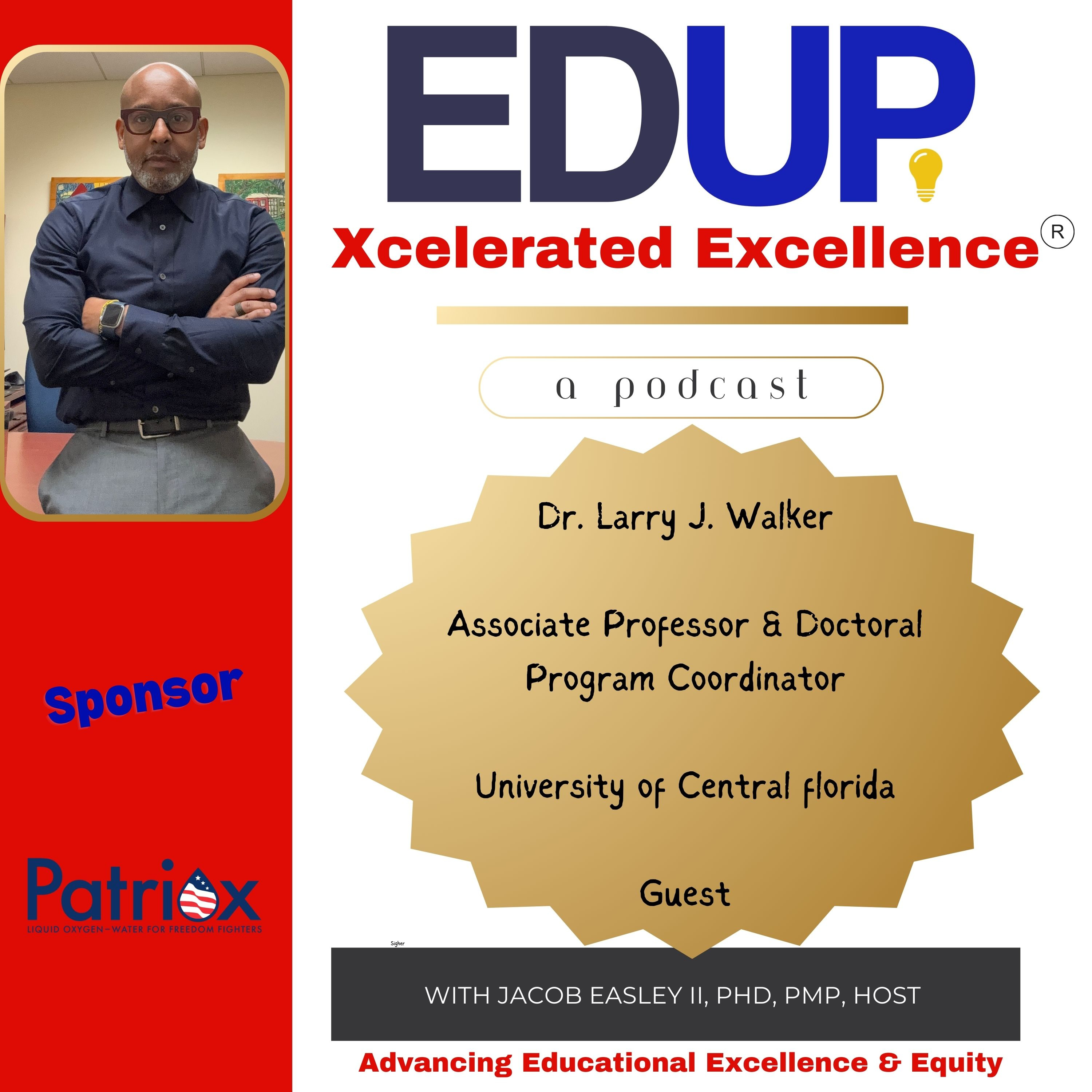
Our Guest, Dr. Larry J. Walker, is an Associate Professor and Doctoral Program Coordinator at the University of Central Florida. Previously, he held faculty appointments at Howard University and Loyola University Maryland. His research focused on leadership, policy, and racism. In addition, he served as the Legislative Director for former Congressman Major R. Owens and selected as a Congressional Fellow with the Congressional Black Caucus Foundation.
Dr. Walker is a political commentator who appears regularly on Roland Martin Unfiltered and Fox 35 Orlando. He has also appeared on Live NOW from Fox, Fox Business among other national and regional platforms.
Your Host: Jacob Easley II, PhD, PMP
Sponsor: Patriox oxygenated water. Drinking Patriox helps oxygenate the body, promoting overall health, energy, and vitality. Receive a 10% discount on your next purchase with the code EDUPXE.
Resources:
Greeting: Nicholas Hartlep
Research Assistant: Emma Worthington
#EDUPXE #EDUCATIONALEXCELLENCE #EDUCATIONALEQUITY
0:03 So I had an experience, all right, So not a good one. When I was teaching, I taught in Baltimore City and and this is what because I think this is this really moment is the reason why I left preteen through 12. And it is also the moment that it solidified what I believe we need to do in terms of supporting black males. I saw a principal call the police on a young black male. I'm thinking, I only think it wasn't one of us. I think he was like elementary school. And I could have wrapped my mind around and it was for like something, it wasn't something that like overtly violent. And at the time, I could wrap my mind around why an adult would call the police on a student.
0:47 And like I said, it just reinforced everything that I experienced and everything that I read, everything I've written about up to that point in terms of the challenges black males encounter. So is that particular meant that then was a, it was a stressor, right? That it let me to say, OK, I'm Lee, I can't do this anymore. And then B, you know, what else do I do? And then thirdly, I was like, OK, so my as my as I develop a research agenda is going to have to be focused on some of these issues. This is Nicholas Hartlett, Robert Charles Billings Endowed Chair in Education at Berea College, and you're listening to Add Up Accelerated Excellence.
1:37 Are you listening? Listening is more than just hearing. It's the engine of transformation. When leaders truly listen, they unlock hidden insights and spark meaningful change. The power of listening turns quiet voices into catalysts for educational excellence and equity. That's why we've launched the XE Listening Tour, a journey dedicated to amplifying every voice, especially those least heard from this week. Seek out and listen to a quiet voice, a student, a colleague, or parent.
2:20 Let us know what you learned about educational excellence or equity from their story, and record your experience and insights via voicemail at Add Up xe.com. Your contribution may be featured on this podcast. Are you listening? We are join the XE listening tour at Add Up xe.com. This episode is supported in part by Patriarchs. Ultra high oxygen content water drinking. Patriarchs helps oxygenate the body, promoting overall health, energy and vitality.
3:01 In 2026. Try Patriarchs on your journey for accelerated excellence. Receive a 10% discount on your next purchase with the code Add Up XE. That's 10% off with the code Add Up XE at Patriots dot US. Patriots dot US. Find more details in the show notes. Welcome, welcome. Welcome to the Add Up Accelerated Excellence podcast for the advancement of educational excellence and equity. And I am your host, Jacob Easley, the second PHDPMP. And today's guest is an expert in the field of policy, and we're going to focus on educational policy and educational justice with Doctor Larry J Walker, who is associate professor and doctoral program coordinator at the University of Central Florida.
4:03 Mary, welcome to the show. And will you please introduce yourself to the Add Up Accelerated Excellence community by giving names to your voices? Only you can. And if you can share that 35,000 aerial view of what's happening in your sphere right now. What's top of mind for you? Yeah. First of all, it's it's a pleasure to join you today. I look forward to, you know, in depth and conversation during some interesting times, not only in the state of Florida, but nationally and internationally, obviously. So as you you kind of highlighted my, you know, kind of where I am academically at UCF, I've also taught at Howard University health faculty appointments there, Lowell, University of Maryland.
4:44 But in addition to that, we're going to kind of deconstruct some of my policy background working on Capitol Hill and also have some experience work to work in a pre-K through 12 settings. People always surprised to realize I have a policy background and also have experiences as a as a teacher. But it's it's true. And I think it really grounds a lot of ground a lot of my policy work as I continue to do a lot of that work as a researcher, presenter, as a writer. But one of the things I want to highlight is I think that's really important about background. I know we chatted about this a few weeks ago, is that I'm from the city of Philadelphia, which is a long history of, I guess, you know, black activism. And I think I would certainly say that in terms of who I am and my orientation is is centered in a lot of that.
5:29 And I'm proud of that background. And I carry that with me here, you know, in the state of Florida. And overall, just I'm still one who cares deeply about education. And like I said, look forward to having a deep and important conversation. So, Larry, thank you for that. Philadelphia, Philadelphia, Philadelphia. I said three times, because Philadelphia seems to keep resurfacing on this show. Jamal Watson is from Philadelphia. He was on the show. Bryce Thompson, who's a young brother now in his first year of teaching, is from Philadelphia. And we had Shani Fellmecki, who is director for the Center for Black Educated Development.
6:10 Of course, that organization is in is in Philadelphia. So as shady for say, Philadelphia City of brother-in-law and sisterly affection. Let's start there. So you talked about Philadelphia's unique Black justice legacy. How did growing up in that environment shape your early understanding of what justice or opportunity should look like before you even entered this work of of formal policy work? And, and thank you for the question. So one of the things about interesting is that I, I should add a, add a note to this. So I was born in Camden, NJ, which is right across the Grand Franklin Bridge.
6:52 My parents divorced, my mother remarried and we moved to Philadelphia when I was in middle school. So it when I talk about, you know, Philadelphia and you know, growing up, the time I did it is not only obviously the culture and history, black history there, but it's also a trans a pivot point for me in my life as a young person. I can say my parents divorced and my mother remarried, but sort of it really means a lot to me. My aunt still lives there. My sister and mother moved out of that city. Actually, my sister lives in Texas right now. But you know, I love going back to the city to see, you know, my family, aunt or family and friends, colleagues, college. I'm with the chain university undergraduate, so I do you get a chance to go back to Philadelphia a couple times of the year.
7:36 But it's such a such a city as so much rooted in black history and culture. As I said, it's one of those things when you're in Philly and around Black Philadelphians is that you just kind of immerse yourself in being around good people. I know that people from the Northeast and Philly and sometimes New York are accused of being a big blunt, but what I always say about people in Philadelphia is they're going to be honest with you, right? They're not, they're not, they're not going to tell you that something is not true. And in addition to that, you know, obviously talking about history of, you know, the AME church, you know, I am AME found that, you know, found the AME church, the Boulet among all the organizations.
8:17 The other thing about Philadelphia heads, it's had several black mayors starting with Wilson Good and you know, Mayor Parker, now Mayor St. in the past, so Nutter, who's also another black mayor. So the city has a long history of black mayors. And I think once again, that that speaks to the cultural identity of the city. Obviously you have a strong Puerto Rican population, white, etcetera, but it is that that foundation that still exists today in terms of the black community. I grew up in West Oak Lane in Philadelphia, So it is in that, like I said, that tradition that I carry me to this, to UCF and to the state of Florida. So thank you for that and you mentioned the word that I don't hear that often.
9:01 You mentioned the boule. So it just take a few minutes and enlighten the community on what the boule is. So I'm not a member of the Boulet, but the reason I mention it is because because I think it's important we talk about black excellence, right? So a Boulet is actually Boulet is the black oldest black Greek letter organization in the United States. So I'm a member of Alpha Phi Alpha. So we are clearly the oldest intercollegiate black fraternity, but the Boulet is the oldest Greek fraternity in the United States. I said founding in Philadelphia a Black professionals who realized that they needed a place in the space and organization to continue to do some of the work they can do and have a meeting of the minds. And obviously that organization years later is continues to thrive.
9:54 And like I said, it's important when I talk about Black excellence to mention all the aspects of what it means for City of Philadelphia in terms of what it what is it produced and what is done to contribute to the Black diaspora, not only the United States, but throughout the world. So you mentioned your early work in in K12, so let's just jump back a bit. And before we get to policy, how did you come to the field of education and how I guess instructive was your K12 experience parlaying you into your profession beyond what we would call, I guess, public, public or basic education? You know, it's interesting I spent my time was split between public school and parochial school, you know, Philadelphia it came to New Jersey, but I spent most like high school was when I was all parochial school where I attended Colonel Doctor high school in Philadelphia, which is unfortunately not closed like a lot of religious.
10:53 You know, our schools in Philadelphia are archdiocese now closed. But my pre KP 12 experience, you know, it's interesting. I was very I was an average student. In fact, my family reminds me that often they don't have to because I remember it. But you know, it's like families always give you a hard time about things, but it's just being a professor now. But I was AI was a mediocre student. But I think a lot of that in terms of my pre KP 12 experience was, was was rooted in the fact that I don't think that teachers taught to the things that I was interested in. Let me give an example. When I was in when I got to high school, like I was and we had their family track students, right? So I was an above average track and like history and religion and and all the other subjects average track the two subjects that I love the most, religion and history are intertwine, right?
11:46 So the classes that dealt with how do we get here essentially are the classes that I excelled in. The other courses, they just didn't kind of they didn't speak to me. And as I reflected, I was gotten older, I realized that was just that that is that is those and top subjects I was always interested in and continue to center my work in history. The other thing is about, you know, as it relates to my pre-K through topics, I didn't have any black male teachers throughout my throughout that experience. And I know we talked about that a lot in terms of, we know research wise, Black students who have at least one black teacher are far more likely to be successful. We also know that black teachers also increase the outcomes of white students and other students, right? So it's really important to highlight that. But not having a black teacher impacted me. And you know, as I, you know, the other thing I want to just outline is, you know, I graduated from high school, got into a couple colleges.
12:41 My parents are like, you're a mediocre student. We're not going to pay off for that's tuition. So I actually spent like 2 years working. I attended the Community College of Philadelphia part time for like 2 years. And then I was like, you know, I read the autobiography of Malcolm X. And I think I want to I'm mentioning that because that's a pivotal moment of my life that as told the outside Alex Haley, that version after I read that book and I read about his transformation from Malcolm Little to Malcolm X, I realized like, wow, wait a minute, They really tapped into something within me and says, listen, if you can change his life like in like I was doing fine. But I think that I realized that I needed to go back to a four year.
13:23 I attend a four year institution full time and that experience of not having any black male teacher wait on me. So I attended chain university and major and graduate a degree in elementary education. That's how you got to elementary education, but I'm kind of sensing that because you love history and religion. I think and we'll and let's explore this. I think you were deeply concerned about the human and social conditions and so that that might track now to what you're doing. Tell us about those first few years in in K12 teaching after you left Cheney, which is an HBCU, and how did that influence the way you began to think about education and I would say in some ways educational justice. Yeah, it's a good point.
14:14 So actually after I left Cheney, I went to Howard and got a master's degree in education. It was after Howard that I started started teaching in Maryland. I've taught in Maryland, Virginia. So and also, you know, short period of time in Florida. So in terms of you know, Cheney helped guy and shaped me into, you know, we historically as a teacher's college, not anymore, but that experience is important to me. And even after I was at the time I was graduating leaving Cheney, I was going to go and you know, teach maybe the Philadelphia area and I came to DC actually had a former girlfriend who was doing some was an American. That was my first experience coming to DCI. Think that's important to know.
14:58 The first time I came to DC was goes to see to see a young lady. So I I should I should unpack that right? Right. So I was like, wow, DC is really nice. And then, you know, as I was finishing up, I say, you know, I think I want to go to Howard. And the interesting thing about Howard University is I actually, I didn't have a car at the time and I was doing my finishing up my student teaching and I actually jumped on a bus to to to the DC and met with the associate Dean who I had been, you know, calling, talking to on the phone. Indeed. And as I'm with the Howard end up getting a scholarship, teaching citizenship and some other scholarship aid. But it was after I graduated Howard that I started working in pre K212 systems.
15:40 I should know before that I will work in various summer programs where I was teaching young students in Philadelphia outside the city. So I had plenty of experience working with young people prior to even, you know, during my time at Cheney and, you know, after graduating Howard, even when I was Howard, I was doing some tutoring. All right, so Eddie, I wanted to take you back to social educational justice through P12 your experiences. How does that begin to shape your thinking about educational justice? So I had an experience, all right, So not a good one. When I was teaching, I taught in Baltimore City and when I was teaching in Baltimore. And it's just because I think this is this really moment is the reason why I left pre-K through 12.
16:24 And it is also the moment that it solidified what I believe we need to do in terms of supporting black males. I saw a principal call the police when a young black male. I'm thinking only thing is it wasn't one of us. I think he was like elementary school. And I could have wrapped my mind around and it was for like something, it wasn't something that like overtly violent. And at the time, I could have wrap my mind around why an adult would call the police on a student. And like I said, it just reinforced everything that I experienced and everything that I read, everything that I've written about up to that point in terms of the challenges black males encounter. So as raceless kind of these these social social justice issues as it relates to pre PP 12, That particular experience is all the other things and doing all the reading and writing and Graduate School then teaching, you know, predominantly black students or minoritized students. That particular meant that then was a it was a stressor, right? That and let me to say, OK, I'm Lee, I can't do this anymore. And then be, you know, what else do I do? And then thirdly, I was like, OK, so my as my as a developer research agenda is going to have to be focused on some of these issues.
17:36 That that definitely makes sense. So you you've worked across high Ed federal policy space and research communities. What first pulled you into the intersection of education and policy? And I know you talked about this K12 classroom experience. Was that it? Or, you know, when did you start bridging together policy and education? So, yeah, so I had to go back. So I have a lot of different experiment experiences. So I neglected to mention when I was an undergraduate, I was very active on campus. I was vice president, student government. I was actually appointed student. I was a student representative, council trustees. So what led me to my policy interest?
18:19 First, I was running for student government right at the, at the it's kind of starts for a lot of people. And then I found out that Pennsylvania had a legislative fellowship program. And so I had like a semester left. Oh, I had to finish all my coursework and I had to do with my student teaching. I would have finished in the fall, but I was like, that doesn't make any sense. It's kind of an awkward place, time to finish. So I said, well, I'm going to apply for the scholarship. If I get it in the fall, I'll move my student teaching to the spring semester. So I applied for it. I got it. So I spent a semester working in Harrisburg, which is the state which is the capital of, of the Commonwealth of Pennsylvania. So I spent a semester working for, at the time he was chairman of the Education committee, a Republican.
19:00 So I worked for him for a semester and it was really kind of my, my first time. And one of the final projects we had, we had to draft a bill and then we have to, we have to present it. And I remember one of the black state representative, Philadelphia, and he's retired now and I can't remember his name. China took me under his wing, you know, because I was, I'm, I was always ambitious as an undergrad. So I would, I would go visit Philadelphia area state or state representatives and introduce myself. And one of them took me under his wing. And I remember the day I gave my presentation, it was, I think it was like 7 of us in, in my cohort. And he came and attended and I remember, you know, giving my presentation when it was a related to his like education bill and that amount of confidence that I felt stand at that podium once again. HPCL are very proud right?
19:52 All the other students are right students in BW is and I think no. I know based on the competition that of all the presentations minds with the best. And not only. Knowing that staying at the podium, finishing, but also had the state Rep tell me that so is in that moment. I think, you know, the, the, the, the political, you know, advocate, you know, scholar or whatever. And then future, you know, a political staffer was born and born in in that moment. Do you happen to by? Any chance remember any of the tenants of your argument? Yeah, I was. Arguing it was it was center in the bill importance of supporting underserved communities and my argument was, and I still make the same point to my students and in my work is that the United States then and now will eventually become a minority. We knew eventually become a majority minority country, right.
20:50 So in order to make sure the economic engine continues to go, you have to invest in the group that's behind everyone else. We're not behind anymore because group is coming hard. It's charging hard. You know, states like Texas are majority minority now, right? Minorities. So you have to make sure you invest in those communities to make sure United States can main continue to be economic superpower. So I have to say. Not bad. I'm, I'm talking to your family. Not bad for the young kid who was sort of the in the mid range. So to, to end up having a fellowship with the Commonwealth of Pennsylvania.
21:33 So you intern later at on the Hill in DC through a congressional fellowship. So there's sort of a, I'm seeing a pattern here from the state level. Now, at federal level, how did that opportunity come about and what experience did it teach you that academia alone does not or did not? So it's an interesting. Story about So I applied for the Congressional Fellowship, Congressional Black Congress Foundation, and when you're applying the program usually, you know, had to have an advanced degree. And so I initially applied to that program, got it and actually turned it down because after I finished Howard, I was like, I need to spend some time in the school system. And I remember the person who was in charge of the program, I told her, I said, listen, I know this is not crazy, but I'm going to wait another year.
22:24 Actually, I reapplied and got it and it really and I think when I in retrospect, I think about I'm very proud of that because the program is really competitive and it's even grown since since, you know, I've been a a fellow fellow, but you know, applied for it and end up working in the office of Congress of Major Owens. The 11 at that time was 11 grational district in New York. He represented Brooklyn Park Heights Brownsville. So you know, that was a very it was a the time that the fellowship was nine months. Now it's a year. So I was placed in his office as chief of staff was Jack on the Ellis who I'm who's passed away a few years ago and I measure her name because she I cut my teeth. My boss is a civil civil rights activist and Jackie Ellis was a was a long time health staffer and I that really every skill, everything I learned in that office I still use to this very day and it was a great experience. My boss was a politician but an introvert, which is always which was really a difficult.
23:37 Transition for me. So I spent nine months as a fellow. I was finished up my fellowship and they said, hey, we want you to come on as permanent staff because I'm essentially I'm, you know, I'm being funded through the Greshen by Caucus Foundation, right? Foundation is paying for me to be in the office, so they would hire me as legislative assistant. I spent three months as legislative assistant handling a couple of policy issues and then my, she navigated me and said, Hey, we're firing our legislative director and we want you to be a legislative director. So you have to keep in mind that happened. That was, that was like a year, right? So they put it in context, legislative directors, they, they run the policy, they run all policy issues, right? You have legislative assistance and legislative correspondence.
24:18 So a legislative director overseas, the entire legislative staff. So from I went, I made AI made a major leap from a congressional fellow to legislative director in a very short period of time. And that was very challenging because on the hill you either you either learn or you get fired. And it's that quite that simple. And I had to learn a lot of policy issues, foreign affairs, every possible issue you could possibly think about. I had to be well versed. And even though we had other staffers to handle those issues, because when I went my boss's office, he didn't care. I told him that he should vote for an amendment on the floor of the House. He didn't care. Another staffer handled that issue. He wanted to know right there why I thought he should vote. He should support this bill or amendment. So it was a, it was trial by fire, but I survived. So yeah.
25:08 Anyone who spent? Time on the Hill with any of the legislative staff, you will know that it is a keen ear of listening, but it is very fast-paced. So 1 issue, the next issue you pivot to another issue. So you do have to have that breadth of knowledge, particularly as a legislative director. You mentioned things that you've learned that you still carry with you so if you could, what are three top lessons that continue to shape your work today? The. The ability to communicate complex issues so that everyone can understand it. And so the other thing I should add is by select, the director also served as deputy press secretary for about two years.
25:53 So the ability to communicate, like I said, those complex talk because I, you know, sometimes you have to explain it to a state, you know, someone from New York, from New York City to or you know, or, or the state about an issue they may have an understanding about. But to make it to make it so people understand, there's that communication, the ability to consume and understand information in a very short period of time. Because I was. Constantly daily consuming information. And then I think the third thing is my ability to negotiate understand so most others else's perspective and negotiate key points. We talk about legislation, getting people to support bill my my boss had was going to introduce in the committee we introduced in Congress.
26:44 So, yeah. So lastly, the ability to, you know, to negotiate and talk to people. And I think it's funny because we go back to when I was in school. The thing I neglected to say is I got in trouble a lot from talking. So I had a conversation. With a friend of mine who's also a professor and I was, no, I was telling my students this a couple weeks ago and I was telling them that you always have to be careful when you're interacting with young people because what may seem like a negative actually may be, it may speak to what they're good at. I've always been a talker and now I'm in a profession where I do a bunch of talking.
27:24 And I was in another profession, you know, you know, as a pre A to 12 teacher or in politics where I talked and communicated a lot. So there you have it. So speaking. Of talking you have an upcoming speech at the Academy of Education that will focus on connecting research to policy. So if I were a doctoral student and I would think and I'm thinking about research and and research on perhaps policymakers or research related to policy. What is 1 practical thing that you would share with me if I'm a doc student thinking about research and policy?
28:06 I would look at. Whether you're looking at state or federal policies, I would look at the current political ideological shift. What are the long term? Ramifications from menoritized students and and so my work is pre-K to P3P, K to pre HD. So as I see the pipeline, So what at the federal and state level these changes, what is it going to mean from menoritized students? And then it's my earlier point about the economic engine, because they're going to drive it. Does it start or does it? Stall. And you know, and I. Appreciate your honesty about you say getting in trouble with one of your talents is being able to communicate, but also getting in trouble through for communicating. What would be one of the biggest mistakes that researchers might make when trying to get their findings in front of legislators or staffers, those who make political decisions? I think that one of the.
29:05 Problems is there with with academics is that they have a tendency to talk too much and be they have to talk to you tend to use acronyms. Just make it plain. And I, like I said, I'm giving the speech National Academy education, their postdoctoral was Spencer Foundation, I think grantees or fellows. So talk with them in DC about how do you train? How do you, and I've been doing a lot of that. My my work is making the connection between research, public policy and the common good. Those 3 pillars for me right now. So in talking those individuals or you know, current doctoral students and and or other individuals get the front of policy makers. Just make it plain and also find out beyond them, whatever the bills they've introduced. What are the interests like some some stuff was a website. You know, you have to personalize the experience. You may suck.
29:54 You may have done some research, but dig a little deeper to someone else and make a connection to something foundational. Wife is on or or the husband is on. So you know also personalize the experience and you don't have much time so you better you better make sure. That's why I said don't get too too talkative. Just making me clear and concise so I. I want to ask one question before we pivot a bit, but I've been thinking about this, that all politics are personal and some yes. Yeah, I mean it, certainly. Is because the, the topics that you know what this local state of federal level these these topics often very personal for these members, especially if they introduced a bill. Now look, somebody else might have given. Let me be clear there, there's some some context there somebody else.
30:41 And often sometimes you could be a lobbyist or other policy maker or constituent give them ideas for bills. But once you you introduce it, your name is on it, right? So it, it is essentially, even if it was someone else's, like adopting a child, it is now yours. So yeah. But ever you have to, you have to, if you can get a make a personal connection, if they went to the same university, something you got some kind of personal connection, It, it makes a difference. I know I've sat in there, I've sat in those rooms before. And you know, when, when there's, you know, you've sat with, you know, lobbyists, high profile, other policy makers, some other places. If you can make a personal connection, it makes a, it makes a huge difference. The other point I want to make is staffers do all the work right? Having a relationship with a with a member is probably far less likely than you develop relationship with staff well. Thank you for that.
31:32 Tidbit for those of us who who often make heal visits. This episode is. Supported in part by patriarchs. Ultra high oxygen content water drinking Patriarchs helps oxygenate the body, promoting overall health, energy and vitality. In 2026, try Patriarchs on your journey for accelerated Excellence. Receive a 10% discount on your next purchase with the Code Add Up XE. That's 10% off with the Code Add Up XE at Patriarchs dot US. Patriarchs dot US.
32:18 Find more details in the show notes. Listen. Are you listening? Listening is more than hearing. It's the engine of transformation. When leaders truly listen, they unlock hidden insights and spark meaningful change. The power of listening turns quiet voices into catalysts for educational excellence and equity. We've launched the XE Listening Tour, a journey dedicated to amplifying every voice, especially those least heard from. And we want to hear from you. This week, seek out a voice least heard from a community member, a parent, or a student. Let us know what you learn about educational excellence or equity from their story and record your voicemail at EDA xe.com. Your contribution may be featured on this podcast. Are you listening?
33:20 We are. Join the XE Listening Tour at edupxe.com. We're speaking with. Doctor Larry J Walker, who is associate professor and doctor program coordinator at the University of Central Florida. So, Larry, in your 2017 book How the Obama Presidency Changed the Political Landscape, you explored whether the administration reshape the nation's economic, educational, and political realities. Looking back now, what has been the lasting shift that you see? So, you know, it's interesting.
34:08 Because I talked about history, right the the the Obama presidency absolutely without a question first black president fundamentally changed this country forever as an. As a As someone. Who sent us a lot of my work in history there. We I think we are experiencing similar we saw at the end of at the end of World War One and then the black community experienced the red summer of 1919. Consequently the Coy massacre in Florida, Rosewood etcetera. And what I'm explicitly saying is that there is always been a response to black progress in this country. And I think the Obama presidency, which was limited in controversy, right?
34:55 There's no no major controversial issues besides wearing a tan suit. This is not to suggest President Obama was flawless. He certainly was not. No politician is. But he was drama free. He could articulate to you his policy positions and. I would also. Remind those who were listening, watching, etcetera is that he inherited the worst recession in U.S. history and turned it around. Affordable Care Act, I can keep going. That's been dismantled. But you know, you know the country went from a recession under Bush junior to the prospering economically. And how?
35:42 Do you think that is shaped where we are today? I. Think. That there is a long history in this country of struggling when. Excellence or generally? Just society and overall is centered within experiences of other people President and Mrs. Obama both you know and you know, obviously his background her people from Chicago well educated, extraordinarily extraordinary black folks who who epitomize black excellence. I think that the, I think that there's some people in this country who even may have voted for him eventually struggle with that, with that, that what America is to be centered within a family that is, you know, a group of people historically that had been marginalized since 16/19.
36:46 I'm pausing. I'm sad. That's my pause. I'm. I'm internalizing that so well with the recent hollowing out of the Institution for Educational Sciences IES and the cancellation of nearly 1,000,000 in research contracts. This is by the Department of Education, Art Education Department, actually, Ed. How should we think about the future of evidence based policy making in education in general, but particularly at the federal level? Yeah, so. Data is.
37:27 Really important data drives everything, particularly in our society. It's going to have serious. Long term. Implications. I don't and like I said, I think when I when I talk to people when they ask me questions about you know you talk about DOE and particularly what when I have to explain to them what happens when you start pulling on levers. A lot of times it depends how interconnected things are. You may not release and you know you have those, you know wedges etcetera. You may not realize what is happening way down the line if you want like an assembly line. So to your point is, there's some there we have. Some serious. Problems here as it relates the federal government needs to need to collect have those individuals who can collect understand and interpret data.
38:12 It also needs to be accessible to act at you know IES and all you know to folks like us. If we can't access it, how can we figure out how to solve some more societal issues? So then you become stuck and that economic. Engine. Stalls. And and to follow up on that though. I'm just wondering at the federal level, how then if we dismantled, for example, IES, how do we assess the effectiveness of our policies for educational equity and excellence? Yeah, that's going to be very. Difficult right now and. I mean, just completely honest.
38:54 We're we're in a, we're in a we're, we're, we're in a paradigm shift and I. Think that people? Are some people get it and some people do not. Now look, however you view that we're in a paradox ship, though the country is, is, is dramatically changed. So I must tell you as a as a, as a researcher, a policy person who cares about the common glue, who is also a father that I am. I am committed. To making sure my son's future is bright as he has as many opportunities and as bright as whatever opportunities I had. I cannot in good conscience, and this is nothing to do with academia, the job right that I cannot even conscious as a parent to to stand steadfast if I think that his life is going to be made difficult.
39:45 Not as a parent and all. The degrees and all that other stuff. Doesn't matter to me. And I'll, I'll, I'll bring it back to Philadelphia and what I said again in terms of the history of the city. And, and that is, that is my, my orientation. So I will continue to fight for what I believe is right in the common good. So how how that plays out, we'll see. And I'm wondering too. With limited. Access to. I would say reputable data or evidence. What other mechanisms might exist for us to be able to Fact Check or to monitor policies before improving educational outcomes? And I mean I'm.
40:39 Saying outcomes and often folks think about So what happens on a test or an exam, but it's not necessarily what's happening on the nape or some exam, but accessing the broad spectrum of of positive outcomes so as some as research it's. Going to be part of, it's going to be our responsibility to continue to do the work we do in terms of collected data individually and then with colleagues. I'm at UCF, we mentioned Doctor Wilkinson, etcetera. It is going to be important to connect with other researchers with similar interests and work collectively together to collect data, analyze it, and publish it.
41:19 Now when I say publish. It I don't mean just peer. Reviewed journal articles, because I think, you know, I talked before I do a lot of political commentary. I wrote an op-ed not too long ago for Orlando. So I, I mean, there's different ways in which you can get that information out on different platforms. We don't we don't live in a society. We just publish an article that's great. The reality is only a certain number of people want to read it. There are far greater ways as a researcher to get in. Look, not saying it's going to be challenging, but there's so many social media in particular, there's so many other ways of the academics engaging with the public outside of this idea of the ivory tower or this, this publication game in which we live in. Because that's the way that's where the people, they're outside of the ivory tower. And like I said, they're not in our street journals. So you live, you're currently in. Florida.
42:06 And so Florida has been in some ways the epicenter of, I would say sort of the micro experiment of some of the larger federal educational policies that we're seeing. So using Florida as a case study for the shifts we're seeing nationwide, how are these political changes fundamentally altering the culture of higher education, particularly for excellence and equity across diverse communities? So you have book banning issues around gender or de gendering or re gendering individuals, silencing them around those kind of issues. Yeah.
42:51 So take it how how you you would like, but how do you think what's happening in Florida is shaping the culture of higher education in particular? So Florida is at the epicenter. Of everything you said, it's usually Texas, but this time the last several years has been Florida. So you're right, it's all this started in Florida and Texas, you know, Nebraska, you know, whatever on the state you want to identify and obviously certainly at the federal global so. I think that. What we've seen. Obviously in state of. Florida legislations that pass you know anti DEI legislate etcetera has has rewritten has. Helped change we.
43:35 Rewrite the rules. Because besides the DI but there are other. Things about post tenure review, other things that state changes they had made. So depending on what side the aisle, you, your ideological views, some people might think that's good, that might be bad. But it goes back to the point is typically the faculty members, do they feel comfortable enough having having conversations that are really important as it relates to what it is mean to be fundamentally American. And look, I'm not when I say fundamentally America, I'm not the same a specific person, but because it this is a this country's a wide is a is a is a wide has a wide tapestry of individuals. But specifically at the higher education, are we headed in the right direction and once again, all connected to the economic engine, right. You said outcomes, not necessarily testing outcomes. But let's be listen, this and capitalism. It is about the economic engine.
44:26 Let's be clear, it is. And so if that, if we don't have people at the head of the of, you know, of the boat, driving the boat in the right direction in the United States, we're going to encounter some challenges and. You know it'll. Happen and I think a lot of things about America's I want to highlight also is that I don't think we've done a very good job of and I talk about I'm a fan of I love history and having people not understand U.S. history, but world history. There are a lot of lessons to be learned outside of the United States in terms of what other countries encountered, and I just don't think a lot of Americans have been exposed to that. And so. Let's draw.
45:07 A through line for that. So when you're mentoring students, whether undergraduate or graduate, how do you help them think about impact? Beyond. The classroom. So one thing I talk about students is particularly. Like I said, I do masters, mostly masters, doctor, doctor students, but I have so no thesis committee for undergraduate and some work some other undergraduate students who start up my my support. So what I essentially tell them is, you know, first encourage them based on whatever their interest, their work is, is that go out and look to transform the world, right? Is this? Kid who you know was. Who talked about in high school was a mediocre student. I never thought I'd be working on CAP. I'd be at the White House for bill signing or on the negotiating language with the US, sent with senators, not necessarily members of the House.
45:53 But even when I negotiated with people on the other chamber or sitting at this dance would give me speeches, I never envisioned any of this, right. So I encourage them to go and change the world. You know it it. They're they're. There are. Limitless possibilities. We let's be clear there, you know, depending on who you are, they're going to be challenges, they're going to be barriers set in your way, but no different than our members of our community and family members they encounter you had to do with Jim Crow. And so. Go be bold, transform, not just. The country transform. The world. You, you know, I, I like that thought.
46:34 Because it it reminds me of something that I heard a long time ago. You know, we used to ask young folks. You know, who do you? Want to be? What do you want to? Be usually what do you want to be? I remember someone changing that question saying what problems do you want to solve in the world and that. Was just so profound. Because I think it shifts from, it still has its agentive sense of agency, but it gives a sense of purpose versus just a matter of doing something and standing in the place. I want to be a plumber. I want to be president. I want to be a baseball player. But this is what problems do you want to solve?
47:14 And that speaks to your mentorship is change the world, but be a positive influence in the world in some ways. If you can, any thoughts about that question of what problems would you like to solve in the world? Yeah, you know what? There's a lot of them. It's funny because I really been, like I said, I focus on that. I mentioned early these three pillars, you know, research, public policy and the common good. And I, I should make that a part of my focus on my policy background. And just recently I, you know, I wrote it, I've been in Orlando Sentinel about, you know, unhoused or homeless individuals. Think about how many problems we could solve that we made sure families, veterans, etcetera had somewhere to live and thrive and do well.
47:57 Yeah, I mean, that's just one societal issue by itself that being solved. You make, I mean, students are more likely to attend school, more likely graduate. We're supporting veterans, we're supporting families. They encounter challenging times. So once again, it would also have a net positive net income, the economic income impact on the nation. So that's just one societal issue. I mean, there are the million and one I could talk about, but I that's the one at the kind of forefront of my mind because I just recently wrote about it. Yeah, I mean that's. Powerful you and. And this almost speaks to we think about issues and what we want to solve, but some of those aren't necessarily root cause issues, they're symptoms.
48:40 Of. Other matters. So if you go back to Maslow's hierarchy of basic needs, when you're, yeah, you're meeting basic needs, it's sort of foundational to some of the larger other sort of needs. You know, how can you be socially productive when you don't have housing? Yeah, yeah. So where do you see the greatest opportunity? Right now for scholars and policymakers to collaborate constructively. So you talked about this idea of how we need to get together in the absence of evidence and data in a data desert, how do we work together? But what is the greatest opportunity right now, whether it is in collaborating for data or in other ways, for scholars and policymakers to collaborate constructively?
49:30 So getting together to. Look at not only understanding what is some of the like contemporary issues, but what are the long term challenges. Because you have to for. People's heart, but you have to see behind yourself. I've made a point. Of the people that come behind you. What are some of the challenges they couldn't encounter in a world that would be more dominant by AI? Particularly job loss. There are a lot of. People there, there are literally millions of people worldwide, they're going to lose their job over the next jobs over the next several years because AI in particular. So what do we do from, you know, research policy perspective? And once again, I talked about unhoused AI issue by itself, right? What are, what are we going to do about that?
50:11 Making sure people have the necessary skills to do something else because we're already seeing corporations layoff people because they're saying way I can have the technology can do it. That is going to dramatically increase over the next couple of years. And for those of us in who are in higher. Ed, we're seeing it now where folks are figuring out how to use AI for accreditation reports, how to use AI to monitor and track student progress. But I also was listening to the news this morning and folks are going into the courtroom who cannot necessarily for the defender are using AI, open AI in particular to help make a case in court. So I mean, there are different ways in which you can see how AI can be used for those who might be marginalized or cash strapped in some ways, but you have to have the tools to use it. But at the same time outsourcing meaning and displacing certain roles and responsibilities and and hired in other places, yeah. So.
51:26 If listeners walk. Away with one insight about the relationship between research policy and higher education. Let's stick with higher education right now. What do you hope that is? Hope that. They understand. I made my point about. Being bold and transforming, changing like systems have to be changed, but they are pushed back and don't want to be changed, right? So it's not easy, you know, transform. I mention we're experiencing paradigm shift. So higher education is and we'll have to continue to change. Who are the people that are going to be in help lead that effort, right? You and the people who have the experience and knowledge, who also care about the people that come up from behind.
52:11 Doctor Mary J Walker What's? Next for you and how might the Add up Accelerated Excellence community engage with this work? Yeah, sure. So, you know, like many. Researchers, you know, presentations, conferences, 2 book projects coming out in the next two years. But you want to follow me on social media? Instagram, Doctor Philly Alpha. Same thing for Threads and Facebook. Larry J Walker or you just look me up, I'm around. I do a lot of political commentary, Roland Martin and etcetera. So you know, I'm around. So if you Google me, you can find me, follow me on social media, let me know you heard me on the podcast and you know, let me know what your thoughts and I look forward to the conversation.
52:56 So, Doctor Walker. I want to thank you for this. Opportunity to learn with and from you here at Add Up Accelerated Excellence, where we seek to advance educational excellence and equity. Thank you for that. And you know, this is Larry. J Walker, you know, wishing everyone thanks for listening and I look forward to engaging and continue the conversation. Thank you for engaging with Ed Up Accelerated Excellence, a member of the Ed Up Experience network of educational podcasts. You can find this in other episodes on Spotify, iHeartRadio, Apple Radio, YouTube, and other outlets where you listen to your favorite podcasts. If you like this episode, don't forget to follow us and share within your network.
53:42 To leave a comment or suggest a guest, contact us online at EDUP xe.com. A special thanks to our research assistant, Emma Worthington, a PhD student of Fordham University's School Psychology program, and we want to hear from you. If you have feedback on this or other episodes or would like to nominate a guest, contact us online at EDUP xe.com, where you can join our XE Listening tour and leave an e-mail or a voice message that's add up. Xe.com.

Associate Professor
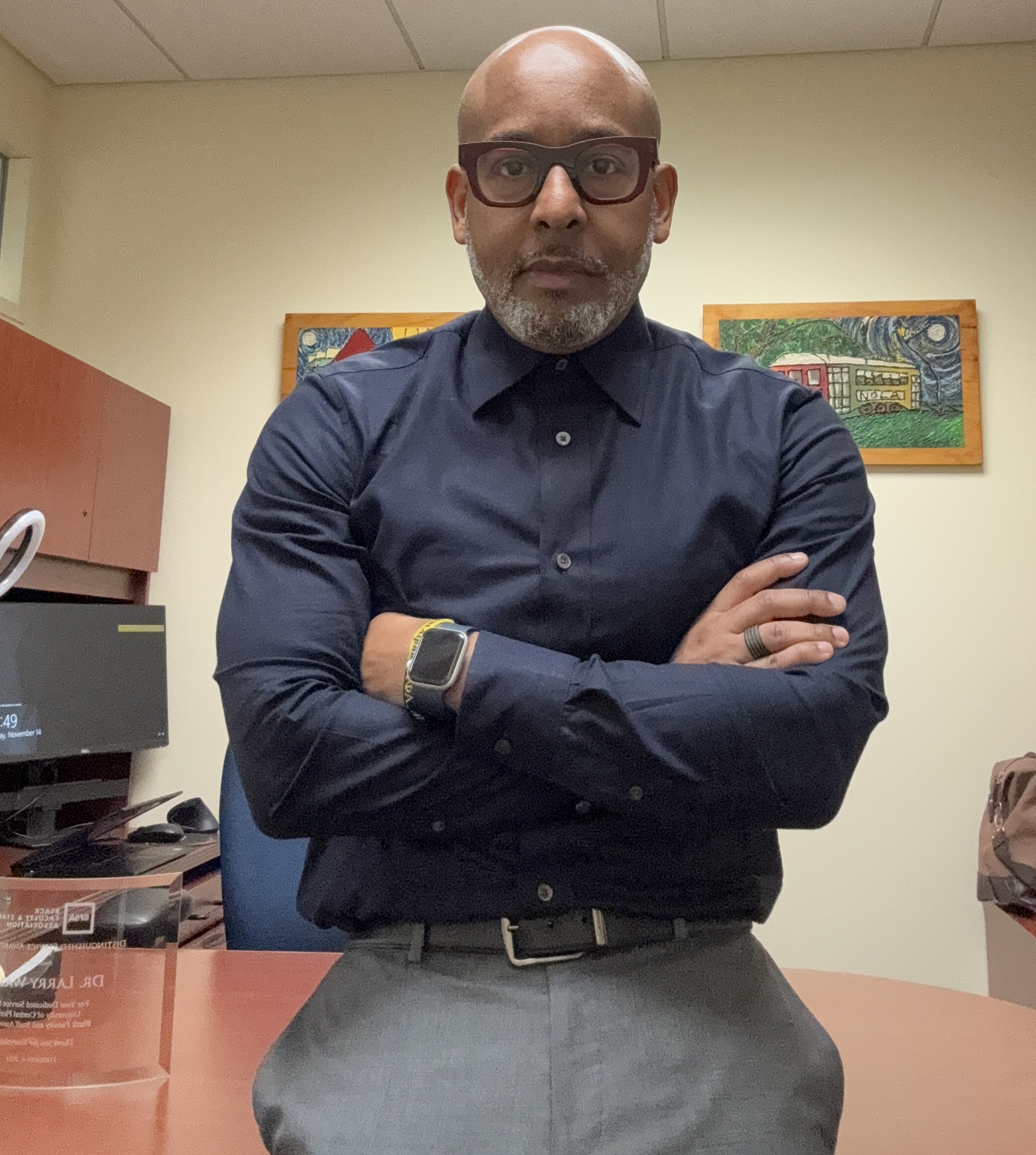
Dr. Larry J. Walker is an Associate Professor and Doctoral Program Coordinator at the University of Central Florida. Previously, he held faculty appointments at Howard University and Loyola University Maryland. His research focused on leadership, policy, and racism. In addition, he served as the Legislative Director for former Congressman Major R. Owens and selected as a Congressional Fellow with the Congressional Black Caucus Foundation. Dr. Walker is a political commentator who appears regularly on Roland Martin Unfiltered and Fox 35 Orlando. He has also appeared on Live NOW from Fox, Fox Business among other national and regional platforms.