


 Spotify

 iHeartRadio

 Apple Podcasts

 TuneIn

 Pandora

 Audible

 Amazon Music

 YouTube

 Castbox
Dr. Maylén Sullivan—(Re)envisioning world languages instruction for social engagement and change as the 2026 California Language Teacher of the Year
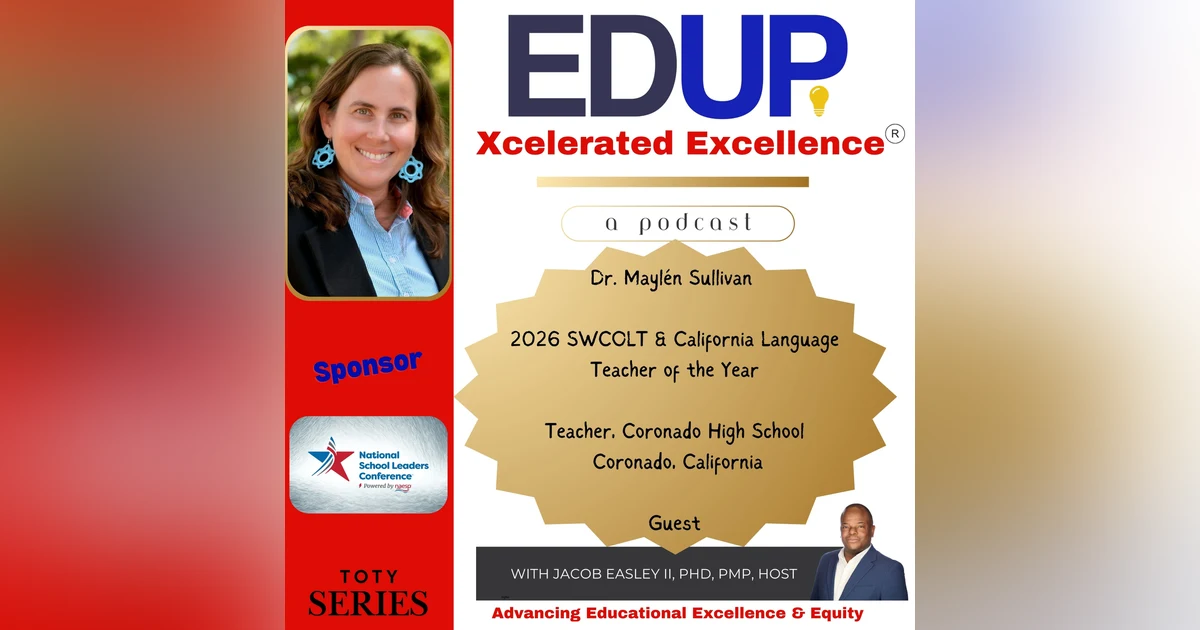
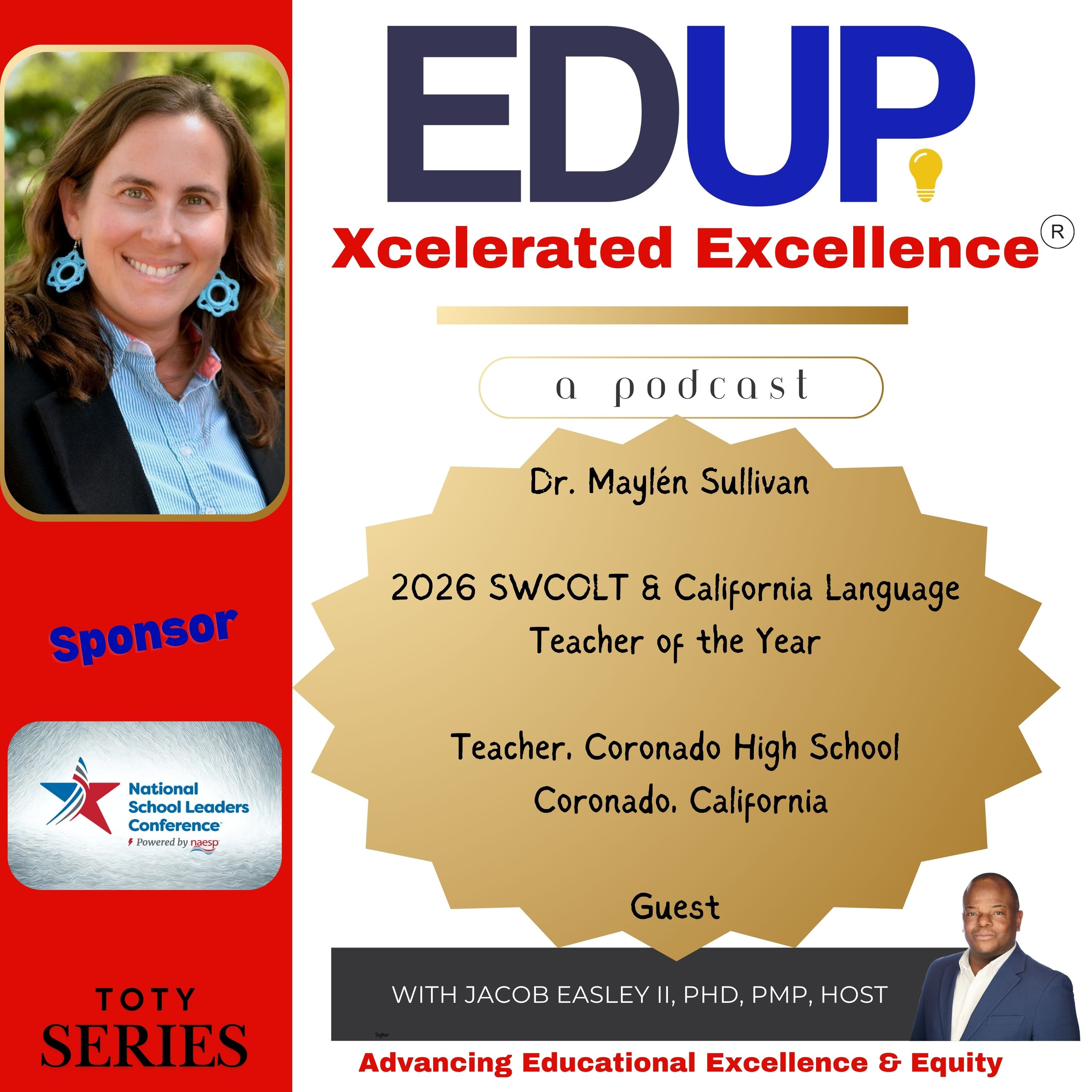
Our guest, Dr. Maylén R.R. Sullivan, is the 2026 SWCOLT and California Language Teacher of the Year. A passionate trilingual educator originally from Cuba, she serves as the Coronado Unified School District World Language Teacher on Special Assignment (ToSA), where she leads K-12 professional development and shapes the department's vision.
Sullivan believes language is a powerful vehicle for problem solving and civic engagement — empowering students to servetheir communities, contribute meaningfully to the world around them, and take action on issues that matter. Her instruction motivates students to connect with new cultures, analyze authentic texts, engage in high-level academic discussions, and use their linguistic skills to address real-world challenges.
Sullivan's work has significantly increased the number of students receiving the Seal of Biliteracy and earning travel scholarships. A Certified Leadership Coach with a PhD in Leadership Studies from the University of San Diego, Dr. Sullivan has 16 years of teaching experience and a decade of instructional leadership, facilitating workshops for educators locally and nationally.
Your Host: Jacob Easley II, PhD,PMP
Sponsor NAESP. National School LeadersConference–Powered by NAESP is designed for Pre-K–12 principals and assistant principals, featuring high-impact learning tracks, networking, and the newly added "Camp Lead-A-Lot" retreat. Held July 13-15, 2026, Orlando, FL, learn more and register at naespconferenence.org.
Resources:
CALanguage Teacher’s Association (CLTA)
Greeting: Dr. Rosa Rivera-McCutchen
Research Assistant: Emma Worthington
#EDUPXE #EDUCATIONALEXCELLENCE #EDUCATIONALEQUITY #TOTY#XEListeningTour
0:01 Yeah. So I think in in a world where it's becoming increasingly tech heavy with AI and everything, anyone could, you know, put on their headphone or whatever and converse with someone in another language, but through the intermediary of AI, it's absolutely not the same thing. So by learning another language, students learn lifelong skills like empathy. They learn how to recognize different perspectives, how to situate cultural perspectives in a certain context, how to understand why people do the things they do, how to empathize with the problems that are happening abroad. And learning how the solutions that are also being created abroad and how those solutions can then inform how we can take local action and national action in our own backyards. I'm a huge believer that we are all interconnected and with world languages.
0:55 As students learn about challenges abroad and what countries abroad are doing to solve those challenges, that can inspire them to take local action. This is where I bring in the civic engagement piece, which is very, very important to us. So we try to have at least one unit per year that engages the students in some sort of reflection and action. This is Doctor Rosa Rivera McCutcheon, author of Radical Care, Leading for Justice in Urban Schools, and you're listening to Add Up Accelerated Excellence. Welcome to the Add Up Accelerated Excellence podcast, and we would like to share an opportunity for educators to contribute to our XE Listening tour this week. Take time to listen to a community member regarding their educational excellence and equity experience because we believe that by listening, we unlock the engine for powerful educational transformation.
2:00 Share your insights via voicemail at Add Up xe.com and your comments may be shared on air with the podcast. That's the XE Listening Tour at edupxe.com. School Leaders this summer your leadership journey continues in Orlando. Join the National Association of Elementary School Principals for the National School Leaders Conference July 13th through 15th at Disney's Coronado Springs Resort. Connect with principals, assistant principals, and education leaders from across the country for powerful conversations, practical strategies, and inspiration you can take straight back to your school community for instructional leadership and school culture to Wellness and success.
2:53 This conference is designed for leaders at every stage. Learn more and register today at NAESP conference.org. That's NAESP conference.org. Welcome, welcome. Welcome to Add Up Accelerated Excellence, the podcast for the advancement of educational excellence and equity. And I am your host, Jacob Easley, the second PhD PMP. And today's guest is someone who's going to talk about a topic very near and dear to my heart, language learning, in particular, foreign language, having had my first job as a foreign language teacher in education, teaching high school in particular. So this just really warms my heart. Our guest is Mylan Sullivan, PhD. So, Mylan, will you please introduce yourself to the Ed Up Accelerated Excellence community, giving voice to your name as only you can, and tell us what is your classroom like now?
4:08 What can we if we were to peek our heads? And what will we see given that we're at the end of academic year? Yes, thank you so much, Jacob. Really appreciate you having me on. So my name is Mylan Sullivan, and I'm a world language teacher in Southern California, specifically in the Coronado Unified School District. And right now, you know, a spring kids are pretty tired and you know, everybody's like dying to get out of here, let's be honest. But if you were to peek into, for instance, my Spanish one classroom right now, what you would see is the students are engaged right now in a project where they're they're building a website for an ecotourism tour that from a place in the Spanish speaking country that they have selected.
4:53 So they're in groups of three. So they're working on reading authentic resources, gathering the research that they need to put their tour together. They're working on identifying actions that help the environment so that when we travel, we do our best to work with the local communities and help the environment and, you know, just conversations, journal entries and other forms of input around those types of topics. So I have to tell you that's a bit of a pressure. I have to tell you, I'm, I'm, I'm saying that because I'm thinking back to my first year teaching Spanish one O 1 in high school, just leaving college. My classroom did not look like that.
5:34 I was given a textbook and of course each textbook their chapters and the curriculum was essentially to follow so many chapters or 1 chapter more per week. So most of the focus was on grammar. So for your Spanish one class, are these advanced learners or are these this is the first Spanish course they've had? I'm given the type of assignment, so I'm wondering is the assignment in Spanish or is the assignment in English? Well, the project, the project task card usually is in English and we do that in English because, you know, we want to make sure they understand all the instructions and also if parents have questions about like what are my kids doing.
6:19 So the task card itself is written in English with, you know, a lot of Spanish in it as well. But the project that they're doing is in Spanish. We have a real mix of kids. We have kids who this is their first experience with Spanish and we have, you know, a few, maybe a handful of kids that they hear Spanish, but maybe they don't speak it very well. So those are all together. It's, you know, it's a mixed classroom and we are now almost at the end. So this is the second to last unit of the school year. So by now, most students have already reached the novice high level and many, I would say more than half are at intermediate low and then we have a handful that are already heading towards intermediate mid.
7:02 So I would say it's a real mix, but there is a lot of support in terms of the structure of the task card. There's a lot of center starters that are provided so that they know for all the different sections of the website what what could it sound like. In addition, I have provided them with a template, a fully developed website, which I made that's like a sample of what it could look like. So essentially they're taking the template they're reading and then they're going off and researching their own city or their own tour and changing the information. That's what they're doing. Wonderful, brilliant. And you know, I had to keep in mind that yes, you you did tell us at the beginning that this is the end of the year.
7:44 So this is a culminating project. So in my mind, I went straight to, as I mentioned that first year teacher hears the book. The book is the curriculum. So, Milan, you came to the US from Cuba at the age of 10, speaking no English. Can you take us back to that moment and what effect do you think that moment had on you as a learner and as well as as a future educator? Yeah. So it's such a great question. I mean, I think this is probably the pivotal moment that changed my life, immigrating from from Cuba to the US So I came and obviously I had 0 English. I probably just knew 1-2 and three, the three numbers. And at first it was really hard because I was like, Oh my God, I don't understand anything like this language is so hard. But one of the great assets that I had working for me is that I had very high literacy skills in Spanish. And you know, I always loved to read. I was a voracious reader.
8:47 So I started at the school library. Obviously I didn't understand anything, so I started with just children's books, very simple with just a few words. And then I started reading those. And then when I understood those, I went a little up, up, up up until by the end of 5th grade, I was reading Babysitters Club. And then on the other side of it as well, watching TV. I would watch so much TV in English with the English only subtitles, like the subtitles for the deaf so that I could figure out how is this language even spelled. And through hours and hours and hours of that, plus the books, plus the support in in my school, which the program that I was in started, I was like maybe half the day taking classes in Spanish like history and science, and half the day in the standard classroom.
9:40 They eventually phase me out so that by the end of the year, I was in the standard classroom basically 90% of the time. With those supports, with wonderful teachers, with a great family support, I was able to acquire the language. You know, that's interesting that you talk about it. Really it sounds like a dual language program that you were in with pull out services. We just interviewed the Arizona State Teacher of the Year who teaches special education and her program looks similar to that, where students who have Ieps or or individual education programs are sometimes pulled out of one classroom for one subject and and are moved to a different classroom for a different subject based on their level of proficiency and skills. And was it indeed a dual language program in your in your school?
10:31 I don't know to be honest, when they called it, but to me it felt like there were certain lessons and certain subjects that we would get pulled out for. And of course we had our ELD, we had an ELD classroom. We would get pulled out for that classroom maybe an hour or something a day. And then we would go back to the regular classroom with everybody else. And then the amount of time that we were pulled out would decrease as our English increased is what is what I understood. So I don't honestly know what that's called. I'm not sure. But you mentioned 2 points in that experience was I think we should probably highlight. One is you were already high proficient in your first language and two, you talked about or you mentioned learning outside of the classroom.
11:20 So listening to English programming list and, and using the closed caption. So, and I think that's a very important tool because I when usually when I travel and in the language that I may have some proficiency in, I find one way to, to really gear up on local language is by listening to television and honing in on commercials in particular and reading commercials on the billboards. Because the the language that they use often reflects everyday language that that is is somewhat universal within that context. Yeah, I couldn't agree more.
12:00 I just didn't even like seeing how things are spelled, understanding how the sounds connect to the print, the idioms, you know, I would watch like babysitters, clubs, you know, Full House everything, all those things. So, babysitters, that's a show. That's the book. That's the book. Sorry. That's a book, okay? Babysitters. The book Full House was the show and I had other ones. I had a bunch. Yeah, because you said full house. I it took me right to television side. And so Babysitters Club is is a series of books. Yes, it's the little novels. Excellent. SO you were named both the 2026 California Language Teachers Association of the Year teacher as well as the Southwest Conference Language Teacher of the Year. So that represents California specifically and then also a broader region.
13:01 Can you talk about the difference in these two and how profound is that the whole 2 awards at the same time? And are they and how are they related or interplay with one another? Yeah, that's a great question. So these awards are kind of all part of the national ACT Full Teacher of the Year program. So ACT Full Language Connects is our national language organization, language teaching for language teachers. And So what it is, is if you win at the state level, then you go to the regional level, which is Southwest cold. And Southwest Cold includes 9 states, So California, New Mexico, Arizona, Texas, I don't want to forget anyone, Nevada, Oklahoma, etcetera, I don't want to forget anyone. Hawaii as well.
13:50 So if you win at the, at the regional level for the 9th, in my case, it's nine states, then you go on to the national actual teacher of the year competition, which is then taking place in November. So in November, there will be five of us there sort of engaging in the national process for that, for that award. So this really isn't Gauntlet. What do you mean? So you, you go so there's a state and then you go from state, you have to compete at the inside of national, I mean, sorry, regional and then from regional you go to the national. So it's sort of like whitewater rafting where you're, you know, you're, you're headed down some of these really heavy terrains to get to whatever be the pinnacle, which would be the national or finishing the finish line and so to speak. Yes.
14:46 And, and no matter what, for anyone participating in this, being one of the state representatives or maybe regional or maybe even obviously one of the national finalists, it's a great honor to represent the the profession, win or lose. It's a great honor for your work to be highlighted. And you sort of like have the sense of like, wow, OK, maybe what I do have some value. Maybe I can help others and I can collaborate with teachers from all over the US, so. So in the prep in preparation for each of those levels, so there are three levels and you have achieved the award at the state and the and the regional levels. How do you get ready for each of those?
15:28 Is there are there different strategies for each level? And then I'm sort of double barreling these questions. But the next one is how impactful has this been for you and just preparing for the competition? That's a great question. And it's a little different per level. It, it's a little, it gets a little more complex in terms of the number of things you have to put together to participate in the competition. For the state level, you have to have one like a state outstanding teacher or outstanding teacher leader prior, so a year or two prior or anytime. So for that one, you are nominated by a colleague for your, you know, your accomplishments and your service to the profession and the things you've done.
16:12 So once you've won that one, then you can apply to become your state's teacher of the year. For the state Teacher of the Year application, there's like a small, small little essay and things you have to do and then an interview. So if you are selected for that one, then you have to put together a very substantial portfolio for the regional competition. And as you can imagine, a portfolio will include letters of recommendation, videos of you teaching, reflections, student work samples with more reflections and more reflections, more reflections after that. And you have to show evidence of your professional accomplishments. You know the how you've been engaged in leading others professionally, etcetera, etcetera. And then when you show up at the at the regional conference, you have an interview and you also have to give a 5 minute policy speech which has to be entirely memorized, no notes and obviously you know, written by you on a topic that you care about.
17:11 So I would say that's about 90%. Now as I head into the into the national competition, the portfolio is, as I said, 90% done. But there's a certain parts of it that need to be redone. Like you need a 20 minute teaching video versus a 10 minute 1 and you need now a 5 to 7 minute, 5 to 7 minute policy speech and so on, which may not necessarily be the same thing that you did before. It could be something different, right? So there's quite a lot of work. The value for me has been reflecting on my practice. It's always great to just really not just reflect, to be proud of everything you've done. That really helps, you know, I would also reflect to see what areas I still want to grow in. I sit things, things that I still want to learn about and I there was something else I was going to say. So the value I'm reflecting and it just also see in putting together the portfolio and gathering all the materials, you realize everything that you have done and it's sort of like gives you any appreciation and refreshes you in the teaching profession, which as you know, because you were a teacher, it's, it's very difficult and we, it's, it's hard to retain people.
18:29 It's hard to stay in the profession. So this processor of like has even like refreshed me even more, if that makes sense. Oh, it definitely makes sense. Those reflections in particular sounds similar to applying for the National Board Certification for Teachers. And I know in this idea of video yourself creating a new video reflecting on those, how have you brought your students along in this process and how have they responded to the idea that their teacher is an award-winning teacher? Well, I, I'm, I'm like literally so lucky because right now I have the, the Spanish one class that I have where I ended up doing my videos. They are literally the sweetest and they are so curious. I mean, I don't even have to tell them to like ask questions. They ask questions.
19:26 So it's, it's been really great to do the process with them. I let them know in advance, This is why I need to do it, you know, explain the rationale. You know, these are some of the things that I want to make sure that we're able to show the judges this and that and the other. And they're all like, we got you. We can do this and they're just the absolute sweetest. So you know, it's been great to to do that with them. And I think it's also been like, OK, guys, we really met. We really better make sure we show them that we are in the target language the whole time. So like, OK, we will try even harder to be in the target language and we will, you know, I, I did give them I, I do give them normally anyway, video or not, this yellow card. That has things that they can ask when they're confused or how to ask questions about the Spanish in Spanish so that that helps you know, so that they can think simple things like what does this mean?
20:20 Or can you slow down or can you repeat? So they should be able to do all that in Spanish using their yellow card. We're speaking with Doctor Mylan Sullivan, who is the 2026 SW Conference on Language Teaching and the California Language Teacher Association Teacher of the Year. So, Mylan, you represent the 1.4% of classroom teachers who hold a doctoral degree. This makes you part of what some might consider a an elite minority. And we're, you know, of course we're familiar with the expression representation counts. In your mind, what does representation matter in this regard?
21:02 Or how does it matter in this regard? That's a great question. Well, I think, I think what matters to me is that I always wanted to reach what I perceived to be as like the pinnacle of education, right? I always wanted to take it as far as I could go. And you know, as you know, PhD is a terminal degree. So I I was able to do that and. I I like how you're smiling. You're very modest about this. And you and I had a chance to speak a bit early and I, and I referred to you as as Doctor Sullivan. And I can tell that, you know, it, it made you feel a bit uncomfortable.
21:49 And, and so having been, I remember being a newly minted Dr. it was the strangest thing for someone to call you doctor anything because you're like, wait, who are you talking to? You know, you look behind you, really you're talking to me. But I, I just want to lift you up on that. So congratulations. Because that is no small feat. And as I, as I mentioned earlier, 1.4% of classroom teachers hold a terminal degree within their field. And it's in this case, I mean specifically a doctorate degree. So what does high quality language instruction look like across your classrooms? So you gave us an example from your Spanish one. And this is really in contrast to something you mentioned earlier that span that language learning is more than just a matter of engaging with worksheets and grammar drills. Yes.
22:38 Absolutely. Yes, Yes, yes. So in the past I've also taught French, for example, I mean, I've taught all levels in, in the different things, but in French 3, for instance, one of the really important threads in that class is French identity, one of the units that we do. And so we are very mindful throughout the whole French program. My my teaching partner and I, Alexandra, we're very mindful of making sure that students understand that France isn't just about, you know, the Eiffel Tower or baguettes or, you know, Paris or anything that we expose students to the wide richness of the French speaking world. All the different countries that, which speak it, we bring in during the our unit on identity.
23:22 Our essential question is what does it mean to be French? And we bring in a guest speaker from Algeria who's one of my friends. And so she talks to the students about her experiences moving to the US, all the different things that she has faced in her community. And she is currently fighting against discrimination against Muslim students in, in our, in our region. So wonderful, wonderful person. And we also engage the students in a project where they research and learn about a well known francophone, but from any country. And we encourage them to pick a variety of different people from different countries. And then so we sort of discuss and bring all these people's experiences that they learned about together and we dissect them and say, OK, this is what it means to be French. This is what this person's version it means of what it means to be French and so on.
24:14 And so weaving that thread of identity, social justice and diversity throughout the curriculum is something that has been really, really important with us in addition to the the civic engagement like the the ecotourism type thing that I was describing earlier. Oh, that's wonderful, Absolutely beautiful. Let's transition to business a bit because we know that you have to have a platform. And I don't know if you want to give too much of this away because you mentioned you had to have a policy position that you addressed. So if you can, as much as you can, share it with us today. What is your policy in brief or what is your position in brief around the value of world languages or language learning? Yeah.
25:04 So I think in in a world where it's becoming increasingly tech heavy with AI and everything, anyone could, you know, put on their headphone or whatever and converse with someone in another language, but through the intermediary of AI, it's absolutely not the same thing. So by learning another language, students learn lifelong skills like empathy. They learn how to recognize different perspectives, how to situate cultural perspectives in a certain context, how to understand why people do the things they do, how to empathize with the problems that are happening abroad, and learning how the solutions that are also being created abroad and how those solutions can then inform how we can take local action and national action in our own backyards.
25:51 I'm a huge believer that we are all interconnected and with world languages. As students learn about challenges abroad and what countries abroad are doing to solve those challenges, that can inspire them to take local action. This is where I bring in the civic engagement piece, which is very, very important to us. So we try to have at least one unit per year that engages the students in some sort of reflection and action on a civic project. And in your mind or what I'm going to say in your mind, but from your the evidence you've seen, how has that been transformative in language learning? So I think that a lot of the times, because languages has been taught traditionally in such a real manner of like, learn this chart, memorize these 20 words and then apply them, right?
26:46 A lot of the times, because languages has been taught like that, kids don't really understand the value of it. They don't see the why, like why should I learn this language? So bringing these ideas of diversity, equity, social justice, and civic engagement into the curriculum serve gives students a bigger why they should learn because through language they can make a difference. So language is a vehicle to solve problems. Language is a vehicle to serve the community and especially down here in in California, we have so many, obviously we have, so we live in a border town, so many Spanish speakers. Spanish of course is, is hugely important.
27:27 So I believe that it builds that greater Y that we've been missing. Yeah, I I agree with you and I think in some ways it is. It can really serve as an entree or the foyer foyer for folks to enter the world of others through language in a deeper and more passionate way and and in some ways it becomes part of their own world, particularly around language learning. Yeah. And then they change. What a wonderful adventure to be changed by language. So it's not like, you know, I have my world and their world and you know, now their world is a little bit part like the, the, the boundaries become more porous and so who I am now it's more expensive.
28:15 Right, right, right, right. I can I agree with you on that. So with that being said, what do you think of some of the misconceptions held broadly about language learning that you wish other educators and parents understood better? Yeah, that's a great question. I think 11 misconception is that students can't talk or discuss or learn about complex topics in level one in the earlier levels. And this is something that I feel very passionate about because we know that our students, especially if you're teaching secondary, our students are ready to think about complex topics.
29:00 I mean they're they're, you know, emerging adolescents where they're already adolescents. So they are ready to think about these topics and they know things about the world. They might not know them in Spanish, but they know things about the world and in their own languages and, you know, with their own language backgrounds. And so really in a Spanish wine classroom, yes, of course there's the basics that we need to teach and, and you know, whatever the community wants to learn with that. But we can also strive to create a curriculum which is really meaningful and scaffolded for the language so that we are giving them the linguistic tools they need to discuss the topics that they are interested in and that they should be discussing. So I think that's one one big misconception. Yeah, I, I think if, if, if I had to sum all of this up, this really is about connectivity.
29:54 So, and, and I'm thinking about that because it's a complete contrast. I have to say thank you for your approach to world languages and language teaching because it's, it's a radical shift from what has been the traditional norm. So I remember in high school, my, particularly my mother who had studied French, I was taking Spanish and I took two years of Spanish and one year of French. But there were two stories really quickly. One was when I wanted to take Spanish 2:00 and French. One, the school counselor told me that I, I could not because she thought that you're taking honors English, you're taking Spanish 2:00 and taking French one would be 3 languages. And I kept thinking to myself, I'm, I'm not learning English, honors English.
30:45 I think this was would have been 11th grade is literature. It's not you're not learning the language. So which, so that was 1 was a barrier, but then two, it was difficult to have folks in my community help me outside of the Spanish teacher or, or the French teacher themselves in school, because folks in my community who had taken foreign languages only knew basic grammar and this and, and some principles of, you know, I, I speak French, you speak French, they speak French, we speak French. That was the extent of it. They couldn't remember the fundamentals beyond this idea of just translating a verb.
31:28 So I appreciate the approach that you're taking because it really is about connect. Connectivity both to the world, but for the student to connect to aspects of the language that are important to them as as is reflective of their own real day-to-day lives and thoughts about the world in general. Thank you for listening to the Ed Up Accelerated Excellence Podcast, and we would like to share an opportunity for educators to contribute to our XE Listening tour this week. Take time to listen to a community member regarding their educational excellence and equity experience because we believe that by listening, we unlock the engine for powerful educational transformation. Share your insights via voicemail at Ed Up xe.com, and your comments may be shared on air with the podcast. That's the XE listening.
32:20 Torrid, Ed. Up xe.com. Have you ever felt like everyone else in education has their people, their network, their place to grow, and you're still searching for yours? The National School Leaders Conference, powered by the National Association of Elementary School Principals, is where school leaders come together to reconnect with their purpose, to find fresh inspiration and remember they're not doing this work alone. This July 13th through 15th in Orlando, you'll hear real stories, learn practical strategies, and build relationships with leaders who truly understand the challenges and joys of this profession. Whether you're an aspiring leader or ready to lead a school community, this experience is designed to help you grow, recharge, and lead forward with confidence. Learn more at NAESP conference.org. That's NAESP conference.org.
33:44 So you talked about also not just in your classroom, but this idea of study abroad and the importance of removing financial barriers for study abroad. Why is access to Study Abroad Act opportunities important from your perspective and and what impact have you seen when students have the opportunity to study abroad? Yeah, absolutely. This is an area that I'm actually really passionate about, so I'm glad you're asking. So I mean, when you think about it, I mean, unless there there are some students that have access to travel and they travel a lot with their parents and that's fine.
34:24 But unless you have access to that, I would say the vast majority of high school students don't have the opportunity to study abroad. And if you, if, if all of us listening right now could just picture their first time, you know, if, if they have their first time traveling to another country and being in a culture and trying to like, understand what's going on and we're just really immersing themselves, you could probably think it was probably one of the most powerful learning experiences of your life, right? So I think that the younger that we can provide students the ability to do that, the better. So in, in the high school, we, we work on students applying for travel scholarships through CIEE and we get the students going to study languages to study, you know, STEM, robotics, business, art, culture, a bunch of different things, whatever they're interested in.
35:14 And honestly, they come back 100% more confident. Well, one of my students said 300% more confident Oak. Ferry then. And they left because, well, it's just they have to be on their own. They have to figure things out. Yes, they have a lot of support, so you know they're not going to fail and that, you know, nothing's bad is going to happen. But they have to figure out how to be on their own 2 feet, how to ask for help. They connect with people who are native speakers of the language, who are teaching them the language. Then they go out into the community and they actually go to a restaurant and they order in the language and they do all these wonderful things that really also help them grow their intercultural skill set.
35:58 I think it's a wonderful opportunity that should be accessible to everyone. So if you're a multimillionaire listening, please donate to Students Study Abroad. Students study abroad. There you go. I mean, there you go folks, you have there's your challenge and one way to engage definitely by supporting on that, that this program and an opportunity or one way to support the programming opportunity for students, students to study abroad for sure. Thank you for that. I'm going to ask you to dream a bit, if you will. So imagine you were to design a program, a world language program. You can choose your language from the ground U. What would be the three to five core components or attributes? I think 1 component would be like the task based, project based approach where students have to use the language to do something with it because it helps the students own it. You know, it's not, they're not just like we're not just opening the brain and pouring in language and then they can verbalize it.
37:02 They have to do something with the language they have to create. So I think that would be 1 component. Now that we're on the topic, the second component would be study abroad for everyone. It would have to be, you know, it would have to be part of it. Another component I think would be really amazing to get the latest and best AI tech, AI tech tools to help students, to monitor the students progress and their growth in proficiency and to just provide rich and varied feedback like, you know, minute by minute to really accelerate their language acquisition. Another component would be perhaps access to and a way to help the students build clubs or community groups where they're practicing the language with people on a on a clear basis. And then my final component would probably be one this has been really fun to think about, but one that I would take away. I would take away grades because I do think that now I wouldn't take away assessment and knowing where they are, but I, I would definitely take away grades because I think that they get in the way of true learning and true curiosity for many kids. But you know.
38:18 OK, I'm laughing now externally because I'm going to give you some insights into a recent situation, which is definitely, and I use grades as an example. I was evaluating a staff member so the person had competed in their self evaluation, but I had to give my evaluation and of course the the ranking went. I think I don't know what was at the bottom, but meets expectations, exceeds expectations in one is sort of in the some ways super exceeds and there was some few descriptions of tasks and roles for each area, but there were no metrics of quality to define meets exceeds or super exceeds.
39:03 And so we had this discussion because of course, overall the evaluation was fine. But for some of the metrics, I would, I was told last year I got this level and I said, here's the issue with these levels is there's no sort of qualitative or descriptive language around each of the levels so that we can have a common conversation. So overall it means great. So their interpretation was meet is a grade of C and I said, actually, I don't interpret it as grades. So to me it's, it's a quality, but not necessarily a grade. And I said, so this is one of the errors, one of the shortfalls of the current evaluation system when we don't have clear metrics because it's still so subjective. So you're absolutely right about this idea of grades, because grades mean certain things to different people. Yeah.
40:05 Oh, I was going to say to follow up on what you said. You know by not having clear metrics like you don't have a clear rubric, is that what you mean, right? And and it's rubric. Yeah, even the script of rubrics can be biased and can be not, not fully. In other words, in order for the rubric to work, you have to calibrate it. You have to celebrate it with your peers. You have to have evidence. OK, This is what meets looks like. This is what we're looking for and this is where I think a lot of these hopefully new AI programs and dashboards that are being built to help accompany students in their language acquisition journey where they can really help us make this a lot easier. Right.
40:49 So you think about this on the instrumentation of development of instrument. So from my perspective, valid, reliable and bias free. And so getting and getting to those 3 levels, you're absolutely right, requires community and requires requires calibration and it has to make sense not only for the developers, but ultimately has to make sense for the users who are the students. So that when you mark someone on this at any level, just the marking by itself, there's enough descriptive and descriptive language and clarity in the language and and the examples that serves as a form of feedback.
41:33 And and students should readily agree if they're honest with their assessment that the outcome, if it's now valid in terms of integrated reliability in this in this regard, who's rating it? It's also rating it rating the student properly. And and that brings me to the point, I, I did want to add a fifth one then or a 6th 1. I don't know which one. That is that students should have the opportunity to reflect on their growth self-assessment portfolios. I think these are great tools as well to have in the Dream World language program. I agree with you, definitely. That almost sounds like in some ways your application for your state and regional awards.
42:19 So what advice would you give to folks who might be interested in foreign language teaching in particular? So teachers, what would you say to them that would attract them to the profession? And again, since we have been double barreling your questions, the second part of that would be what would you say to school administrators and policy makers? What needs to happen to keep those folks in the classroom? So the first question is what I would say to them is, well, do it if you're interested in it, right? If you're not interested in it, I would never force you to do something you're not interested in. But if you're even, you know, remotely interested in languages, you love, the idea of helping young people grow and acquire another language, and essentially you're changing their lives because language is a new language changes your life.
43:13 I would say it's one of the most rewarding careers that one could ever have, seeing the growth in young people. So that is so, so worth it. And seeing the difference that you have that, you know, I have students still contact me years after like, you know, telling me what they ended up doing with their careers and how I impacted them, etcetera, etcetera. It's so wonderful to see that what you do makes a real difference in society. So that's number one. And #2 for policymakers, we have some, some real obstacles that we need to solve. You know, the salaries and I know I, I'm at the opposite end of the pay skill now with a PhD and everything, but teacher salaries are not anywhere near worth what teachers are worth. So double it, triplet, quadruplet, quintuplet. I don't know.
44:00 We need better salaries. And then we also need better systems of support within school districts, which I know can be really every school districts very different. We need better systems of support to keep those teachers in, to keep them invested in their growth, to keep, you know, having coaches and planning partners and collaborative partners and people to bounce ideas off of because teaching can be a very isolating career. But by building all these networks of support, systems of support, teachers will stay. If you are satisfied, if you feel that you are growing and you are continuing to make a difference, they will stay. Well, well stated indeed. So, Doctor Minor Sullivan, I have absolutely appreciated this opportunity to learn with and from you. But before we end, I had to ask what is next for you either at your school level?
44:56 I know you, you will be competing in the National Language teacher competition, 5 of you. Is that correct? In November? You're currently hold the Southwestern Regional Language Teaching Award for for 2026 as well as the California State Language Teachers Association award. So the award is coming next in in November, but what else is next to you and how might the add up Accelerated Excellence community engage? Yeah. So what's next? I've got a couple conferences coming up this summer. I have the ATDLE conference in San Diego, which is for dual language education.
45:40 So come check it out if you'll be here mid mid June. And then I have the the World Languages Summer Seminar. I definitely want to plug this event. It's for any world language teacher across the US and we've even had people from abroad, from abroad sign up and come to beautiful, sunny Santa Barbara in mid to late July for five days for an intensive experience where you can sign up. There's a number of different workshops. There's workshops for Japanese, Chinese teachers, Spanish teachers. I will be teaching the Spanish Teachers strand with my friend and dear colleague Michael Silva, also a long time veteran educator in the San Francisco Bay Area. So definitely if you're interested in growing your professional practices, updating your your skill set with the latest frameworks, with the latest standards, the the World Languages Summer Seminar in Santa Barbara is the place to be.
46:34 And in terms of how people can keep in touch with me, I'm pretty active on LinkedIn. So you can just look for me and my name on LinkedIn. So we would definitely add those to the show notes. And again, I want to thank you for this opportunity to learn with and from you here at Add Up, Accelerate Excellence as we seek to advance educational excellence and equity. It was a real pleasure talking to you, Jacob. We've. Enjoyed it, thank you so much. Thank you for engaging with ET UP Accelerated Excellence, a member of the ET UP Experience network of educational podcasts, and we encourage you to participate in our XE Listening Tour by listening to the educational stories of others and sharing your thoughts with us at EDUP. xe.com school leaders join us at the National Association of Elementary School Principals conference in Orlando, FL, July 13th through 15th.
47:33 Learn more and register at NAESP conference.org. You can find this and other episodes on Spotify, iHeartRadio, Apple Radio, YouTube, and other outlets where you listen to your favorite podcast. If you like this episode, don't forget to follow us and share within your network. To leave a comment or suggest a guest, contact us online at EDUP xe.com a special. Thanks to our research assistant, Emma Worthington, APHD student of Fordham University School Psychology program, and we want to hear from you. If you have feedback on this or other episodes or would like to nominate a guest, contact us online at EDUP xe.com, where you can leave an e-mail or a voice message.
48:16 That's at UP xe.com.

World Languages Teacher
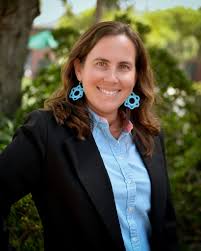
Dr. Maylén R.R. Sullivan is the 2026 SWCOLT and California Language Teacher of the Year. A passionate trilingual educator originally from Cuba, she serves as the Coronado Unified School District World Language Teacher on Special Assignment (ToSA), where she leads K-12 professional development and shapes the department's vision. Sullivan believes language is a powerful vehicle for problem solving and civic engagement — empowering students to serve their communities, contribute meaningfully to the world around them, and take action on issues that matter. Her instruction motivates students to connect with new cultures, analyze authentic texts, engage in high-level academic discussions, and use their linguistic skills to address real-world challenges. Sullivan's work has significantly increased the number of students receiving the Seal of Biliteracy and earning travel scholarships. A Certified Leadership Coach with a PhD in Leadership Studies from the University of San Diego, Dr. Sullivan has 16 years of teaching experience and a decade of instructional leadership, facilitating workshops for educators locally and nationally.