


 Spotify

 iHeartRadio

 Apple Podcasts

 TuneIn

 Pandora

 Audible

 Amazon Music

 YouTube

 Castbox
Prince Johnson—NYTOTY2026: Championing Sustainability, Civics Education, Career and Technical Education (Part 1of 2)
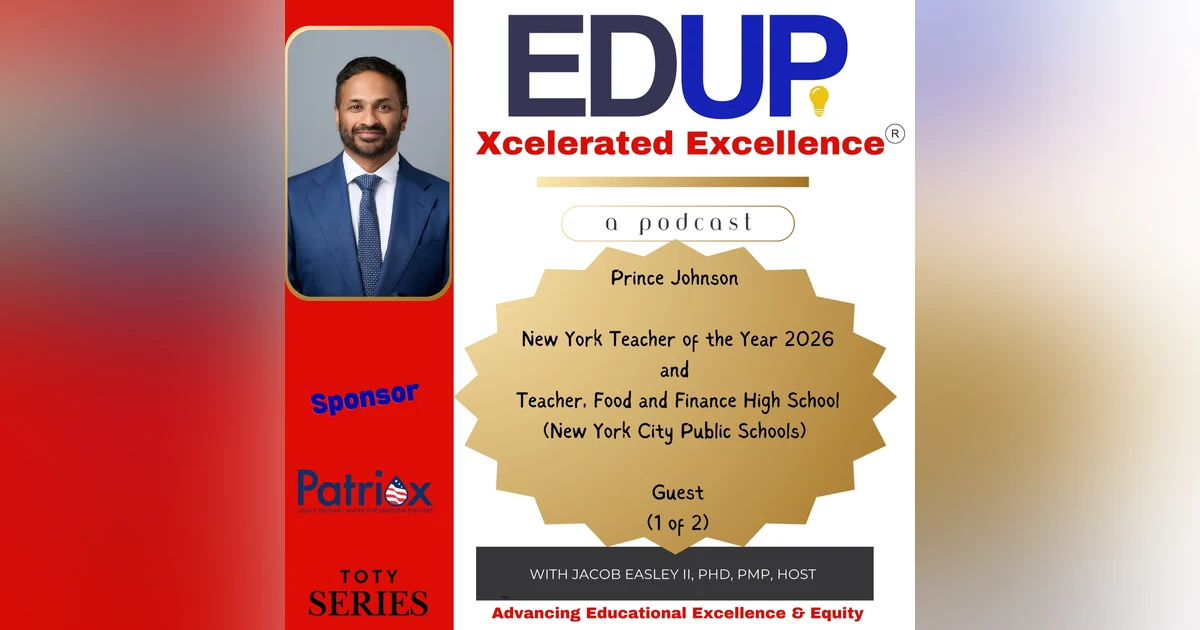

Our Guest, Prince Johnson, a 26-year veteran educator, is the 2026 New York State Teacher of the Year as well as the 2025 Gilder Lehrman New York History Teacher of the Year. A passionate advocate for career and technical education (CTE) and a leader in sustainability, he teaches social studies at Food and Finance High School in New York City and serves on the NYCPS Climate Education Leadership Team.
His drive as an educator was shaped by the injustices he observed while teaching on Rikers Island. Today, he develops cross-curricular projects that unite history, culinary arts, and environmental stewardship. He encourages students to apply their skills and voices to create stronger, more equitable communities, always with the goal of empowering every student to realize their full potential.
Your Host: Jacob Easley II, PhD, PMP
Sponsor: Patriox oxygenated water.Drinking Patriox helps oxygenate the body, promoting overall health, energy, and vitality. Receive a 10% discount on your next purchase with the code EDUPXE.
Resources:
Greeting: Anna Young
Research Assistant: Emma Worthington
#EDUPXE #EDUCATIONALEXCELLENCE #EDUCATIONALEQUITY #XEListeningTour
0:04 We can even write papers about your, you know, create a hypothesis and write about it. But action, right it is, is so essential to education. It's not enough to just teach the history or, you know, have students engaged in in writing and, and, and, you know, really critical thought, but actually engaging in that. And so I started to focus on. So we started taking trips while we went to Williamsburg, Brooklyn, where gentrification and red lining can be seen. We went to sewage facilities near Newtown Creek in Queens. And even though their own neighborhood students started taking a look at the cultural landscape, the physical landscape of their neighborhoods, how it was built, what kind of stores they have, what kind of where the lack of supermarkets, right, or where the garbage dumps are with how often the garbage is picked up. So we started really analyzing that, taking that data, and then seeing what we could do.
1:21 Hi, I'm Anna Young from Sunnyside Literacy Lab and you're listening to the Add Up Accelerated Excellence podcast. Are you listening? Listening is more than just hearing. It's the engine of transformation. When leaders truly listen, they unlock hidden insights and spark meaningful change. The power of listening turns quiet voices into catalysts for educational excellence and equity. That's why we've launched the XE Listening Tour, a journey dedicated to amplifying every voice, especially those least heard from this week. Seek out and listen to a quiet voice, a student, a colleague, or parent.
2:14 Let us know what you learned about educational excellence or equity from their story, and record your experience and insights via voicemail at Add Up xe.com. Your contribution may be featured on this podcast. Are you listening? We are join the XE listening tour at Add Up xe.com. This episode is supported in part by Patriarchs. Ultra high oxygen content water drinking. Patriarchs helps oxygenate the body, promoting overall health, energy and vitality.
2:56 In 2026. Try Patriarchs on your journey for accelerated Excellence. Receive a 10% discount on your next purchase with the code Add Up XE. That's 10% off with the code Add Up XE at Patriarchs dot US. Patriarchs dot US. Find more details in the show notes. Welcome, welcome, welcome to Add Up Accelerated Excellence, the podcast for the advancement of educational excellence and equity.
3:36 Today's guest is the accomplished 2026 New York State Teacher of the Year and the 2025 by Gilda Lemur, New York History Teacher of the Year, Prince Johnson Prince, welcome to add up accelerated excellence. And if you would, I know you've been on the on the on sort of the circuit talking about your agenda as the New York State teacher of the year. Could you just introduce yourself to the Add Up Accelerated excellence community, giving voice to your name, and give us that high level campaign of what is the argument you're making as the New York State 2026 Teacher of the Year? Well, thank you Jacob, for having me. Yes, my name is Prince Johnson.
4:33 I am the 2026 New York State Teacher of the Year. And as of since January, I've been going around the state representing the state to uplift this community and uplift the profession and public education across the state and also nashing. And what we are expected to do is to share what makes us unique as teachers of the year. And for me, I teach at a culinary high school. I am also very much involved in sustainability, but I am a social studies teacher. And so I find the Nexus between these three worlds, between sustainability, career and technical education and civics. And what I'm finding is there are various connections between the three.
5:30 And then the country needs to move forward, the state needs to move forward for developing ways which connect these different worlds, to uplift the whole, the whole country and to create opportunity for students and adults of them. So Prince, thank you for that. I want to take you back a bit. So just imagine your classroom. What was the reaction of your students when they found out that you were the 2026 Teacher of the Year? Just just just paint a picture for us. What was that moment like for your students? So they actually, I found out in July, but they knew I was competing in May and June and they worked. I was teaching AP Human Geography at the time and we were, I was in the third round of the competition for New York State Teacher of the Year.
6:28 There are 4 rounds and the third round was actually former New York State Teacher of the Year is actually observing you coming to the classroom, talking to different stakeholders. And so my students worked very hard to try to say all the right things. We actually had a fiscal debate about gentrification in Williamsburg, Brooklyn, and it touches deeply for my students who are primarily from minority communities who are being pushed out of their communities. And so they definitely had a perspective during the debate, but when they found out that I won and that technically they only found out in September. So it was supposed to be a secret till September 9th when I gave my official speech.
7:17 But when I came back to school, it was to a heroes welcome I and then you just realize how much impact students make on your life. But also, you know, we don't always get as teachers these awards and these, these pieces of praise that we always kind of live for. But that moment I'll never, I'll never forget just classes and classes of students just really being happy for me. And, and, and, and it hasn't stopped, right?
7:59 Every time these kids and I, I don't have the same students that I taught last year now, but every time I see them and anybody from my school, they're just really, they're just really supportive and it just tells the unique relationship teachers have on students and vice versa. Yeah, yeah, I can definitely imagine that all the records that probably ensued and that sense of pride that the students probably have. Have you seen perhaps since the notification, a difference in how students walk into your classrooms? Are they proud to to study with the New York State Teacher of the Year? I'd say so.
8:46 I think there is, I think the award wasn't just for me, but for my students, and they feel really proud to say that they had this teacher, right, who has this award? Parents during parent teacher conference, our first one brought up to me multiple times. They're just really happy for me and that their child is in my class. So it's truly special for the whole school community. It really is, whether the kids have me or not. Indeed, indeed. I'm so glad that the parents got in on some of that joy. So, Prince, let's go back a bit.
9:30 You and I had the fortunate opportunity to meet at a state conference, but since then, we've had a few conversations that I knew I had to get you on the show. So this is also a first for you. This is your first podcast ever. Yay. So, so excited. That you have entrusted and up accelerated excellence, but you talked about you had some struggles as a as a young learner. Do you mind sharing that story with us of your struggles and how those struggles and have impacted you as an educator today? Well. Sure. So my family is a family of immigrants from India.
10:13 They came to this country for opportunities. And you know, a lot of ways as many, I, I feel, I see this pattern often. Many immigrant parents trust the educational system to take care of their child, right? They're, they're, they're coming to this space where it's different than the educational system that we have, at least in India. And, and so they trust the teachers and administrators wholeheartedly. And for years, I really struggled in class. I did not enjoy being in school. I always shield away from being the center of attention because I really didn't understand what was going on. And then around 6th grade, actually 6th grade, I had this fantastic teacher, my favorite teacher of all time, Miss Alexander from Hillside grade School in New Hyde Park. And she just sat down with me one day and just really had a one for one conversation.
11:19 I'm hard to work and, and obviously she noticed, you know, and that was hard for me because I was the one trying to hide, you know, all the time and she wouldn't let me And she really got to know me and she realized I had a learning, learning difficulties. And and so she ended up getting intervention for me, you know, with my speech, with my writing, with my various learning disabilities. And I started really blossoming and enjoying school.
12:03 And from that point on, I realized how important teachers are. And I still like truly, it's like I have to like keep the emotion down. But every time I've said this the story a few times, obviously, but every time I I talk about Miss Alexander, it still brings emotion to my my throat and my voice because she really didn't make an impact in my life. So listen, shout out to Miss Alexander, if you're listening to this. Thank you for thank you for this remarkable moment in which a student now teacher of the year can, can look back and say, I felt seen.
12:49 And how powerful that is, not only for Prince, but for any student. So Prince, when did teaching become the dream? So what were those conditions? That's interesting. So it wasn't a right of way kind of situation for me. So within my community, I think my parents really pushed me toward a different path. And so that's the path I went. So I ended up going to Stony Brook University as a pre Med for a focus. I was taking a lot of science and math courses, but my love is always history. But that really didn't seem like a reality. And so, and I didn't want to disappoint my parents. However, eventually I I did have my best friend was my roommate. And he was, yeah.
13:50 His name is Sergeant James. He's actually a New York City teacher, also social studies. And he showed me, you know, between semesters, he showed me what courses he filled out for you. Now you'd get to choose your courses. And this is about junior year, actually. And I looked at the courses and he was taking an introduction, introduction to education, you know, like the the intro pedagogy, right? And and also all these history courses. And I said to him, man, I wish I could take these courses. Yeah, they sound so much. They sound so much fun, you know, and so far. And he said, why don't you?
14:31 And he knew my background and and you know, I told him, you know why? But at that moment, it was the Ahama, right? It was that moment really was a trend. And actually, I got to go back to Stony Brook and go to the exact location in the library where that happened. Yeah, it's Stony Brook Library. So it was huge, massive library. It was on the 1st floor in a passing area. And I still remember that. I mean, so vivid to me that. And then I filled out the exact courses he had. We took all the courses together. I really enjoyed it.
15:12 And I ended up teaching a lesson. We had to teach a lesson in that intercourse. And they, Oh my God, the way the other students reacted to my lesson, you know, like literally applause at the end. And at that point, I knew I could do this. I, I didn't know what I was getting myself into at that point. I thought, you know what, maybe maybe this was God's called him for, you know, maybe this was my calling to, to follow the spout. And, and you know, in India, I have some great uncles who were head masters, you call them, you know, it's like the British, this stuff.
16:00 We have head masters, you know, so it is in my you can say my blood to be even though everybody in my family here are in the health professions, there's not one person outside the health professions. They accept me. So I'm kind of like I am the black sheep. So it only took about 26 years for my parents to kind of accept after this, this award that I am a teacher and you know, and it's OK, it's OK to be a chief. Well, you know that that's a very strong commentary. Imagine here's your passion, but you're being directed socially even on this case family.
16:41 But we often see that time that that we also see that often cases with sort of larger social norms, whether it be a matter of which professions either are likely to yield more income or or community status, so on and so forth. But there's nothing better than finding, as you mentioned, your passion and being able to live out your dream every day to have a positive impact on students in this case, but also to get paid for it. Yes. And, and kudos, I'm glad that now the validation has has come from your familiar familial community.
17:31 So you're teaching history in a career and technical school. How do you find the way to, as you mentioned earlier, bridge the intersection between about civics, CTE, and sustainability through history? Right, yes. So originally for years I taught thinking, you know, history is the most important subject. This is my class. And I think a lot of most of us think whatever we're teaching is the most important subject, right? And I always say, I think history is really important for students to understand civics and to be engaged in their community. And I taught like that even when I ended up at food and finance high school.
18:18 And I and I was there realizing that I was in a silo. Everybody's in the silo. We're all teaching separately. And I remember hearing this quote. You know, why be a star when you can be a constellation, right? Why be a star when you can be a constellation? And if that's just a thought about working with others, you know, like we have all these great teachers working separately, but if we actually engage with each other, we'll get more done and the education would be more enriching for our students and more engaging, right. And I realized not every kid loves history coming into my class. Maybe I'm hoping that after the afterwards they love it, but I but they came to our school because they love cuisine. They love to cook, they love to bake. And I realized, you know, why fight against it? Why go against the stream?
19:17 Why not learn what's going on in the kitchens? And so I went into the kitchens. I started observing the chefs and the bait instructors. We have some rock stars, rock star chef instructors. And going into those cases, I saw the same kids who were struggling in my class really being leaders and, you know, being on top of the game in the kitchens. And it really gave me a better outlook on children. And one of the things I do believe in is that you really need to get to know your students first. Get to know their likes and dislikes, who they are, their family.
20:04 Before you can actually engage in teaching, you need to get to know them. And so I got to know them in the kitchen. And then I started to create projects that integrated culinary with history. So if I'm teaching about India, we're making butter chicken in the in the kitchen, right? If we're, if we're learning about the French Revolution, it's going to be a lot of, you know, mother sauces and, and croissants, right? It's so it's the kids started really hating coming into my classroom. They were, oh, you know, they wanted to understand the history part of it. Then what I started to realize is that our students are facing and the city and I think the country is facing a lot of issues that have been built historically into our country.
20:56 I you know, a lot of people call it environmental racism where most of us know about redlining right back in the in the 40s and 50s, communities were marked out by banks and certain areas weren't giving out loans. Some were. But those same areas, if you over overlay the red lined areas with the areas that have garbage shops where garbage trucks are and sewage treatment facilities are placed, they almost always are placed in these formerly red lined areas. And so even though the practice of redlining is gone, all the legacy is still there. And so if you could drive through the Bronx, right, I-95, we got asthma alley.
21:44 I mean, literally that highway cut right through communities of color, destroyed and divided communities. But the let that's one legacy. But the second legacy is there's high rates of asthma and longevity numbers are lower for anybody who lives around that area. And that's true across the state. You can go to Rochester or Buffalo, Albany, and you can go across the country. I mean, this is the legacy that many communities of color are still living. And so I wanted to understand how what I can do, you know, like, I don't like the idea that, you know, I'm just teaching this course and we can even write papers about your, you know, create a hypothesis and write about it.
22:30 But action, right. It is, is so essential to education. It's not enough to just teach the history or, you know, have students engaged in, in writing and, and, and, you know, really critical thought, but actually engaging in that. And so I started to focus on. So we started taking trips while we went to Williamsburg, Brooklyn, where gentrification and redlining can be seen. We went to sewage facilities near Newtown Creek in Queens. And even though their own neighborhood students started taking a look at the cultural landscape, the physical landscape of their neighborhoods, how it was built, what kind of stores they have, what kind of where the lack of supermarkets, right, or where the garbage dumps are with how often the garbage is picked up. So we started really analyzing that, taking that data and then seeing what we can do about.
23:29 And one of the things I realized is, is a lot of the garbage we waste even in our kitchen is in our, you know, I teach at a culinary school. So we throw away food, we throw away ends and butts, right of that we don't use in the kitchen. And then in the actual cafeteria, a lot of food is wasted. And that food is ended up ending up in garbage that's picked up in garbage trucks that are driving through and eventually parking in communities of color. And so it's creating a high amount of pollution. And so I thought, hey, why don't we find a way to reducing this was can we divert any of this waste away from garbage dumps and away from getting picked up so that we would have less trucks driving through these communities, right? At least less often?
24:20 Because I mean, the idea would be, hey, it'd be great if you could just move these facilities somewhere else. But then there's this nimity idea, right? Not in my backyard, right? Who who wants a garbage, who wants to waste that waste facility in their backyard? So if we can't move those, and if anybody who's known New York City, there's so much red tape and bureaucracy, stakeholders pulling in different directions. So I thought, hey, why don't we find a way to reduce food waste? And so when I, when I brought those three things together where we got the career and technical education right, How can we learn sustainable approaches in the kitchen and not just for culinary.
25:06 At this point in New York State, I am really an advocate for career and technical education. I, I believe students shouldn't graduate with, not just with dual education, both the academics and with certifications, but I want them to graduate not just with certifications, but to understand whatever industry they're going into, right? They can go into carpentry, construction, you know, whatever they're going into, obviously culinary, how can it, how can they promote sustainable approaches to that? And so these are young individuals right now, they're not in the industry, but once they join the industry, they can bring these new approaches and then these and new approaches can proliferate and hopefully reduce sustainable, the waste that we're creating and creating and then create better opportunities and, and health conditions for their, their communities. And that's why right now, currently I'm taking courses at MIT just to learn industrial sustainability, you know, like it's a sustainability, it's a sustainability course work that I'm taking, but it's, it's really outside my framework of education or even of civics.
26:26 And sometimes I feel out of the depth, depth actually, I'm deep in the, in the ocean sometimes taking these courses. But it's, it's amazing that the, the students that I'm meeting who are in sustainability all over the world, you know, they're, they're literally the, the chief environmental officer of, of various organizations in Dubai and obviously New York and California and all over the world. And we're sitting in these Zoom courses, zoom classes together and we meet offline and, and I learned so much about the practices they're doing. And, and I'm hoping to turn key some of that in New York City. And obviously I'm on a local level in my classroom and in my building.
27:11 I'm hoping that whatever I'm doing is scalable so that hopefully it passes to all public schools. So currently I'm on the New York City Climate Education leadership Team and, and that that committee helps advocate for sustainable approaches. And actually only last week actually the Board of Regents voted to make sustainability a part of mandatory requirement in state schools, public schools. And so the work is happening, the changes are happening, and I hope to be at the forefront. This episode is supported in part by Patriarchs. Ultra high oxygen content water drinking. Patriarchs helps oxygenate the body, promoting overall health, energy and vitality.
28:10 In 2026. Try Patriarchs on your journey for accelerated Excellence. Receive a 10% discount on your next purchase with the code Add Up XE. That's 10% off with the Code Add Up XE at Patriarchs dot US. Patriarchs dot US. Find more details in the show notes. Listen. Are you listening? Listening is more than hearing. It's the engine of transformation. When leaders truly listen, they unlock hidden insights and spark meaningful change. The power of listening turns quiet voices into catalysts for educational excellence and equity. We've launched the XE Listening Tour, a journey dedicated to amplifying every voice, especially those least heard from.
29:09 And we want to hear from you. This week, seek out a voice least heard from a community member, a parent, or a student. Let us know what you learn about educational excellence or equity from their story and record your voicemail at edupxe.com. Your contribution may be featured on this podcast. Are you listening? We are join the XE listening tour at add up xe.com. We're speaking with Prince Johnson, who is a 2026 New York State Teacher of the Year.
29:50 So, Prince, thank you for that. What are you seeing in turn, in terms of the transformation of value and in either the conversations that are being had among teachers or the way students are showing up as the introduction of the intersection of sustainability, career and technical, educational skills and knowledge and civics have been developed. So I can say that there has been a shift in the culture of the school. You can see in the past, there's always been this competition between the academic teachers and the CTE teachers, almost a jealousy in a way.
30:34 It's almost like, well, our regions exams are more important than anything that's happening in the kitchen, right? And obviously the chefs feel like what's about their own, what they're doing in the in their kitchens, But I feel that there is getting much more. And I'm not alone in this. I'm not, I'm not taking full credit for all of this. There are many academic teachers in my school who have cross paths, right? And then this is this is something that I found actually at MIT. One of the things I learned is that a systems approach, right? If you just focus on one thing, it isn't enough because if you change one thing, let's say transportation or energy, you're going to create a ripple effect into other systems.
31:24 And so you need to understand how these systems interact. And there's a lot of sustainable energy saving, energy saving waste between the systems, right? And when I think about teaching, I think of it the same way. You know, if I teach in this this silo and I have the, the chefs teach in the same way, it's if there's a, there's a missing opportunity right in the middle. And so students now are much more engaged, at least in, I can say my classroom and the teachers that are doing this to academic teachers. I mean, there's a lot of pressure on academic teachers to teach toward exams, right, to get certain scores. And you know, obviously those are those are important, right? But we're missing out on the opportunity to fully engage the student, to fully make students who want to come to school right in and to enjoy each each and every one of their courses. And so when teachers work together and they create cross curricular projects, and that's the beginning of that culture show, right?
32:37 I really believe that teachers need the time to prepare and to work with their Co teachers to work with other academic and and in this case elective course teachers to develop curriculum, develop projects that would be engaging for all children. So it is happening and I and I can see the shift in kids right. There is joy in children's lives, but it is hard work because like I said, everybody still has these responsibilities, right? These state scores, you know, passing rates, you know, so there is this bureaucratic level, administrative level of responsibility.
33:23 And especially for untenured teachers, right, who may not have the same freedom to or may not feel like they have the same 3 to engage in more creative work, right, To take that risk. You know, it's hard for them, you know, and I think that's something teachers need access to is the right to be creative, the right to take a risk, the right to take a chance. You know what? It doesn't always work out, but we tried and we learn from that and we reflect for that, right? We reflect what we've done right, what that has gone as well. And the next step, next year, it's going to be better. But all teachers need that opportunity and we really need support of administration for that, which is hard for them to write.
34:13 I, you know, I have my, my school built in a building license, right? I, I, you know, I could be an administrator at any point if I wanted to. Not that, not that I ever want to, because I can see what they're, they're going up against, right? They're, they're, they have superintendents pushing down on them. They have teachers pushing up on them. And it's, it's a no win situation for them, right? I mean, they are judged based on the scores that are produced. So it's really hard to give to trust that giving teachers to allow them to take a risk would actually be you'll actually still get those scores if not there and the kids will be more engaged and you'll get higher, less students not showing up to school, right.
35:01 So I think there is this dominant effect, but has to be trust. There has to be trust and you have to give a ton, and that's hard. It's really hard for everyone to be in the same place on the same year to believe that. So, Prince, well, well, well said. And just as I make sense of what you're saying, you're really speaking to the need to focus on the systems approach. But in doing so, it requires a level of understanding and empathy of the roles of others. Because having had having had the opportunity to Co teach before, I can tell you first hand that Co teaching or Co planning, particularly Co planning is significantly more difficult and time consuming than if you can sit by yourself and plan a lesson or a few lessons or a unit.
35:59 So it it stretches everyone involved. But I think when done well, not only is there demonstrable benefit on the learning of teachers by listening to one another, also, as you mentioned earlier, it enriches the quality of education joy for students, but it helps make connections across the different subjects so that students can begin to more easily internalize the value of education. Totally agree. Thank you for engaging with Ed Up Accelerated Excellence, a member of the Ed UP Experience Network of educational podcast. Join us in one week for the second part of our conversation with Prince Johnson, the 2026 New York State Teacher of the Year, as he advocates for teachers and the teaching profession.
36:58 And we encourage you to participate in our XE Listening Tour by listening to the educational stories of others and sharing your thoughts with us at Edu xe.com. You can find this and other episodes on Spotify, iHeartRadio, Apple Radio, YouTube, and other outlets where you listen to your favorite podcasts. If you like this episode, don't forget to follow us and share within your network. To leave a comment or suggest a guest, contact us online at EDUP xe.com. A special thanks to our research assistant, Emma Worthington, a PhD student of Fordham University School Psychology Program, and we want to hear from you. If you have feedback on this or other episodes or would like to nominate a guest, contact us online at EDUP xe.com, where you can leave an e-mail or a voice message.
37:47 That's at UP xe.com.
Johnson
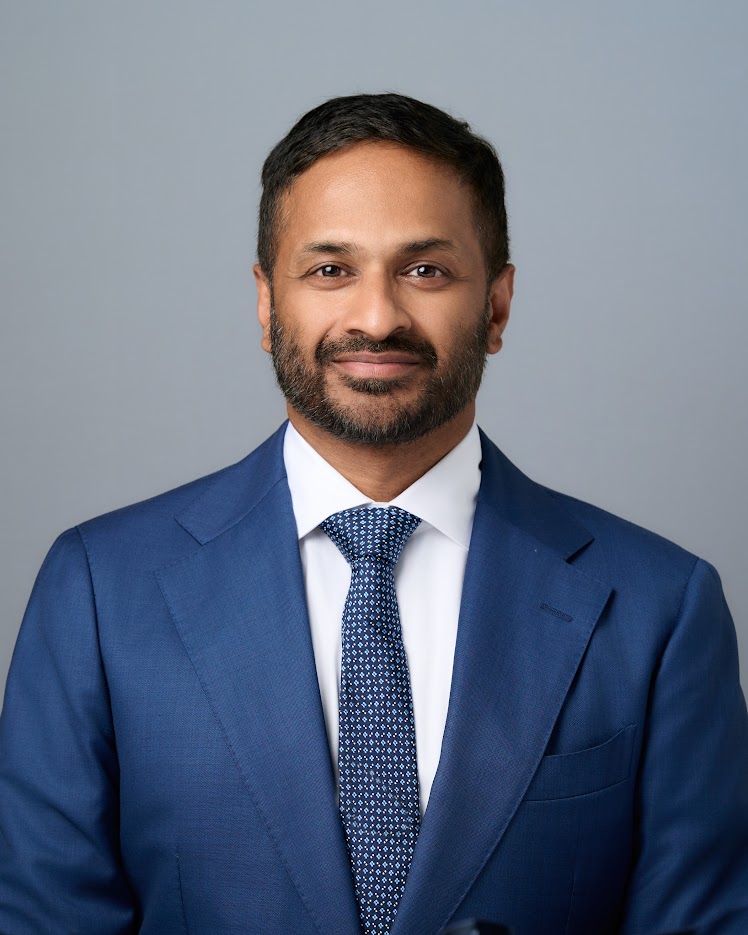
Prince Johnson, a 26-year veteran educator, is the 2026 New York State Teacher of the Year as well as the 2025 Gilder Lehrman New York History Teacher of the Year. A passionate advocate for career and technical education(CTE) and a leader in sustainability, he teaches social studies at Food and Finance High School in New York City and serves on the NYCPS Climate Education Leadership Team.
His drive as an educator was shaped by the injustices he observed while teaching on Rikers Island. Today, he develops cross-curricular projects that unite history, culinary arts, and environmental stewardship. He encourages students to apply their skills and voices to create stronger, more equitable communities, always with the goal of empowering every student to realize their full potential.