


 Spotify

 iHeartRadio

 Apple Podcasts

 TuneIn

 Pandora

 Audible

 Amazon Music

 YouTube

 Castbox
Dr. Taha Duri—Leading Architecture & Design as a Social Tool at American University in the Emirates
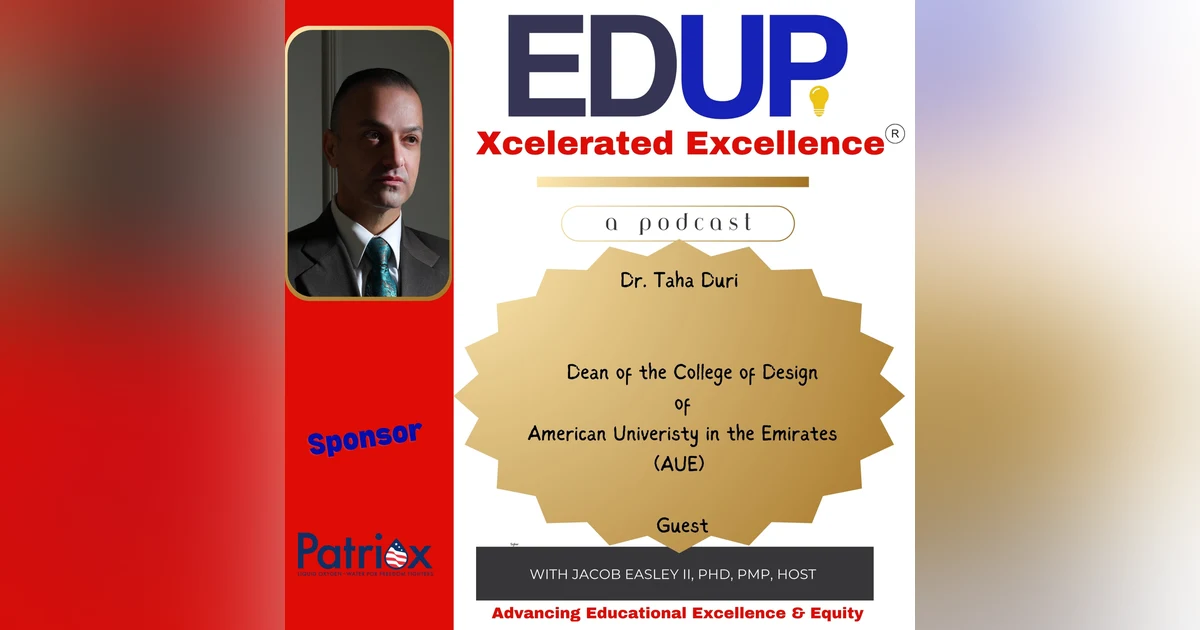

Our Guest, Dr. Taha Duri, is a figure in the fields of architecture and design. Currently, he serves as the “Dean of the College of Design” at the American University in the Emirates (AUE). He has a rich academic background and extensive professional experience in architecture, interior design, and the built environment.
Professor Duri earned a Ph.D. in Architecture from the Universityof Pennsylvania and a Master of Science in Architecture from Pennsylvania State University.
He has over 20 years of teaching experience across various disciplines including architecture and health sciences. Prior to his current position, he was involved in establishing academic programs in architectural engineering and interior design in the UAE.
As a published author and artist, he has contributed articles to various international journals and has held art exhibitions in major cities like New York, London, and Dubai.
As Dean of the College of Design at the American University in the Emirates, Professor Duri is responsible for curriculum development and academic leadership at the American University in the Emirates, focusing on innovative educational practices in design.
He has provided editorial contributions to notable publications such as the New York Times and Architectural Digest.
Professor Duri continues to engage in artistic projects, with some of his works included in prestigious collections.
Professor Taha Duri is recognized not only for his academic contributions but also for his role in shaping the future ofdesign education in the region. His approach blends architectural theory with practical applications, preparing students for challenges in the contemporary built environment.
Your Host: Jacob Easley II, PhD, PMP
Sponsor: Patriox oxygenated water. Drinking Patriox helps oxygenate the body, promoting overall health, energy, and vitality. Receive a 10% discount on your next purchase with the code EDUPXE.
Resources:
The Xcelerated Excellence Future Teacher Award https://www.edupxe.com/xcelerated-excellence-future-teacher-award-2025-2026/
Greeting: Dr. Rosa Rivera-McCutchen
Research Assistant: Emma Worthington
#EDUPXE #EDUCATIONALEXCELLENCE #EDUCATIONALEQUITY#XEListeningTour
0:04 So while people have their varied savage ways of of asserting their existence, at the end of the day, what they want is a better life. So one of the aspects of enjoying a better life is in understanding the culture, empathizing with it, feeling that it has something to offer, and then ultimately becoming a designer for it because a designer. And that goes back to the initial point of your question. A designer is a designer. Doesn't matter if you're a fashion designer, graphic designer, interior designer, architectural designer, whatever the the creative fiber is 1 you have an inkling if you want to sing it, if you want to dance it, if you want to sculpt it, if you want to, you know, build it. It's ultimately the same jolt of energy inside. And design only teaches you how to channel it to the outside world and teaches you that element of accountability we discussed before.
0:58 How, how can I communicate my my feeling to you and lets you see it and as closely to what I intend as possible. And if you don't understand, it's my fault because I did not communicate it correctly, not yours, because the audience is part of the creative. This is Doctor Rosa Rivera McCutcheon, author of Radical Care, Leading for Justice in Urban Schools, and you're listening to Add Up Accelerated Excellence. Thank you for tuning in to Add Up Accelerated Excellence, the podcast for the advancement of educational excellence and equity.
1:47 And we would like to share 2 wonderful opportunities for educators, policy makers, advocates, and scholars to engage in community. 1st is with our Add Up Accelerated Excellence Listening Tour because we fundamentally believe that by listening to others, we empower the engine of transformation, unlocking the hidden insights that spark meaningful change. This week, listen to a voice that you often don't hear from to seek out new insights about educational excellence or equity, and share your thoughts via voicemail at Add Up xe.com. That's Add Up xe.com and your thoughts may be shared on air through this podcast.
2:42 That's the XE listening tour at Ed up xe.com. In addition, Deans, directors and faculty of educator preparation programs. We invite you to submit nominations for outstanding future teachers for the accelerated excellence Future teacher award. Research informs us that teaching is one of the most rewarding professions and one upon which all others are dependent. So help us in elevating educator preparation by nominating an outstanding future teacher for the Accelerated Excellence Future Teacher Award 2020 Five 2026. Find more details in the show notes. This episode is supported in part by Patriarchs. Ultra high oxygen content Water drinking. Patriarchs helps oxygenate the body, promoting overall health, energy and vitality.
3:50 In 2026, try Patriarchs on your journey for accelerated Excellence. Receive a 10% discount on your next purchase with the Code Add Up XE. That's 10% off with the Code Add Up XE at Patriarchs dot US. Patriarchs dot US. Find more details in the show notes. Welcome, welcome, welcome to Add Up Accelerated Excellence, the podcast for the advancement of educational excellence and equity.
4:31 I'm your host, Jacob Easley, the second PHDPMP, and today's guest is Doctor Taha Doherty, who is Dean of the College of Design at the American University in the Emirates. AUE by So Don, can you? Introduce yourself to the Add Up Accelerated Excellence. Community by giving what's your name and give us sort of that 35,000 aerial view of what's top of mind for you right now. Thank you for having me, Doctor Jacob, and it's nice to be on this podcast. I look forward to introducing myself to you and your audience at the best capacity possible. My name is Taha Duri, I am the Dean of the College of Design at the American University in the Emirates. And before that and after that I am a professional of architecture and design.
5:30 The reason why I don't say I'm an architect is because back home you need to be a practicing architect with a stamp to be able to call yourself that. But my PhD was in architecture, history, theory and criticism from the University of Pennsylvania. My master was also in architecture from Pennsylvania State University. And in the meantime, I've also worked in the profession mostly in New York City and then tri-state area. Most of my practice was at Perkins Eastman, which is one of the large firms in New York City right now. It's actually a global firm. They have branches everywhere, including one in Dubai that I helped set up back in 2007 and I continue to be in touch with to date through, you know, engaging professionals, etcetera. The thing that's on my mind most right now is how a designer could reclaim their place in the world as a strategic thinker rather than as a service provider. I think that is something that needs to be reclaimed. When we remember that the Prime Minister of Alexander the Great was an architect, we realize how important architects were once were, rather than a service provider for a client who has capital, which is pretty much how it works nowadays. That's absolutely brilliant.
6:56 Thank you for that. And we're just going to jump right into this. So I but I do have to say we are Penn State. That's great. Since we're both Penn State graduates, I just had to get a shout out. What first sparked your interest in architecture and design? Primarily it was my artistic tendencies. I've always painted and and drew since I as early as I can remember, and I think that while people think that is a skill of the hand, I think it's a skill of the mind and the eye. It's the way you see the world and the way you can bring your imagination to share it with others. You mentioned equity, and I think one of the most equitable aspects of design is feeling accountable to society. The difference between art and design is that design is art that works, so it is supposed to be addressed to a certain audience.
7:58 That's the aim. When you're an artist, you can just unleash your imagination, do whatever you want and if a person asks you what is this about, you say it's what you see, plain and simple. But in design you cannot do that. You're supposed to meet society requirements, a certain technical aspect and also a certain accountability to being able to deliver your imagination to the other. So what got me interested in the first place in architecture was being able to get myself across to someone else where they can say I see and actually mean it. So that was the initial spark and it carried into a a lifelong interest basically. That's actually brilliant, because I have not heard someone refer to design in that way as art that actually works. Actually, it, it does.
8:50 And that's, see, that's the thing when we teach our students to stand up and defend their work or present it or communicate it, whichever way you want. And depending on the audience, obviously they get all flustered up, feeling all attached to the work and feeling that they, it, it has just to be accepted because I've been working on this for the past 48 hours and I haven't slept, etcetera. The fact of the matter is that no, ultimately a designer is the one accountable and is the one who has to explain to the recipient, why does it matter for us to define social structure to design? Why do we need to enhance financial institutions? Why do we need to look at educational institutions and and reconsider the way they're being set up? Why is it important to redefine entertainment facilities and family facilities for safety?
9:48 What does it mean when when you create a public urban space that nobody uses and it turns into a drug den or a crime den or something like that, and whose fault is it? So these are all things that translate into social accountability ultimately. And the closer the designer is to the decision maker, I think the better the world could be, frankly. Yeah, I, I like that. You know, we had guests who are in the development side of the House of Fundraising and they echo almost exact same sentiment is you need to have close connections with the community you're trying to serve. So who's going to use this space, and how would they and and how does it meet some fundamental need that encourages them to use it?
10:40 Yes, that would be the main question. And then after that you have sub questions. Why is the way I'm proposing better than the way he or she are proposing? Why is it worth investing that much money into it? Why is it we're three shaping an entire city into another reincarnation? Because this vision proposes that kind of outcome. It's quite a complex discourse actually. But ultimately, if you are close and if you have the ear of the decision maker, and in this day and age, a lot of it is also connected with political economy. So if you have the ear of somebody who, who also has the money to be able to fund those ideas, then you could be instrumental. And, but like we were you and I chatting a little bit ago, it's a bit of a schism when decision making is away from the from the average person, when the average person found themselves caught in a situation where they, they did not really choose and they were not consulted.
11:41 So that that is, I think where most of our modern day problems are. You've worked across, of course, the US now in the international context, particularly in academic systems. How has the global perspective shaped your way of thinking about the role of higher education in preparing students in the world? And you can use architecture as sort of the discipline, but you don't have to stick with that discipline. Well, it has shaped it in letting me realize that at the end of the day, and this will sound really banal, but people are people ultimately. And when you did are teaching students in Central PA or on Long Island or in New York City or in Dubai, you find out that the generational characteristics or appearances pretty much remain the same.
12:46 The influences are pretty similar. However, this is when when one first encounters this crowd and that crowd being in the US or overseas, once one delves a little bit further into the social structure and the value system, that's when differences start to show their face. And the main, I guess, key to handling that is to realize that those are factors that will affect the way people react to a proposal, academic, social or otherwise. So to understand as an educator that all value systems are equally valid, but they are different.
13:33 And that may seem obvious, but it's not. One must understand that differences exist and ought to be honored. How are they honored? And realizing that they are on equal footing, that they have to be addressed with the same degree of importance. This may be taken as me being not exactly a globalist, and maybe I'm not, but that comes from the angle that everybody anywhere in a certain setting is equally valid. There is no template. There's no one-size-fits-all. And if you're fortunate enough, as I've been, to be in a position where you can influence people in the US or all the way in the Middle East and carry that responsibility and be aware of that consequence, then you'll realize that if you honor the fact that these people and those people are equally engaged in their surroundings, but their surroundings are fundamentally different, then I guess you would have a better chance of success. I'll give an example of that.
14:38 When I was starting the School of Architecture and Design in Abu Dhabi for my previous institution, we had to bring the same curriculum that we teach in New York, which was Cedar Cedar accredited. Cedar is the Council for Interior Design Accreditation. It was an interior design program. We had to take that structure and use it in Abu Dhabi, but there are so many factors that simply would not work, from the resources afforded to the students to the value system of what's allowed and not allowed. Morally, ethically, religiously, socially, in terms of gender character, in terms of racial character, in terms of religious imports, all of those things that that curriculum had to be fine-tuned and we had to go into every syllabus and reconsider certain aspects to make it fit while never compromising the standard of the New York curriculum, which was tested and tried and and ascertained and accredited.
15:40 So that was a, a, a very practical moment for me where what I'm saying right now stopped being a theoretical outlook and became an actual practical consideration with measurable outcomes that I have to present, for example, to the Ministry of Higher Education and prove that I'm teaching a, a curriculum that is suitable for Abu Dhabi, even though it was conceived in New York. So that is the kind of experience that I wish on everyone who actually teaches. And not everyone gets the chance, but it's AI. Someone who does is definitely fortunate. So what you, you're saying in so many ways is that context does matter. And so folks are different by virtue of culture, history, location, resources.
16:28 Those are, I mean, irrefutable issues. You can't just say that, you know, it's less value because in that particular context it works. And that's how people sustain themselves with these resources. And so I, I, I appreciate the idea of this valuing all of those different voices the the task we call. How do we value them in a design approach or for an outcome. So Speaking of which, as the Dean, you are shaping the next generation of designers and creative thinkers. So thinking about design, what vision guides your leadership in the school with these multiple students from different backgrounds coming to you and who are going to be deployed in different contexts when they leave you?
17:20 And so you talked about the tensions of using AUS based standard standards, but then recognizing how to facilitate local contextual sensitivity. So what is designed for college with diverse students? Diversity in a place like Dubai is a matter of fact. Dubai has a population that's based on opportunity and economy. So people here come from all over the world. Students are either born here or came here with their parents.
18:00 But on on both accounts, they're probably expatriates. There are locals, UAE nationals, but the UAE nationals, first of all, they could have their education subsidized. And I work at a private university. So unless they have a personal reason why they should pay, they would probably go elsewhere. But yet even those who come to the university, they would pick something other than design. Design is a is a nascent culture here. It's not something that has existed as long as law or business or, you know, well, there are no other new models like like global studies and security and and colleges like that. But but the obvious types of medicine and law and business have existed long before people knew what people do at a design college.
18:48 So in a place like design, there is a much stronger connection between or there should be a stronger connection between the student and the the place, the environment and the culture. In a place where everybody speaks English and there is no tangible need to to speak the local, local language, people find it too easy to just not learn Arabic. I take issue with that because while you are able to order a takeout and and shop at the the latest and greatest mall and go to the cinema and do whatever people do, you will not be able to understand public address. You will not be able to read newspapers even if they're online.
19:34 You will not be able to understand the nuances of the news to be able to comprehend the value system that is probably very, very foreign to the way one grew up. So those details are essential even to the level of joy that you take in being in a certain place. I do believe that ultimately life is about enjoyment and and anything that hurts or bothers is not worth undertaking. Frankly. I know that will sound a little bit frivolous, but it's not at the end of the day. Even the greatest of conflicts that people go through essentially is professed to be about having a better life somehow. So while people have their varied savage ways of of asserting their existence, at the end of the day, what they want is a better life.
20:27 So one of the aspects of enjoying a better life is in understanding the culture, empathizing with it, feeling that it has something to offer, and then ultimately becoming a designer for it. Because a designer. And that goes back to the initial point of your question. A designer is a designer. Doesn't matter if you're a fashion designer, graphic designer, interior designer, architectural designer, whatever the the creative fiber is 1 you have an inkling if you want to sing it, if you want to dance it, if you want to sculpt it, if you want to, you know, build it. It's ultimately the same jolt of energy inside. And design only teaches you how to channel it to the outside world and teaches you that element of accountability we discussed before. How, how can I communicate my, my feeling to you and lets you see it and as closely to what I intend as possible. And if you don't understand, it's my fault because I did not communicate it correctly, not yours, because the audience is part of the creative process.
21:31 I'll give a a historic example. When the colonizers of Europe first went to Africa, they were looking for the seat of government, which is a a palace or a house where the world sits, ruler sits. They couldn't find 1. So what was the instant conclusion? OK, these are primitive people who don't have a seat of government. Of course it couldn't be further from the truth because the way things ran, especially in Central Africa going South, was that the ruler ruled from their house and if someone else took power, their house becomes the seat of government. It's a transient, in fact far more forward-looking approach to government than having a house to which the ruler needs to move and live in there.
22:14 So it's much more, much less contrived, more organic, closer associated with the fabric of those ruled. And ultimately it's a completely different model of government that those coming from Europe did not even understand. But they concluded what they concluded and we know the result. So ultimately, unless we realize that all value systems are on equal footing, respecting the fact that they are different and that if you're designing for a certain environment, you need to empathize with it and feel it in order to work with it, then there would always be a problem of having something that, you know, end up with something like the international style of the early 20th century, which was, it looked like spaceships in the middle of, of, of India and Brazil and everything else. And you know, may some may bid to differ, But again, this is a matter of of discourse.
23:08 This episode is supported in part by Patriarchs. Ultra high oxygen content water drinking. Patriarchs helps oxygenate the body, promoting overall health, energy and vitality. In 2026. Try Patriarchs on your journey for accelerated Excellence. Receive a 10% discount on your next purchase with the code Add Up XE. That's 10% off with the code Add Up XE at Patriarchs dot US. Patriarchs dot US. Find more details in the show notes.
23:55 We're speaking with Doctor Taha Doherty, It's Dean of the College of Design at the American University in the Emirates, Eau Dubai. And Todd, you have spoken about balancing tradition and innovation in higher education. How do you approach that balance in design education, specifically tradition and innovation? There is a common approach that I grew to take exception to, which is that if you want to design something and to suit a certain culture, you look at the way it's been done before and you try to understand the elements of style and you basically copy them. So if you work in a in a culture where they use arches, you design with arches in the facade of the building. If you have the triumphal, the classical triumphal arc arrangement, you do that.
25:00 If you have domes, you do domes. But that is not the way it is. It is more sustainable or more forward-looking. I think the approach to sedition comes from program. Program means the arrangement of spaces in a building, or even outside of a building in an urban setting. The way design elements, which are the spaces that people use, are arranged, coordinated at the level of the way they look, each space separately and the way a space relates to the other. Why do I think this is the point? I think this is the point because that is how people relate to one another. How your sense of privacy as a people relates to another more open culture.
25:46 If this is a culture that that values its privacy or if it's a culture that's in an ultra hot climate where your houses tend to look inward rather than look at the street, we find many of the traditional homes in a in a city like Damascus. Damascus is the oldest city on earth that has been continuously populated since the way it was date was built to date with no interruption. In Damascus, the traditional homes look at an inner courtyard. While this is generally a Mediterranean approach, at the same time, what sets Damascus apart from everywhere else is that when you're on the streets, they could be very narrow and plain. But the minute you open a door inside a house, you we move into a paradise of chirping birds, flowers of all colors, trees, you know, water features, just a very different environment that you say, why didn't that show itself to the street? Because this, the value system of that society is not about the streets, it's about the family.
26:51 So another culture might look at that as insular or antagonistic, but again, that's measured against the a foreign template. But if you accept it within the template of its own social structure, you find that this could be an indigenous or traditional home. As a modern day designer, you may not carry the same vocabulary such as the tiles used or the shapes used or the openings of the windows, etcetera, but you may maintain the program of the space accordingly so that people can enjoy their value system in a modern house that still maintains the spirit of a a local family. Somebody in the UAE once said to me, I said, I said I don't really find UAE nationals to be socializing broadly with expatriates.
27:43 Why is that? And she said something that was extremely insightful to me. She said we cannot just go out and live the way they do because we have customs and traditions that govern the way we conduct ourselves in our day. By the same token, we cannot really shackle them and force them to way to live the way we live because to them it will feel like a shackle, while to us it's who we are. So that and results and, and basically live and let's live approach, which is actually quite successful if you ask me, having having lived here for for a number of years. And I know how that works. But ultimately it's can you coexist? Yes, you can.
28:24 And how do you approach tradition with modernity? By taking the elements of the program of living the way you arrange your rooms, the way you arrange your spaces, even go out to the public spaces in an urban setting, who can go where and when without bothering someone else? What's a family space? What's a what's a bachelor space or an open space to all? After a while, you start realizing that the city does have that fabric and you know where to go and when. Kind of like being street smart in New York City, but in a very different outlook. It's more like society smart. We're not talking about crime. We're talking about social values and and social propriety and that is actually a main task that a designer has to keep in mind at all times and an educator has to instill in their students from the beginning of first year so that they can they can heed it anytime they have a project, they can actually have that in insight as they approach this.
29:24 So and as you, as you describe this balance in my mind, I kept thinking of the word equity, particularly around social variances or difference in groups and how people coexist and with some semblance of harmony without, without being an opposition to one another. That is extremely visible in a place like Dubai. And even though Dubai boasts some of the most modern lavish plush buildings and spaces and facilities, especially when you go into the hospitality sector where a five star hotel in in New York probably wouldn't make it to three stars if you compare it to what they have in Dubai.
30:13 Even though that is the case in Dubai, what you just described, which is the equitable coexistence is best seen in the older part of Dubai. There is there is an area called Sukh Nayef, which means Nayef's Market, and that's a place where you can get the most splendid fabrics, spices, goldsmithery, that kind of thing. If you walk on the street in that part of town, you will see everything and anything coexisting in the most harmonious way imaginable with no nothing infringing on anything. It's very strange and actually one best understands it by experiencing it not only to the types of food, not only the types of dress and costume, not only the languages, not only the ways people look and act and behave, but how everything is beyond colorated. It's actually celebrated almost, you know it. It coexists in a way that that with time has become more integrational that you, that when you need something, you know where to go to get it and from which group of people because they are best at it.
31:25 So it becomes multiple resources, all serving, enriching the the the place and the experience. And that's quite nice, actually. Yeah, I, I, I can see that visually. So I want to go back to the comment you're making just prior about on the educative approach for students. But how do you ensure that students develop not only the technical skills for design, but also critical thinking and and ethical awareness, which is really what we're talking about now. So we talked about the word of equity, but in this case, ethical awareness and critical thinking along with technical skills of design. A design curriculum usually has a, a, a vertebral column, a center to it.
32:13 That center to it is what we call it a studio sequence. So you a student learns a number of technical skills and computer and construction documents and building methods and codes and regulations and, and writing for for design, etcetera. And then they get a chance to meld all of that into a design scheme during design studio. I've taught design studio from foundations all the way to to a senior thesis. And in every one of these I made a point of there being a strong research component in the studio. So every studio actually begins with a number of weeks given exclusively to research. That research is usually I try to structure an outline because a lot of students don't even know where to start. So to give them an idea of what it is that we expect and why. But it's it's been rewarding in other ways is that the student will come in and say, well, you know, you asked us to do such and such and such.
33:18 But I also think that that area is relevant and, and what about I, I went into the, the site where or our building is and I found that the, the, the building is falling apart. Maybe I should look into local construction systems to, to find out how I can augment these walls to make them stand up because they look like going to fall apart and I want to keep them, You know, that area seems to be extremely hot and humid and I don't want to be using a lot of electricity. Is there a way that people have been doing this over the years, even before electricity? What did they do before to make this possible? So the research tends to branch out and people come back with their own ideas as to how they want to implement this that will actually create that sort of ethical or environmentally responsible approach.
34:09 Right now I'm actually editing a book for for a series by, by Springer and it's going to be later on this year in in Italy for a conference body called IREC, which are they? They are centered in Egypt, but they work all over Europe and, and all over the world. And the, the book chapter that I am writing is actually about the ethics of sustainability. It's about the theory and the philosophy of sustainability. And I'm trying to argue, which is something that has been established, but I'm looking at it from a certain angle, that sustainability, which is a very trendy modern day world and everybody's chewing it all the time and, and presenting it as the, as the, as the key to, to happiness is really not a new notion that it goes back to the 18th century.
35:01 And people have not really used the word, but they all but spoke about it. And ultimately, it comes from an ethical responsibility by humankind to their environment that if you are not acting as though you are actually accountable for how well your environment pans out, then ultimately it will collapse on all our heads, which we we see inklings of every once in a while when when that notion is is relegated to to the side in favor of of other more lucrative, you know, struggles in life. So, but essentially that is one of those notions that are going to persist with us. And I try to let my students know that their history and theory component and their curriculum, which is what is actually the way to move into the future, that that the the further you want to go into the future, the further you need to delve into the past.
36:11 So looking ahead 10 years from now and we're right now in some challenging times, particularly higher education and I'm going to use the US as one their complaints about the cost of the rising cost of education, the dismantling of DEI in the US context. And I know you you it's the American University there in Dubai. What changes do you believe were most in it's the future of design education, and how do we prepare for those changes?
36:53 One of the most ubiquitous things I hear in response to to anything of that nature would be how things are now different because we have artificial intelligence and how artificial intelligence will will cancel a lot of the jobs and how etcetera, etcetera. I tend to actually believe that the problem lies in this outlook. Specifically, I think artificial intelligence as it is a is actually a prototyping tool. Ultimately, what sets artificial intelligence apart from, say, search engines 10 or 20 years ago, which it which was the the beginning of big data, is that artificial intelligence is capable of garnering cumulative knowledge, reorganizing it, and producing projective models.
38:02 It could suggest to you what not only the future would look like, but what hypothetical situations would look like, what parallel situations would look like, and what potential situations would look like. Aristotle called that poetry. He said the difference between history and poetry is that while history chronicled what happened, poetry spoke about possibilities. What happens if of man married God and what happens if if you know, we had wings and flu and this is what AI is doing nowadays, except and by different means. However, both Aristotle and artificial intelligence derive their content from the human mind. So there is no replacing the human element and artificial intelligence, as potent as it is, as important as it is as instrumental in reducing error in many areas and cutting back time, essentially, it will retract back to its normal place in history and in geography.
39:16 It's it's in a bubble right now. It's in a big fancy point. It's the new toy, and it's a great toy at that. I'm not by any means suggesting that it is less than what it is. However, our perception of it should not really be. We shouldn't be dazzled by the light. We shouldn't be blinded by the lights. We should keep in mind that, and this is something about going back in history to to look back into the future. Nothing ever replaced anything. You know when, when, when cinema started, people said radio is dead. And then when television came in, people said cinema's gone. And then when digit digitization and Kindle came up and everyone said paper is dead. And no, nothing ever replaced anything else. And people will always find emotional gratification in part of our cumulative heritage.
40:13 And for as long as you have an audience for something, that something will survive. Things live as long as the underpinning idea lives. That's why, for example, faith lives for so long, even though it makes no sense intellectually. It's faith, It's a it's a completely separate fiber, but we hold on to it because it is something that makes our life better. We go back to the point that ultimately we need to live a better life somehow. So faith lives, paper lives, radio lives, cinema lives, television lives, and artificial intelligence will find its place in that big library of human output. But I don't think it's actually bound to replace anything, frankly.
40:55 You know, that's interesting. Interesting because we are now producing you and I together a podcast episode, and that seems like this marriage between radio and television in some ways, which existed in the past, they still exist. But think about. History and now the future. Looking at the future, who would imagine that the communication we would we would be on a device, but we're still communicating through audio and video. Yes, and and you know something, what is more radio than podcasts? I mean, we are still producing radio and in fact podcast or radio or whatever you want to call it is more horizontal and more democratic and more available now and consumed now than it ever was.
41:47 Because now anybody with thought and with with presentation is capable of doing that. Before you have to work for BBC or you work for, for whichever big radio station to be able to, to have your voice heard. Now you and I have something to share are capable of doing that and and then sharing it. And this is really a progress and some in a medium that people 20 years ago said it's going to be dead because now we have television or something, and it's just not true, you know? I, I, I just appreciate the fact that you're reminding us of the value of the human mind and the human spirit in this world of innovation as we and, and progress, as we like to call it.
42:31 But it all does come from, from in many ways, these innovations through the human experience. Some of them may be creating harm these innovations with some, or we might think that it's an innovation for good in one context that is ultimately having perhaps a negative impact to somewhere else, either locally or across the world. Thank you for tuning into Add Up Accelerated Excellence, the podcast for the advancement of educational excellence and equity. And we would like to share 2 wonderful opportunities for educators, policy makers, advocates and scholars to engage in community. First is with our Add Up Accelerated Excellence Listening tour, because we fundamentally believe that by listening to others, we empower the engine of transformation, unlocking the hidden insights that spark meaningful change. This week, listen to a voice that you often don't hear from to seek out new insights about educational excellence or equity, and share your thoughts via voicemail at Add Up xe.com. That's add up xe.com and your thoughts may be shared on air through this podcast.
44:01 That's the XE listening tour at Ed up xe.com. In addition, Deans, directors, and faculty of educator preparation programs, we invite you to submit nominations for outstanding Future Teachers for the Accelerated Excellence Future Teacher Award. Research informs us that teaching is one of the most rewarding professions and one upon which all others are dependent. So help us in elevating educator preparation by nominating an outstanding future teacher for the Accelerated excellence Future Teacher award 2020 five 2026.
44:50 Find more details in the show notes. We know that you. Besides your academic leadership, you are an artist with exhibitions in cities like New York, London and Dubai. How is artistry and the practice of artistry important to you, and how does it influence the way you teach and lead? I can't say how important it is to me. It's beyond words. It's the ultimate investment in one's own emotions. It's the ultimate guard against trespasses, frankly.
45:32 You know, we all have all sorts of positive and negative impulses. When you're able to pour them into an artwork, they you're shielding yourself from there becoming something else and from harming yourself or harming others. Art for me is a process when I'm working on a painting and I, my paintings tend to take a long time because I like figurative art and I'm obsessive about details. So 11 painting could take up to six months of work. And for me, it's like going on a date. I come back home from work and I'm looking forward to pick up the canvas and I work with oil mostly and, and work on that painting again.
46:13 And by the time it's finished, there's always a part of me that's sad because it, it's done already. And I, I'm I can't wait to start on something else. And now I don't do it as frequently and as intensely as I would like because of the work that I do. And working in education tends to be consuming both intellectually and physically. But I never stopped painting and I haven't over the years. And that is a lifeline for me in terms of how it affects the way I teach. Actually it, it put me in a mindset where I'm, I think I am more accepting of the eccentricities of my students than if I were not an artist. Once I did a show and it was in Dubai and I had some of those drawings I did in ink about war art. I basically was, you know, I watch the news and I see the demolition and the destruction, etcetera. And I did a series of drawings inspired by the, if we could call it the aesthetics of destruction. And a journalist asked me, she said, what do you advise artists in times of political instability? And my response to her was artists do not need advice. I, I wish politicians would listen to them. I think I said, I think artists
47:44 are the most forward-looking in any society. And that's, I'm not saying that out of my prejudice because I'm into the arts, but because even if you look at the way things are produced, you will find that art comes first, followed by utilitarian endeavors such as architecture and, and, and, and city planning and, and urban design and all these things. And then ultimately you get to the politicians at the end of everything. So the most courageous and cavalier and and forward thinking is the artists. I said they don't need my advice. Actually. We are visually and pictorially depicting the travesties of our world for the people for the world to see. And maybe maybe if they see what an ugly reality they've created, they might think about creating something better if they can. And so.
48:39 I like that through line art, utilitarianism, then the sort of the political nature and then the political nature often tells us, oh, that art is acceptable or is unacceptable and we now need to rally against whatever that are the art form is, I think. Yeah, I definitely think that that they, you know, the artists ultimately is someone who I mean, they, they, they're, they're people dwell on the eccentricity of it. But I think there's a lot more to it in terms of truth than the grown-ups in the room such as the politicians and those would, would allow it to be.
49:26 You know, they, they all run, run back and on the weekends and and watch film and listen to music at the end of the day, don't they? That's what makes life livable, not not their their warfares and and economic discussions and and numbers and figures and all that. That in itself is poetic. Thank you. So you when you talked about going home, and I can see this in my head, going home in the joy of working on a piece, here's a tough question. How do you know when that piece is done? When it's finished? It is a tough question actually, that that is the skill that one develops last in in in the creative world.
50:14 That's when to stop. And the answer to it comes from from 2 two sides. One side is having a vision of what it is that you ultimately want to say. What that means is that that becomes a safety valve against piling on more and more and more elements to make it better. If you know what it is you want to say, then you know what what is inadmissible. You know what the ingredients are. It's kind of like making making a a a meal. If if you are, if you're baking a cake and you decide it's a chocolate cake, then then don't drench it in in fruits and strawberry and then put some dates on top of it and then put some icing sugar on top of it.
51:05 And if it's a chocolate cake, leave it as a chocolate cake. You know what I mean? Stop at that. If you have an idea what the key ingredient is, that is an element of where to stop. This is second side is the skill to correct mistakes in the process of the creative work. And that what that means is that you are less fearful, you approach things more courageously. So you don't say OK, I'm going to draw the slime, but what if it doesn't work? I'm going to ruin it. No, if you can undo the line somehow, and if you can fix it, then you will do the line and you'll see if it looks good or not. So, so that skill affords you courage and then you can undo the the the wrong if there is wrong done. So it's a combination between skill and clarity of vision that that ultimately help you decide when to stop. But it's not an easy question for sure. And in some ways it's this is almost full circle when you talked about design, it's art that actually works. So it's is it meeting the intent or the perspective that you want to deliver?
52:14 Now, that doesn't mean that the beholder might interpret other meanings, but for the one the artist who's producing it from your perspective, is that perspective now clear? Yes, which is why when someone tells me when I show a painting, they say what is it supposed to mean? I never answer that question. It's what you see. It is what you see. You know, ultimately it is what you see. And that's that's the beauty of pure art. But but if it is a design project and I'm designing a bank that looks like an amusement park, then there's a problem. You know it needs to look like a bank ultimately because it is something that has to work.
52:58 Again, we're speaking with Professor Taha Duty, who is Dean for the College of Design at the American University in the Emirates AUE Dubai. Taha, what is next for you or for your College of Design? And how might the add Up Accelerated Excellence community engage? What is next for this college is what is next for the design industry at large. I think I can speak for to a certain degree. For Dubai, I can speak for a region that is geographically situated at a joining point between East and West, which as we all know could be a great asset and also could be a great challenge because potential conflicts with interest and interest begets power struggles and selfishness. So it's also a lot of selflessness in order to think of the greater good.
54:21 And I'm not really being preachy, but I also think that if anybody is poised to think about the general good, it is designers. Because what we do is we prescribe life and we create opportunities. So when you create an urban space, you can never be certain what's going to happen in that urban space. You can create it and see what happens. But you also hold the keys for a better opportunity for a better reality and aim for the best. Through design intent, through skill, through knowledge, through belonging to the place, belonging to your heritage, belonging to your culture, finding a place for this culture and the world.
55:14 I also think that there is plenty of emphasis on power and modern day world and not enough emphasis on the productivity of a culture relative to other cultures. You know, nations do things because they can. And that outlook alone is extremely harsh if it's not mitigated with a sense of how much a certain culture could contribute to the world, even if it's a different kind of contribution. If you contribute openness or tolerance or poetry or song and music as much as you contribute weaponry and technological advancement and you know artificial intelligence, new versions that will destroy the old versions and make new realities, etcetera, all of them again are equally significant, but they are different.
56:24 Over emphasis in one area does result in a lopsided reality and I do think that to a great degree without sounding too dismal to our current reality is a little bit lopsided. And that means that we are accountable to understand that no matter how minute a certain contribution is ultimately by being singular and by being other to ulterior to the general current, it could lead to something that we should not be discouraged by being a smaller number, a smaller university, a smaller college, a smaller population, a smaller nationality, a smaller race. It doesn't matter.
57:18 We actually in being so contribute to D monolithing the world, the man, making it more heterogeneous and more varied. And that variety by definition and and essentially is healthy, you know, to be actually to be because the world does tend naturally by natural order to coagulate into singularity. That does exist whether we like it or not. And that means a lot of the smaller and the less get crushed in the process. And that is not healthy. And we should not be discouraged from keeping that variety just because of the general tendency to coagulate into one.
58:04 That one is not necessarily the best or biggest or most beautiful at all, actually. Thank you for that. And how might folks connect with you? I'm, I'm actually, I have quite a presence online. You know, I have LinkedIn, I have Instagram, which is noise. Instagram is just mostly when I go to New York, I, I take photographs and I post them on it, but it's a way to get to me as well. Also my, my e-mail address. And there is, there's also the College of Design, the American University in the Emirates. I'm also there. I have X that I don't use. I mostly use it to, to see what others post. I don't really write anything on it, but I I it keeps me in touch with and most of the time I avoid it. No Snapchat, no TikTok, none of that. So but but generally I am on Instagram, on X on LinkedIn. LinkedIn is probably the best way, and that's how we met anyway.
59:02 That's how we met. That's definitely how we met. So we will have the other in the show notes. So you can also connect with Doctor Dory at the College of Design and of course on LinkedIn. And I want to thank you for this opportunity to learn with and from you here at Add Up Accelerated Excellence, where we seek to advance educational excellence and equity. I thank you for giving me this opportunity, for hearing me out. You are definitely an incredible platform and you are there for the general good and that's something we don't encounter that often. I so appreciate it.
59:44 Thank you so much. Thank you for engaging with Ed Up Accelerated Excellence, a member of the Ed Up Experience network of educational podcast. A special thanks to our research assistant, Emma Worthington, APHD student of Fordham University School Psychology Program, and we want to hear from you. If you have feedback on this or other episodes or would like to nominate a guest, contact us online at EDUP xe.com where you can leave an e-mail or a voice message. That's at UP xe.com, and we encourage you to participate in our XE Listening Tour by listening to the educational stories of others and sharing your thoughts with us at EDUP xe.com.
1:00:26 You can find this and other episodes on Spotify, iHeartRadio, Apple Radio, YouTube, and other outlets where you listen to your favorite podcasts. If you like this episode, don't forget to follow us and share within your network. To leave a comment or suggest a guest, contact us online at EDUP xe.com.


Professor
Taha Duri, is a figure in the fields of architecture and design. Currently, he serves as the “Dean of the College of Design” at the American University in the Emirates (AUE). He has a rich academic background and extensive professional experience in architecture, interior design, and the built environment.
Professor Duri earned a Ph.D. in Architecture from the University of Pennsylvania and a Master of Science in Architecture from Pennsylvania State University.
He has over 20 years of teaching experience across various disciplines including architecture and health sciences. Prior to his current position, he was involved in establishing academic programs in architectural engineering and interior design in the UAE.
As a published author and artist, he has contributed articles to various international journals and has held art exhibitions in major cities like New York, London, and Dubai.
As Dean of the College of Design at the American University in the Emirates, Professor Duri is responsible for curriculum development and academic leadership at the American University in the Emirates, focusing on innovative educational practices in design.
He has provided editorial contributions to notable publications such as the New York Times and Architectural Digest.
Professor Duri continues to engage in artistic projects, with some of his works included in prestigious collections.
Professor Taha Duri is recognized not only for his academic contributions but also for his role in shaping the future of design education in the regio… Read More